

Pool fence barrier requirements often feel like a nuisance at first—just something to pass inspection and get swimming.
But did you know that…
According to the U.S. Consumer Product Safety Commission (CPSC), nearly 300 children under the age of 5 drown in backyard pools every year. Most of these tragedies happen at home, and the root cause is usually a preventable lack of barrier protection.
So whether you’re a a seasoned contractor or DIY warrior, this guide gives you what you need: straight-up answers and code-verified steps based on the CPSC Guidelines, 2021 IRC Appendix G, and 2021 ISPSC Section 305.
Code Requirements You Need to Know
Here’s your cut-and-dry breakdown of pool fence barrier requirements based on the 2021 IRC & ISPSC codes for residential pools:
➤ Barrier Height

- Must be at least 48 inches (4 feet) tall from finished grade on the outside.
- Some areas bump this to 60 inches (check your local amendments).
Must be at least 48 inches (4 feet) tall from finished grade on the outside.
Some areas bump this to 60 inches (check your local amendments).
What is grade?
“Grade” refers to the finished ground level at the base of the barrier. Code requires you to measure barrier height and clearance from this exterior ground level to ensure children can’t climb up from the outside using landscaping, mulch, or uneven terrain to gain height.
➤ Bottom Clearance
- Max 4 inches from grade to bottom of fence.
- On loose surfaces (like grass or gravel), max 2 inches.
- Removable mesh fences: Max 1 inch above grade.
➤ Openings in the Barrier
- No opening should allow a 4-inch sphere to pass through.
- Lattice cutouts or gaps must be 1.75 inches or less.
No opening should allow a 4-inch sphere to pass through.
Lattice cutouts or gaps must be 1.75 inches or less.
Why 4 inches? This size is based on the average chest and head size of a small child. Openings larger than that can allow a child to squeeze through or become stuck.
➤ Fence Construction Rules
- If horizontal rails are <45 inches apart, put them on the pool side.
- Spacing between vertical pickets:
- Max 1.75 inches if rails are under 45″ apart
- Max 4 inches if rails are over 45″ apart
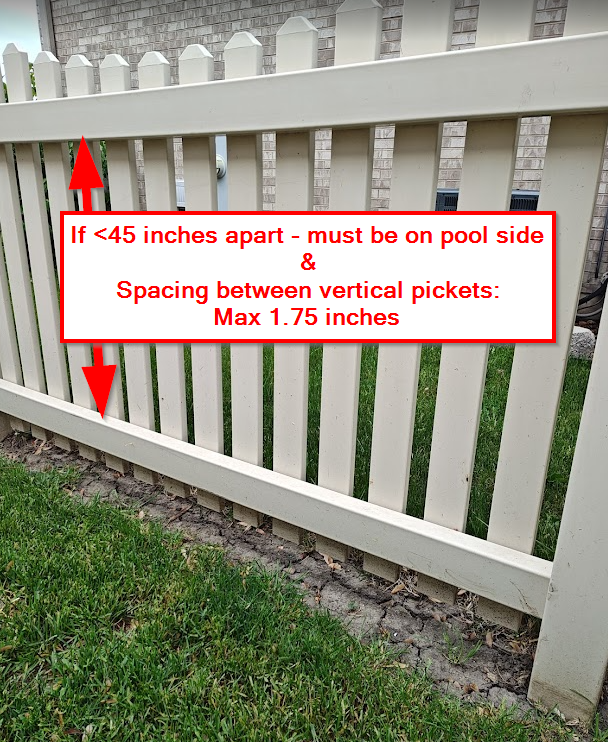
Why spacing and rail placement matters:
Closer vertical pickets and strategic rail placement make it harder for a child to get a foothold and climb over the fence. Think of it like removing a ladder—no rungs, no climbing.
➤ Chain Link Fence Specifics
- Mesh opening: Max 1.25 inches square
- If slats are added: Reduce to max 1.75 inches
➤ Gates

- Must be self-closing and self-latching
- Must swing away from the pool
Why the direction matters:
Gates that open away from the pool require more force to push open from the outside. If a child leans or pushes on it, it closes rather than opens—adding an extra layer of protection.
What does self-closing mean? The gate must return to a closed position automatically after opening, using a spring or similar mechanism.
- Latch details:
- If under 54″ from ground, must be on pool side
- Latch must be 3″ down from top of gate
- No opening larger than 1/2 inch within 18″ of latch
Why the latch height and placement?
The idea is to prevent young children from reaching over or through to open the gate. Positioning it on the pool side and away from hand holes or gaps helps eliminate this risk.
What If the House Is Part of the Barrier?
Have a sliding door or other opening with access to your pool? That counts as part of the barrier. Code minimum requires one of the following protection options to be installed:
- UL-rated audible door/window alarm (at least 85 dB, sounds within 7 seconds of door opening, with a manual reset feature at least 54 inches above the threshold)
- Power safety cover that meets ASTM F1346 safety standards – usually installed for in-ground pools
- Self-closing and self-latching door hardware that provides an equal or greater level of protection
Any one of these methods meets the code requirement when the house forms part of the pool enclosure.
Looking for a pool door alarm that meets code? Here’s one that hits all the key requirements:
- UL 2017 listed
- 85 dB minimum sound level
- Activates within 7 seconds of door opening
- Manual reset button mounted at least 54 inches above the threshold
View Code-Compliant Pool Door Alarm on Amazon
(Be sure to check the specs and install according to the manufacturer’s instructions.)
As an Amazon Associate, I earn from qualifying purchases.
Special Situations
➤ Above-Ground Pools

- Pool wall can act as the barrier, if ladder or steps:
- Are lockable, removable, or
- Surrounded by a code-compliant fence
➤ Mesh Pool Fencing (ASTM F2286)
- Min height: 48 inches
- Poles should anchor 3 inches below deck
- Poles spaced no more than 40 inches apart
- Clearance under mesh: Max 1 inch
Final Word: Fence It Right, Save a Life
Let’s not sugarcoat it—drowning is fast, silent, and preventable. A code-compliant fence gives a child one more layer of protection when supervision slips. Whether you’re a contractor getting final inspection or a parent checking your own setup, understanding these pool fence barrier requirements is how you do it right.