High-Leg Delta Panel Wiring: If you’re working in an older commercial building and pop the dead front off a panel that’s got some unusual orange labeling on the B phase—chances are, you’re looking at a high-leg delta system. You need to know how to wire it right, because one simple mistake can fail your inspection, damage equipment, or worse.
Let’s walk through what you should be checking before the inspector ever shows up.
What Is a High-Leg Delta Panel Wiring System?
You’re looking at a 240V/120V 3-phase, 4-wire service with a grounded center tap on one winding. Here’s what that gives you:
- Phase A to Neutral: 120V
- Phase C to Neutral: 120V
- Phase B to Neutral (the “high leg”): 208V
- Phase-to-Phase (A–B, B–C, A–C): 240V

So yes—you’ve got 120V and 240V available, but that B phase can seriously damage anything designed for 120V. That’s why it needs special attention.

NEC Requires High-Leg Identification
If you’re working on a high-leg system and you don’t have orange marking on the B phase, you’re going to have problems.

- NEC 110.15 and 230.56 both require that the high leg be marked orange at every termination point (meter, disconnect, panelboard, etc.).
- In a panelboard, NEC 408.3(E) says the high leg must terminate on the center (B) bus. Not left, not right—center.
- Color code (for panel):
- A = Black
- B = Orange
- C = Blue
That’s not a suggestion—it’s a code requirement. If you land the high leg on the wrong bus, not only will it fail inspection, but it can easily damage downstream equipment—or worse.
It’s also worth noting that many utilities require the high leg to terminate on the C phase at the meter, and they may require it to be identified as such. But once you’re inside the panelboard, NEC 408.3(E) takes over—and that means the high leg must land on the B phase (center bus position).
Always check with your local AHJ and utility provider to confirm how the high leg should be landed and marked at the service point—because utility-side requirements and NEC requirements don’t always match up, and guessing can cost you the job or create serious hazards.
Breakers: Don’t Use the Wrong Type
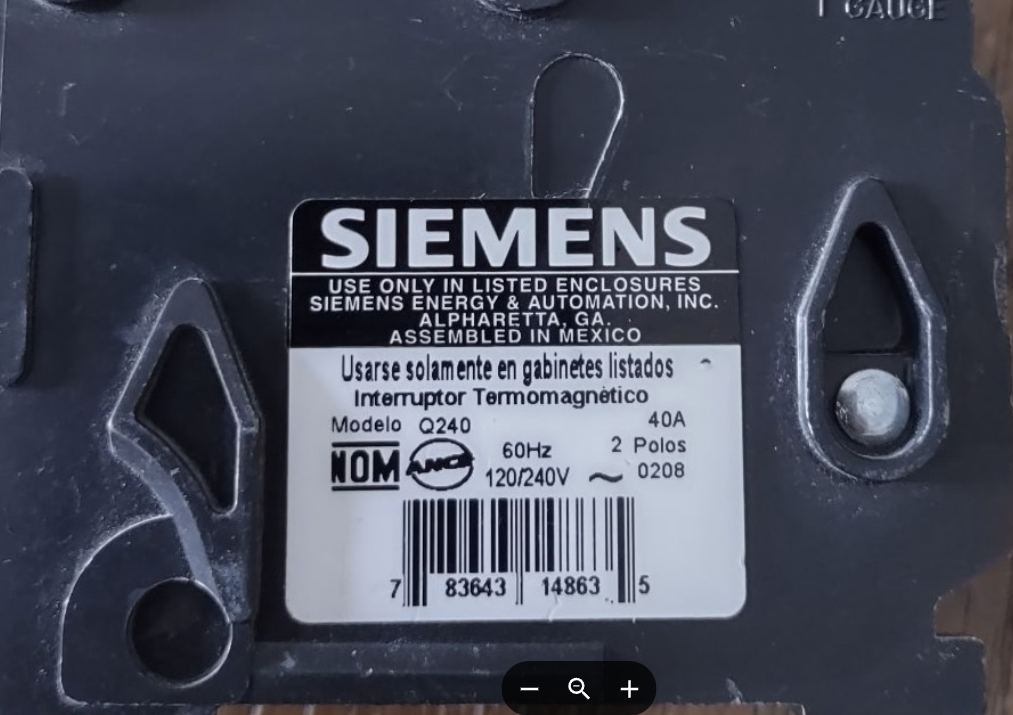
This is where a lot of electricians get tripped up—slash-rated breakers.
- A slash-rated breaker is marked 120/240V.
- That works fine for:
- A to Neutral (120V)
- C to Neutral (120V)
- But if you put that breaker on B to Neutral, you’ve just installed a breaker that’s not rated for the 208V it’s going to see.
NEC 240.85 says you can’t do that.
The rule:
- Slash-rated (120/240V) breakers are OK on A and C only.
- If you’re installing a breaker on B phase or across A–B or B–C, it must be a straight 240V-rated breaker—no slash.
This applies to:
- Single-pole breakers landing on B
- Any 2-pole breaker involving B
- Any 3-pole breaker (unless it’s rated correctly for full line-to-ground voltage)
Get in the habit of reading the label—don’t assume it’s good just because it fits.
Also working in residential? Don’t miss our full AFCI protection guide post to stay compliant with NEC 210.12 and pass your inspection the first time.
Watch Out for Unused/Blanked B Phase Positions

This is usually a dead give away—if you open a panel and all of the center bus (B phase) positions are blanked or not being used, stop and get your voltage meter out.
- Always first check line-to-ground voltages at all three phases.
- If you’re seeing 120V on A and C phases to neutral but ~208V on B to neutral, you are on a high-leg delta.
NOTE: Do not trust color-coding alone—people tape things wrong all the time. Trust your meter.
Problems with 3-Phase Loads
Here’s something you might not hear until it’s too late: Not all 3-phase gear works well on a high-leg delta system.
- A lot of modern equipment assumes a 208Y/120V wye system, where all three phases are 120V to neutral.
- On a high-leg delta, B phase is 208V to neutral—if control circuits or power supplies connect to that by mistake, they’re toast.
- You’ll also notice it’s tough to balance the panel:
- A and C carry most of your 120V single-phase loads
- B often ends up lightly loaded
- Result? Load imbalance and a failed inspection
If you’re feeding 3-phase HVAC, motors, or VFDs—double-check the nameplate. If it says “120/208Y,” high-leg might not be a good match without custom wiring or a transformer.
Code References You Should Know
- NEC 110.15 — High-leg must be marked orange
- NEC 230.56 — High-leg identification at service entrance
- NEC 240.85 — Breakers must match line-to-ground voltage
- NEC 408.3(E) — High-leg must be on center (B) bus
- NEC 408.54 — Color-coding requirements for conductors
Final Checklist Before Inspection
- High leg clearly marked orange
- High leg in panel lands on center (B) bus bar
- No slash-rated breakers on B or any breaker spanning B
- Phase voltages verified with a meter, not just colors
- 3-phase equipment is properly rated for delta
- A and C not overloaded while B sits idle
Bottom Line
High-leg delta isn’t going away. But if you wire it wrong—or overlook the details—you’ll be the reason someone’s freezer, fryer, or control system smokes.
So take five minutes to:
- Check your colors
- Read your breaker labels
- Verify your voltages
That way, when the inspector shows up, you’re not scrambling to explain why your panel looks like a guessing game.