
Understanding and complying with NEC 300.5 underground burial depths is essential for passing inspection and ensuring a safe installation.
Underground burial depths are one of the most commonly misunderstood requirements for electricians, contractors, and serious DIYers. If you’ve ever had a jobsite slow to a crawl because of a burial depth fail or GFCI misunderstanding, you’re not alone. Here’s what you need to know for 2023, why so many get tripped up, and how to pass your next inspection without surprises.
This guide breaks down the real NEC 300.5 underground burial depths and how to get them right.
Understanding NEC 300.5 Underground Burial Depths
The short version:
Most direct-buried cables need to be at least 24″ deep. Conduit depths depend on the type and where you’re installing it. Here are the most common field scenarios:
- Lawn/Yard:
- Direct burial cable (UF): 24″
- PVC or EMT conduit: 18″
- Rigid metal (RMC/IMC): 6″
- Low-voltage UF (≤30V, listed): 6″
- Under Driveways, Streets, or Anywhere Vehicles Can Go:
- All wiring methods (direct burial or any conduit): 24″
- if there’s any chance a vehicle will drive or park over the trench location—24″ min required.
- Exception: For one- and two-family dwelling driveways and outdoor parking areas used only for dwelling-related purposes, the minimum depth is 18″ for most wiring methods, and 12″ for GFCI-protected branch circuits.
- All wiring methods (direct burial or any conduit): 24″
- Residential Branch Circuits (120V or less, 20A max, GFCI protected):
- 12″ burial allowed, but only if the entire branch circuit is GFCI protected—not just the outlet at the end.
- Under 2″ Concrete (no vehicle traffic):
- Direct burial cable: 18″
- Rigid metal: 6″
- PVC/EMT or direct burial raceway: 12″
- Low-voltage UF (30V or less): 6″
- Under 4″ Concrete (slab extends at least 6″, no vehicle traffic):
- Direct burial cable: 18″
- Rigid metal: 4″
- PVC/EMT raceway: 4″
- Low-voltage UF (30V or less): 6″
Note: EMT is now permitted for direct burial under the 2023 NEC—but only if it uses fittings listed for burial, is properly protected against corrosion, and meets all of § 300.6 and Table 300.5(A) requirements. In practice, because these conditions are difficult or costly to meet, many installers default to other raceways such as RMC, IMC or PVC for underground use.
For every underground installation, always consult Table 300.5(A) to ensure you’re meeting the correct minimum burial depth for your wiring method and location.
GFCI Protection—Don’t Get Caught by the Branch Circuit Rule
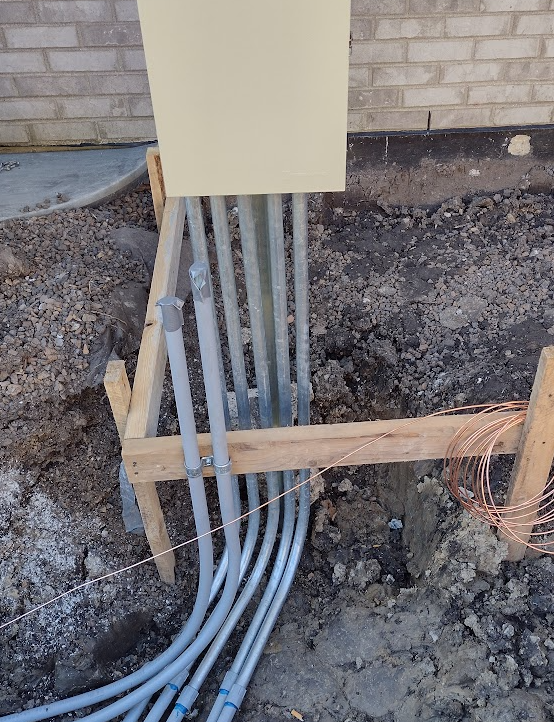
This is one of the most misunderstood parts of NEC 300.5, especially for residential projects. The code allows you to bury a residential branch circuit at just 12″ deep—but only if GFCI protection covers the entire circuit, starting at the panel or at the first accessible junction box above grade, before any underground portion of the branch circuit. Installing a GFCI receptacle at the end is not enough—the protection must be upstream, ahead of all conductors in the underground run.
- If you only protect the last receptacle, the feeder conductors aren’t protected.
- The correct method: install a GFCI breaker (or a GFCI device) at the beginning, so the entire run—from panel to outlet—is covered.
- Why does it matter? If the installation gets damaged anywhere along the trench run, you want that GFCI protection to work instantly.
Wet Locations, Corrosion, and Conduit Choice
Every underground raceway, enclosure, and box is considered a wet location (NEC 300.5(B), 310.10(C)). That means:
- Only use conductors rated for wet locations (types such as THWN, XHHW, or equivalents).
- All metallic raceways must be properly protected against corrosion—aluminum in concrete or soil must have supplemental protection (300.6).
- Although EMT can be used underground if it’s properly coated and listed for direct burial, most electricians avoid it because it’s a hassle to meet the corrosion protection requirements—rigid or PVC is almost always the easier, code-compliant choice.
For a complete walkthrough on clearances at the equipment end of an underground run, see my post on Electrical Panel Clearance Code: NEC 110.26 Explained.
It covers required working space, height and width clearances, and how to coordinate your underground layout with panel access.
Common Pitfalls with NEC 300.5 Underground Burial Depths
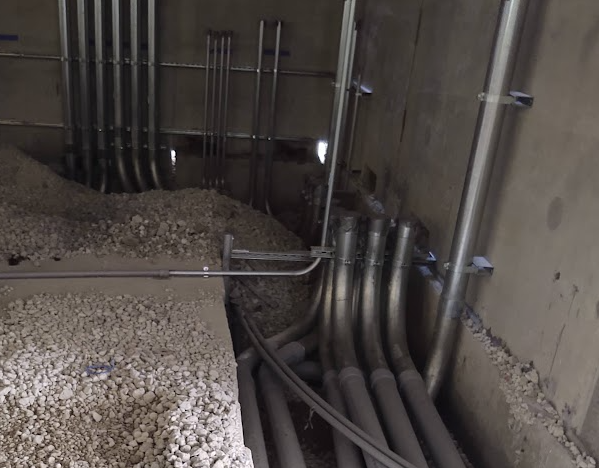
Most failed underground inspections come down to two things: trenches that aren’t deep enough under driveways or parking areas, and misunderstandings about when GFCI protection actually allows the 12″ burial option for residential circuits. Here’s how to stay out of trouble:
- Anything under a driveway, street, or parking pad? Go 24″ minimum.
- It doesn’t matter if it’s rigid metal, PVC, or direct burial cable. Vehicles = 24″ depth.
- Exception: For one- and two-family dwelling driveways and outdoor parking areas used only for dwelling-related purposes, the minimum depth is 18″ for most wiring methods, and 12″ for GFCI-protected branch circuits.
- Measure from the top of your conduit or cable to finished grade.
- Don’t cut corners on backfill: Remove large rocks, debris, and corrosive material. Use clean fill and provide additional protection if needed.
- AHJs may be stricter: Many jurisdictions require deeper trenches or specific methods for commercial or multifamily work. Always check with local AHJ amendments before you dig.
Checklist for NEC 300.5 Underground Burial Depths
✔ Check Table 300.5(A) for your wiring method and location.
✔ If you want a 12″ burial, protect the entire branch circuit with a GFCI protection (and meet code requirements).
✔ Measure from the top of cable/conduit to grade—not bottom.
✔ Protect cables/conduit emerging from grade to 8′ above (300.5(D)(1)).
✔ Install warning tape above service conductors at 12″ (300.5(D)(3)).
✔ Use clean backfill—no rocks or sharp objects.
✔ Seal all raceway ends and use proper bushings.
✔ Always verify your required NEC 300.5 underground burial depths before installing any underground wiring.
Want a field-ready code guide with step-by-step checklists?
Grab a copy of my book, Pass the Inspection: A Field Guide to GFCI & AFCI Code Requirements, packed with real-world tips for electricians, contractors, and serious DIYers. It’s designed to help you pass your first inspection—no guesswork, just the actual AFCI & GFCI requirements and how to apply them.
Final Word:
Don’t guess when it comes to NEC 300.5 underground burial depths—always measure and confirm before inspection.
Following NEC 300.5 isn’t just about passing inspection—it’s about safety and long-term reliability. Most code problems and failures come down to insufficient burial depth, improper GFCI protection, or not checking with your local AHJ. Measure carefully and never guess with underground work—the safety and reliability of your entire system depends on it.