
Let’s set the record straight:
Are wire nuts in service panel enclosures actually allowed? It’s one of the most common questions I get from electricians and inspectors. Here’s the real answer straight from the 2023 NEC—no fluff, just what the code says and how it’s enforced in the field.
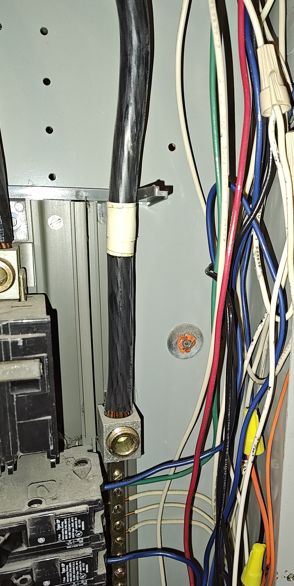
What the 2023 NEC Actually Says: Section 312.8
NEC 312.8 governs wiring space in enclosures for switches or overcurrent devices—including service panels, main disconnects, A/C disconnects, safety switches, and subpanels.
Key requirement:
The wiring space…shall be permitted for conductors feeding through, spliced, or tapping off to other enclosures, switches, or overcurrent devices—where all of the following conditions are met.
Translation:
Wire nuts and splices are allowed—but there are hard limits on space, fill, labeling, and (if large conductors are present) bending space.
The Four Rules You Cannot Ignore (312.8(A))
1. 40% Conductor Fill Rule
At any cross-section of wiring space, conductors alone can’t exceed 40% of the area.
2. 75% Splice / Total Fill Rule
At any cross-section, conductors plus splices and taps can’t exceed 75% of the area.
3. Bending Space for 4 AWG and Larger
If any conductor is 4 AWG or larger, the bending space must comply with NEC 314.28(A)(2). This means there must be enough physical depth for a proper bend radius—no sharp turns, kinks, or forced bends. Even if the gutter fill is acceptable, insufficient bending space is still a violation.
4. Required Warning Label for Feed-Through Conductors
If conductors pass through the enclosure without terminating there, a warning label per NEC 110.21(B) must identify the location of the nearest disconnecting means for those conductors.
How to Actually Calculate Code-Compliant Space
Example: Typical Residential Main Panel, 42-Space
(You must measure your specific panel for an accurate calculation)
Right-side gutter measures approximately 3-7/8 inches deep by 4 inches wide.
3.875 in × 4 in = 15.5 square inches of usable wiring space.
40% conductor-only limit:
15.5 in² × 0.40 = 6.2 in²
75% total (conductors + splices):
15.5 in² × 0.75 = 11.6 in²

Why the Code Allows More Space When Splices Are Present
The different limits exist for practical and safety reasons. Splices and taps are bulkier than straight conductors—wire nuts, overlapping insulation, and connector bodies physically take up more room. If the NEC limited splices to the same 40% rule as conductors alone, many real-world repairs and extensions would be impossible to do legally.
At the same time, the NEC is trying to prevent excessive heat buildup. Packing too many conductors or splices into a tight space restricts airflow and traps heat, which can accelerate insulation breakdown and increase fire risk over time. That’s why the code allows a higher limit—up to 75%—only at the specific cross-section where splicing occurs, while still requiring most of the gutter to remain relatively open.
What Wire Nuts in Service Panel Gutters Look Like in Real Terms
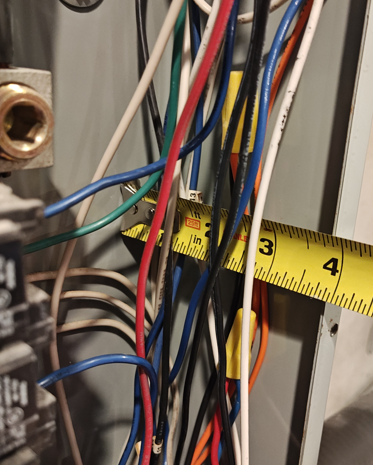
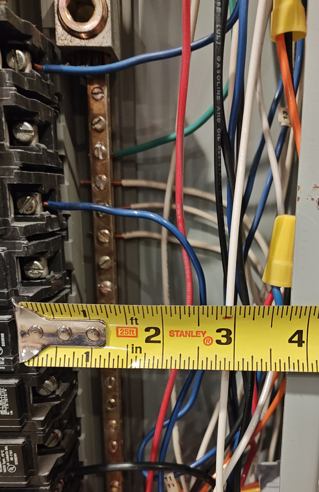
In this panel, the right-side wiring gutter measures about 3-7/8 inches deep by 4 inches wide, giving roughly 15.5 square inches of usable wiring space.
Under NEC 312.8, any single ‘slice’ of that gutter is limited to:
• about 6.2 square inches of conductors alone, or
• about 11.6 square inches once splices and taps are included.
Here’s where installs get into trouble.
This rule is not triggered just because a gutter looks busy. What matters is whether, at any one point, the conductors and splices become locally congested—stacked or compressed into a smaller area at that specific cross-section.
If, at one spot, the bundled wires and wire-nut splices together take up roughly 3 inches deep by 4 inches wide, that’s 12 square inches at that one cross-section. At that point, the installation exceeds the 75% limit and becomes a code violation—even if the rest of the gutter has more breathing room.
Nothing illegal was added.
Nothing ‘wrong’ was installed.
There’s just not enough room at that point.
That’s why wire-nut splices in panel gutters are often flagged—not because wire nuts are prohibited, but because the available space disappears fast in residential panels.
What the NEC Does Not Say
• The NEC does not ban wire nuts
• The NEC does not prohibit splices in panels or disconnects
• The NEC does not forbid pass-through conductors
The real issue is space, heat, and geometry, not connector type.
Why Panels and Disconnects Fail Inspection
Most failures happen because:
- One cross-section with splices exceeds the 75% limit
- Feed-through conductors lack a warning label
- Large conductors don’t have enough bending space
- Small gutters fill up faster than expected
- Local AHJ or manufacturer instructions are stricter
Best Practices to Avoid a Fail
✔ Measure the actual gutter cross-section
✔ Do the math before adding splices
✔ Keep splices in the widest part of the gutter
✔ Avoid stacking and crossing conductors tightly
✔ Install required warning labels for feed-throughs
✔ Verify bending space for #4 AWG and larger conductors
✔ Check panel labeling and local AHJ amendments
AHJ Caveats and Real-World Enforcement
Some AHJs or inspectors may still prohibit splices in panels based on workmanship concerns or manufacturer instructions. Always verify local amendments and panel labeling. If challenged, ask for the specific code section or listing requirement being enforced.
Raceway Seal Code Requirements: What the NEC Actually Says
Curious about when and why you need to seal raceways or conduits where they enter a panel or building? This guide breaks down the NEC requirements, common inspection fails, and how to get it right the first time—all with field-tested advice and code citations. Read the full post here.
Final Takeaway
If a panel or disconnect fails inspection because of wire nuts or splices, it’s almost never about the wire nut itself. It’s about localized crowding, heat buildup, missing labels, or insufficient bending space.
When evaluating wire nuts in a service panel, remember the NEC is focused on space and heat, not connector type. Understand the math, respect the available space, and you’ll pass inspection without guesswork.
Want a no-nonsense, field-ready guide to passing inspection—without the code confusion?
Check out my book, Pass the Inspection: A Field Guide to GFCI & AFCI Code Requirements.
It’s packed with plain-English explanations, real jobsite tips, and the exact code sections you’ll need—so you can wire with confidence and pass on the first try.
Or—if you just want a field-ready checklist that covers every GFCI and AFCI requirement for kitchens under the latest NEC,
grab my Kitchen GFCI & AFCI Requirements Checklist (NEC 2020 & 2023 Field Guide).
It’s a practical, no-fluff PDF with code-verified details for every required kitchen location—perfect for fast compliance, job walks, and passing inspection the first time. Download the checklist here.