
Why Bathroom Fixture Spacing Requirements Still Trip People Up
Bathroom fixture spacing requirements under the IRC are one of the most commonly misunderstood parts of residential bathroom inspections, especially in tight layouts and remodels.
Most bathroom inspection fails aren’t because the rules changed overnight—they’re because the details are easy to miss, especially with tight spaces and remodels. If you’re planning, roughing in, or signing off a bathroom, you’ve probably run into at least one of these:
- Bathrooms just big enough to fit the basics: It only takes an inch or two off to fall short.
- Remodels using old rough-ins: Yesterday’s spacing may not meet today’s code.
- Mixing different codes: Sometimes plans or contractors pull from IRC, IPC, or UPC, not realizing they don’t always agree.
- DIYers or pros trusting “it worked before”: But the inspector’s job is to check against the current adopted code—not history.
- Plans pass on paper, but after finishes go in: Tile, vanities, and glass eat up space.
The main message: It’s rarely a code book problem. Most spacing issues come down to a few inches lost, a misunderstood detail, or not verifying clearances after finishes.
What Code Sections Actually Control Fixture Spacing?
If you’re checking fixture spacing, you’ll see two main code sections referenced in the IRC:
- IRC R307.1: This section points you to Figure R307.1 for a visual layout of required spaces between bathroom fixtures.
- IRC P2705.1: This section gives you the actual, enforceable clearance numbers for each fixture.
Put simply:
- R307.1 (and its figure) shows how fixtures are supposed to fit together.
- P2705.1 tells you the bare minimum distances that must be kept clear.
Important field note:
If you’re comparing the IRC diagram (Figure R307.1) to the written code, you’ll notice they don’t always match up—especially for lavatory (sink) side clearance. The enforceable requirement is found in Section P2705.1, item 5, which clearly spells out that a lavatory must not be set closer than 15 inches from its center to any side wall, partition, or vanity.
So even if a diagram doesn’t label it, the 15-inch side clearance for sinks is code—per P2705.1, paragraph 5—and what most inspectors are looking for.
In the field, inspectors nearly always check both. If your layout meets the numbers in P2705.1 and matches the diagram in R307.1, you’re on the right track.
Let’s Break Down the Minimum Fixture Clearances
Let’s be clear on what the IRC says—here’s what actually matters, with the code’s own language simplified:
Water Closet (a.k.a. Toilet)
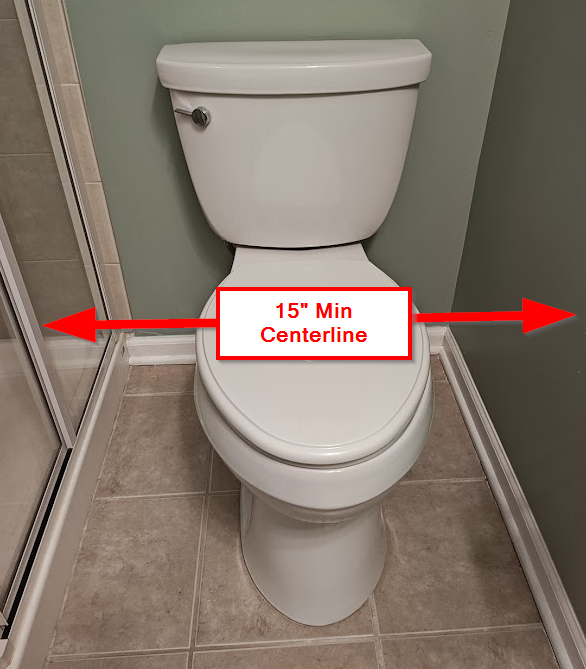
- 15 inches minimum from the centerline of the toilet (not the bowl edge) to any side wall, vanity, tub, or similar obstruction.
- Why centerline? The code measures from the imaginary line right down the middle of the toilet—not the edge of the porcelain. This keeps things consistent, no matter the fixture shape.
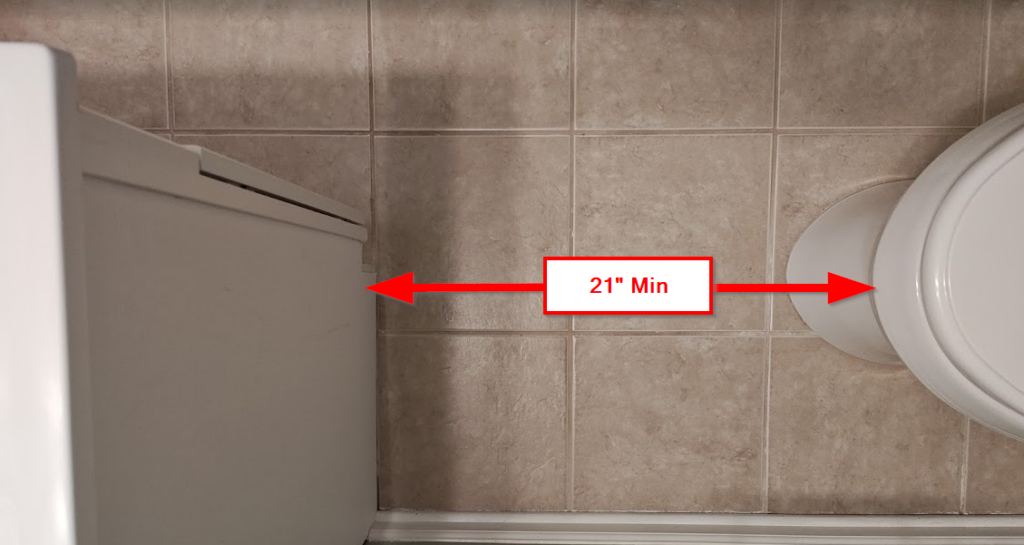
- 21 inches minimum clear space in front of the toilet.
- This is measured from the front edge of the bowl (not the tank) to whatever’s in front—wall, door, vanity, you name it.
Common mistake:
People sometimes measure from the edge of the toilet to the wall and think they have extra space. But measuring from the centerline could reveal you’re right at the limit—or a little short—especially if the fixture isn’t centered.
Lavatory (a.k.a. Bathroom Sink)
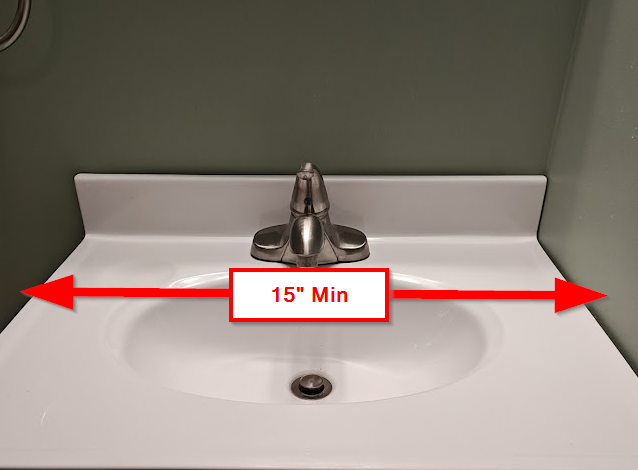
- 15 inches minimum from centerline to any side wall, partition, or vanity (per P2705.1, item 5).
- 21 inches minimum clear in front.
- From the front of the sink or vanity to the wall or next obstruction.
- Side clearances are now clearly called out in the code, so even if a vanity is made for a tight spot, you still need those 15 inches unless your AHJ has a local amendment.
Common mistake:
Assuming a pre-made vanity or an old fixture that’s closer than 15″ is “grandfathered” in. For new installs, inspectors will look for the 15″ side clearance.
Bathtub
- 21 inches minimum clearance in front of the tub’s edge.
- Not just to the tub’s apron, but after tile or finishes.
- Toilets next to tubs must still keep their own 15″ side clearance from the centerline.
Common mistake:
Not accounting for finish thickness—tile or the tub apron can shrink clearances more than you’d think.
Showers
- Minimum interior size: 30″ x 30″ (measured inside the finished shower, not framing).
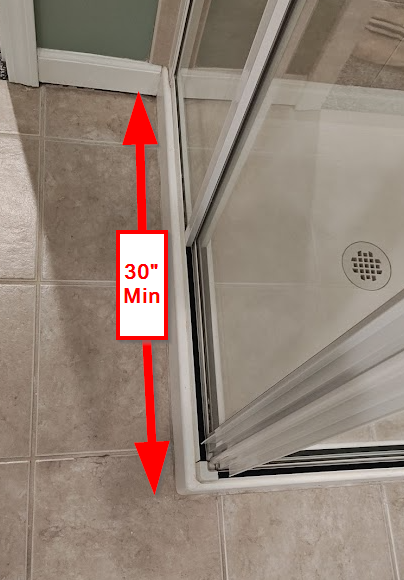
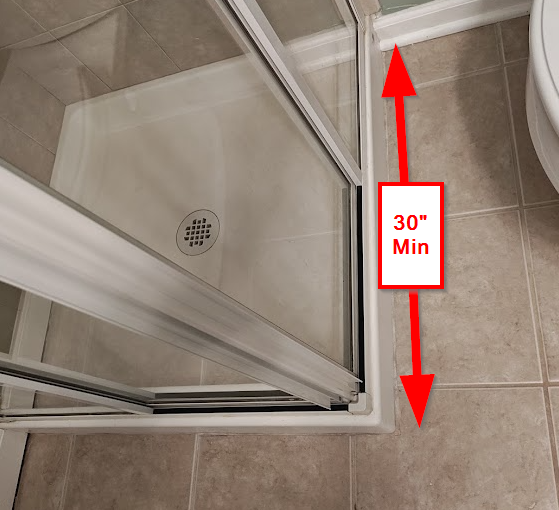
- 24 inches minimum clear space in front of the shower entry.
Common mistake:
Confusing the shower’s required inside dimensions with the clearance needed in front. Also, measuring from the unfinished curb or stud instead of the finished surface.
Where Field Layouts Go Sideways
Start with the finish:
All measurements are from the finished surface—tile, trim, apron—not from the studs. It’s on the contractor or installer to make sure the finished space meets code, not just the rough framing.
Double-dipping clearances:
If a toilet sits next to a tub, you must have both 15″ from the toilet’s centerline to the tub and 21″ clear in front of the toilet. Hitting one number doesn’t excuse the other.
About door swings:
The IRC says you need clear space in front of each fixture, but doesn’t spell out if a swinging door can invade that area. Different inspectors handle this differently.
Field tip: Don’t plan on a door swinging into that clear zone—most inspectors won’t allow it, even if the code doesn’t strictly forbid it.
Bathroom spacing issues often show up alongside ventilation problems. If moisture isn’t properly exhausted, it can affect finishes, clearances, and long-term durability. For a full breakdown of why the IRC requires bathroom exhaust fans to vent outdoors—and what inspectors look for—see my guide on Bathroom Exhaust Fan Code Requirements.
Plumbing Codes, Local Amendments, and AHJ Differences
Here’s where things really trip up jobs:
- The IRC says 21″ in front of a toilet.
- The UPC (Uniform Plumbing Code) bumps that up to 24″.
- Some areas use the IPC (International Plumbing Code), which can differ in small ways.
These bathroom fixture spacing requirements apply the same under the IRC 2021 and 2024 editions and are enforced at final inspection.
The real-world move:
Always check with your local Authority Having Jurisdiction (AHJ)—the building department—before you finalize layout. Some local amendments or plumbing code adoptions are stricter than the IRC minimums.
Rough vs. Final Inspections: Who’s Responsible?
Don’t fall into the trap of thinking a rough inspection “signs off” on your clearances.
- The building inspector and the plumbing inspector are mainly checking framing, drain routing, and basic layout during rough.
- It’s your job (contractor or installer) to make sure final fixture placement and finished surfaces still meet those minimums at final inspection.
If you wait until everything’s set to call for a final, and the inspector finds a clearance issue, you’re looking at rework.
Best Practices to Avoid Fails and Reinspection
- Layout by final finished surfaces, not framing.
- Measure twice: Check centerline clearances and front spaces after allowing for tile, trim, or glass.
- Ask your AHJ about adopted codes, plumbing codes, or stricter local rules.
- Give yourself some cushion: Minimums are just that—minimums. A couple of extra inches saves a lot of headaches.
- Treat tubs and showers as solid obstructions, not partial ones.
Key Takeaway
Passing rough doesn’t guarantee passing final. Bathroom fixture spacing is easy to overlook, especially in remodels or tight layouts, but it’s one of the most common inspection flags. Double-check before calling for final, and you’ll save yourself a second trip.
Get the Right Code Guide for the Job
Tired of code confusion, inspection fails, or second-guessing your wiring? These practical field guides and checklists are built for pros, contractors, and serious DIYers—clear, code-cited, and inspection-tested. Grab the resource that fits your next project:
Available Guides:
- Pass the Inspection A Field Guide to GFCI & AFCI Code Requirements: GFCI & AFCI Compliance
- My book with clear explanations, diagrams, and field checklists to help you wire right the first time and pass every inspection. Covers NEC 2020/2023, written for real‑world job sites.
- Kitchen GFCI & AFCI Requirements Checklist (NEC 2020 & 2023 Field Guide)
- Laundry Area GFCI & AFCI Requirements Checklist (2020 & 2023 NEC)