
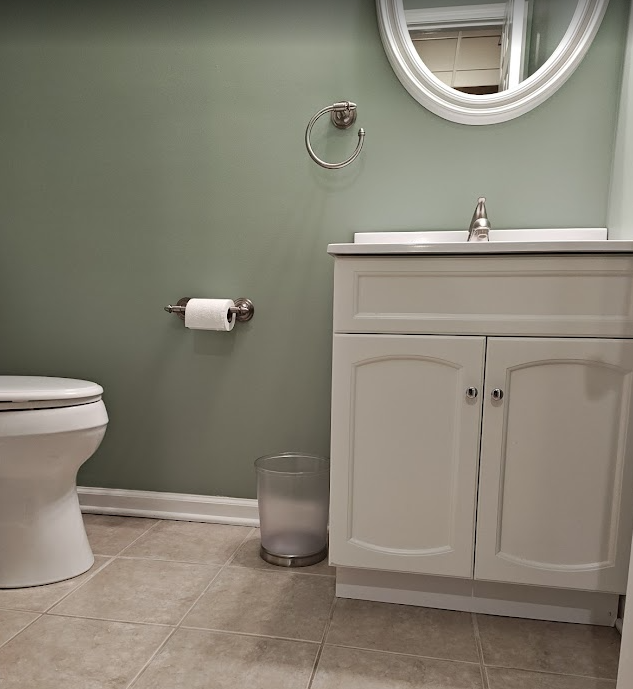
Bathroom fixture clearances don’t get much attention until final inspection — and that’s usually when problems show up.
IRC bathroom fixture clearances are one of those inspection issues that don’t fail because someone didn’t read the code. It fails because someone lost an inch or two and didn’t catch it before calling for final.
Bathroom fixture spacing is simple on paper and unforgiving in the field. Tight bathrooms, remodels, pre-made vanities, thicker tile, glass panels—all of that eats into clearances fast. And when it does, the inspector isn’t guessing. They’re measuring.
This post answers one question clearly and permanently:
What bathroom fixture clearances does the IRC actually require, and how do inspectors measure them at final inspection?
Which IRC Sections Control Bathroom Fixture Clearances
Bathroom fixture spacing in the IRC comes from two places:
- IRC R307.1 and Figure R307.1
- IRC P2705.1
Here’s the important field distinction:
- The figure shows layout relationships
- The written dimensions in P2705.1 are enforceable
These IRC bathroom fixture clearances are enforced the same way at final inspection whether the layout is new construction or a remodel.
If there’s ever confusion between a diagram and the text, inspectors enforce the written clearance numbers.
IRC Bathroom Fixture Clearances: Toilet (Water Closet) Requirements
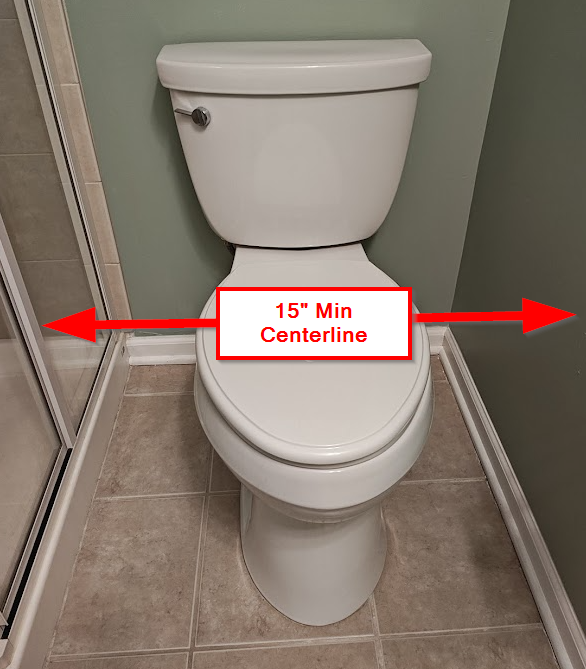
This is the most commonly mismeasured fixture.
Side clearance
- 15 inches minimum from the centerline of the toilet
- Measured to any side wall, vanity, tub, shower, or similar obstruction
Measuring from the porcelain edge instead of the centerline is where jobs get short an inch or two without anyone realizing it.
Lavatory (Sink) Clearance Requirements
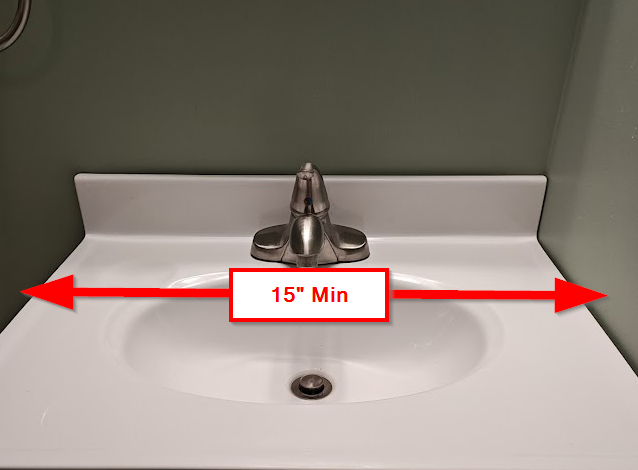
Lavatory spacing is clearly enforceable under IRC P2705.1.
Side clearance
- 15 inches minimum from the sink centerline to any side wall, partition, or adjacent vanity
Front clearance
- 21 inches minimum clear space in front
- Measured from the front of the sink or vanity
Even if a pre-manufactured vanity is designed tighter, the clearance still applies unless the AHJ has adopted an amendment.
Bathtub Clearance Requirements
Bathtubs don’t often have side clearances like toilets or sinks, but they still fail inspections regularly.
- 21 inches minimum clear space in front of the tub
- Measured from the finished tub edge
Tile, apron, and finishes all count.
If a toilet is next to a tub, the toilet must still maintain its 15-inch centerline clearance to the tub. The tub is treated as a solid obstruction.
Shower Clearance Requirements
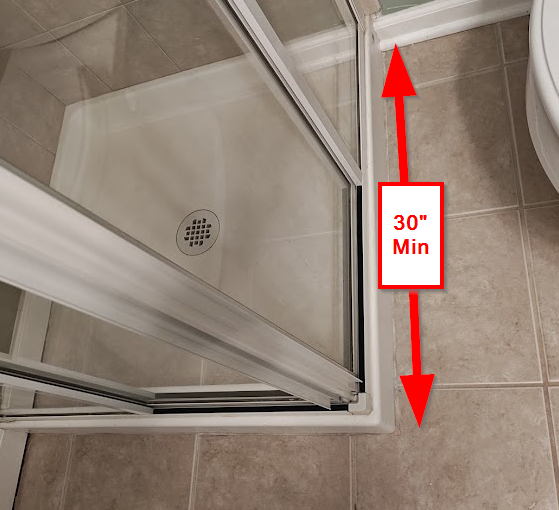
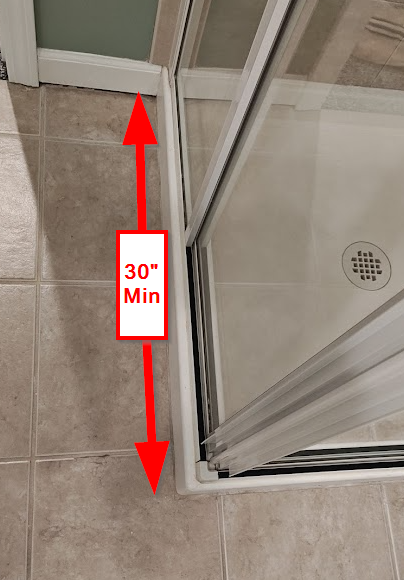
Two separate requirements apply, and they’re often confused.
Interior shower size
- Minimum 900 square inches, with a minimum 30×30-inch dimension
- Measured inside the finished shower, not framing
Clear space in front of shower opening
- 24 inches minimum
- Measured from the finished entry
Inspectors measure finished surfaces only. Stud-to-stud dimensions don’t matter at final.
Finished Surfaces Are What Inspectors Measure
If you want the full field walkthrough of bathroom and shower fixture spacing—why clearances get missed on real jobs and how inspectors verify them after finishes—see Bathroom & Shower Fixture Spacing Requirements (IRC 2021–2024): What Actually Gets Missed in the Field.
This is where many layouts fail after rough inspection.
All fixture clearances are measured from finished surfaces, including:
- Tile
- Stone
- Glass
- Trim
- Tub aprons
- Vanity faces
Passing rough inspection does not lock in clearance approval. Final inspection is where finished conditions are enforced.
Doors and Clearance Areas
The IRC requires clear space in front of fixtures but doesn’t clearly allow door swings into those areas.
Most inspectors will not allow a door to swing into a required clearance zone. If your layout relies on door swing to meet minimums, expect a correction.
Key Questions & Clear Answers
Are clearances measured from fixture edges or centerlines?
Centerlines for toilets and sinks. Front edges for front clearances.
Does passing rough inspection approve fixture spacing?
No. Clearances are enforced at final with finished surfaces.
Do tubs and showers count as obstructions?
Yes. They are treated as solid obstructions.
Are older layouts grandfathered?
Not for new work. New installations must meet the adopted code.
Is the IRC diagram enforceable by itself?
No. The written dimensions in IRC P2705.1 control.
Final Field Takeaway
The IRC sets minimum requirements, not comfort standards. Tight bathrooms, remodels, and finish upgrades shrink space quickly, and inspectors measure what’s actually there—not what was planned.
If you verify centerlines and finished clearances before calling for final, this inspection issue almost never comes up.
This same enforcement-first approach is how I break down repeat inspection issues throughout my book Pass the Inspection—not adding requirements, just clarifying what inspectors actually enforce so jobs don’t stall at final.
Get the Right Code Guide for the Job
Tired of code confusion, failed inspections, or second-guessing your work? These practical field guides and checklists are built for contractors, inspectors, and serious DIYers—clear, code-cited, and written for real job sites.
Available Guides:
Pass the Inspection: A Field Guide to GFCI & AFCI Code Requirements
My book with clear explanations, diagrams, and field checklists to help you wire it right the first time and pass inspection with confidence. Covers NEC 2020 and 2023.
Kitchen GFCI & AFCI Requirements Checklist (NEC 2020 & 2023)
A field-ready checklist covering required protection locations and common inspection misses in residential kitchens.
Laundry Area GFCI & AFCI Requirements Checklist (NEC 2020 & 2023)
A quick-reference guide for one of the most frequently failed areas at final inspection.