
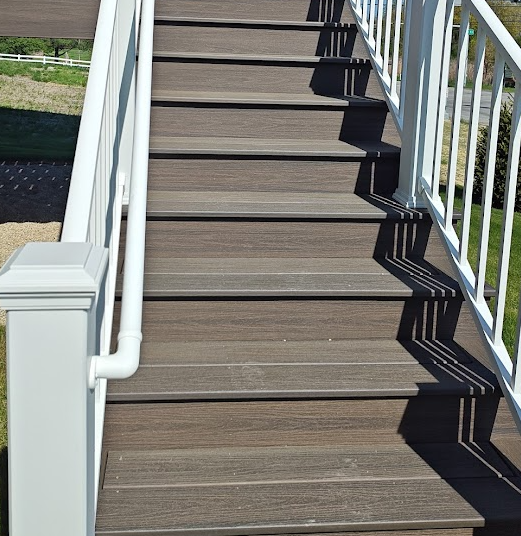
Stair riser height and tread depth are the most common reasons stairs fail inspection in residential construction.
They fail because the stair layout is wrong.
Under the International Residential Code (IRC), which applies to one- and two-family dwellings and townhouses, stair requirements are prescriptive and strictly enforced.
And most of the time, failure comes down to three things:
- riser height
- tread depth
- variation across the flight
This is where inspectors focus, because this is where consistency—and safety—breaks down.
For a full breakdown of stairway requirements including handrails, guards, and clearances, see our complete guide here: International Residential Stair Code Guide: How to Pass Your Inspection
The Governing Code Section (Residential – IRC)
For residential construction, stair layout is controlled by:
IRC Section R311.7.5 (2021 IRC)
This section applies specifically to dwelling units and establishes:
- maximum riser height
- minimum tread depth
- allowable variation within a flight
These are prescriptive requirements under the IRC—not guidelines.
What Triggers This Requirement
If the assembly is a stairway serving a dwelling unit, this section applies.
There’s no special condition or exception needed to trigger it.
If it’s a stair, this rule is in play.
Maximum Riser Height (7¾ Inches)
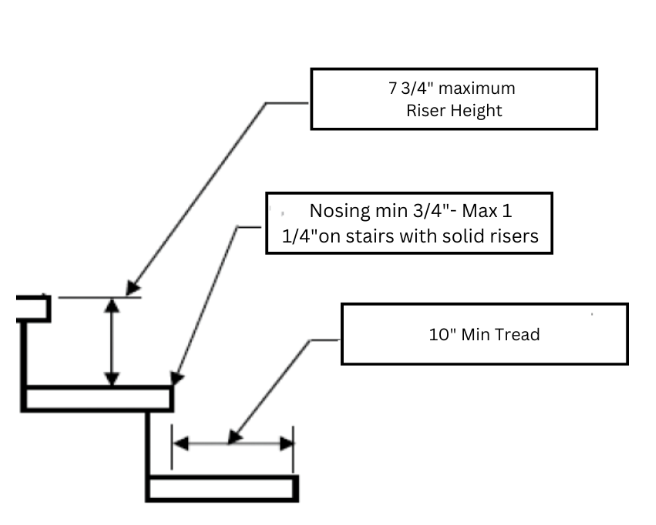
The code sets a maximum riser height of 7¾ inches.
This is a hard cap.
Inspectors are not averaging risers.
They are not allowing “close enough.”
If a single riser exceeds 7¾ inches, the stair fails.
What Inspectors Are Actually Looking For
- bottom riser too tall due to slab or landing height
- top riser off because finish flooring wasn’t accounted for
- inconsistent stringer cuts
This is one of the most common failure points on site.
Minimum Tread Depth (10 Inches)
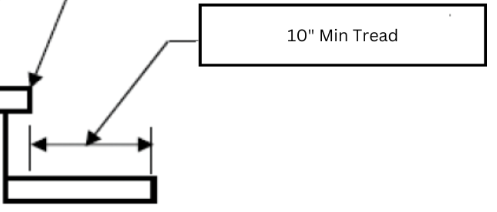
The code requires a minimum tread depth of 10 inches.
The greatest tread depth within a flight shall not exceed the smallest by more than 3/8 inch.
This is measured horizontally from nosing to nosing.
Again, this is not an average.
If one tread is short, the stair fails.
Where This Goes Wrong in the Field
- stringers cut tight to save space
- finish material reducing usable tread depth
- inconsistent layout during framing
Getting stair riser height and tread depth correct from the start is what prevents most inspection failures.
Stair Riser Height and Tread Depth: The 3/8-Inch Rule
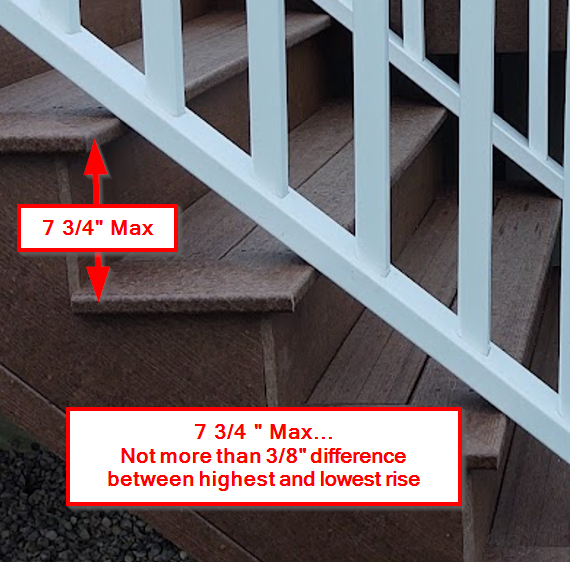
This is where most failures happen.
The code limits variation to:
- 3/8 inch maximum between the tallest and shortest riser
- 3/8 inch maximum between the deepest and shallowest tread
This applies across the entire flight.
Not per step. Not per pair. Across the whole run.
What That Means in Practice
If one riser is:
- 7 “
And another is:
- 7 1/2″
You just failed inspection.
Even though both are under 7¾”.
Because the variation exceeds 3/8″.
Why This Fails Inspection So Often
This is not a math problem on paper.
It’s a field execution problem.
The most common causes:
- finished floor thickness not included in layout
- bottom step poured before final elevations were known
- top landing height changed late
- stringers cut from inconsistent measurements
- rework done mid-install without recalculating total rise
Inspectors are measuring the final result.
How Inspectors Evaluate It
Inspection is straightforward:
- measure multiple risers
- compare tallest to shortest
- measure multiple treads
- compare deepest to shallowest
If the difference exceeds 3/8 inch, it fails.
There is no exception in this section for minor deviations.
Why This Matters (Cadence and Trip Risk)
This isn’t just a measurement issue.
It’s a movement issue.
When someone walks a stair, they establish a rhythm—step to step, the body expects each riser and tread to be consistent.
That rhythm is referred to as cadence.
Once that cadence is set, the person is no longer measuring each step.
They’re moving based on expectation.
What Happens When One Step Is Off
If one riser or tread is different:
- the foot doesn’t clear the step the way the body expects
- the timing of the step is off
- the body doesn’t adjust in time
People generally do not detect small variations while walking stairs, so they continue stepping based on expectation—and that’s what leads to reduced foot clearance and increased trip risk.
In practical terms:
The person thinks the step is where it should be—but it isn’t.
That’s where trips happen.
Why the Code Limits Variation to 3/8 Inch
The IRC limit on variation is about maintaining a consistent walking pattern.
Once variation exceeds that range:
- step predictability breaks down
- cadence is disrupted
- trip risk increases
That’s why inspectors don’t “let a small one slide.”
Because it only takes one step being off to cause a fall.
Scope Limitations and What This Section Does NOT Do
This section:
- does not address handrails
- does not address guards
- does not address stair width or headroom
Those are covered under separate IRC sections.
This section is strictly stair layout and dimensional control.
AHJ, State, and Local Requirements
The IRC provides the baseline requirements for residential construction.
However, enforcement is through the Authority Having Jurisdiction (AHJ), and the adopted code may vary by:
- state amendments
- local ordinances
- adopted IRC cycle (2018, 2021, 2024, etc.)
Always verify:
- which IRC edition is adopted
- whether the state has modified stair requirements
- whether the local AHJ enforces any additional provisions
Inspectors enforce what is adopted—not just what is printed in the base IRC.
Key Takeaways (Inspection Focused)
- 7¾” is a hard maximum riser height
- 10″ is a hard minimum tread depth
- 3/8″ is the maximum variation across the entire flight
- One bad step fails the whole stair
- Most failures come from layout, not framing skill
- These are IRC residential requirements and may be modified by state or local amendments
- Always confirm requirements with the AHJ before framing or layout
Get the Right Code Guide for the Job
Tired of code confusion, inspection fails, or second-guessing your wiring? These practical field guides and checklists are built for pros, contractors, and serious DIYers—clear, code-cited, and inspection-tested. Grab the resource that fits your next project:
Available Guides:
• Pass the Inspection: A Field Guide to GFCI & AFCI Code Requirements
My book with clear explanations, diagrams, and field checklists to help you wire right the first time and pass every inspection. Covers NEC 2020/2023, written for real-world job sites.
• Kitchen GFCI & AFCI Requirements Checklist (NEC 2020 & 2023 Field Guide)
• Laundry Area GFCI & AFCI Requirements Checklist (2020 & 2023 NEC)