
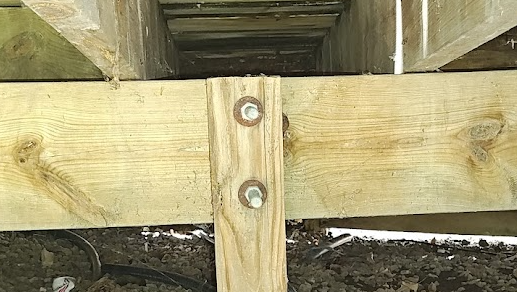
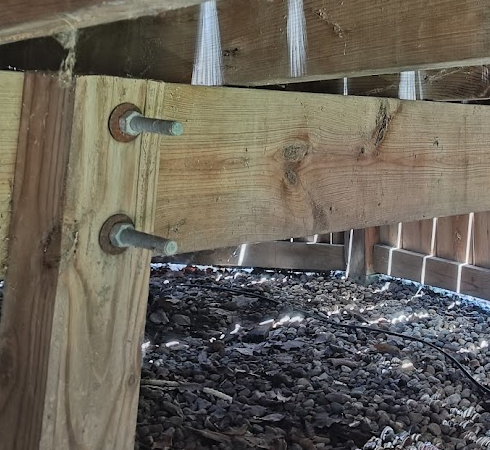
Questions about a deck beam to post connection come up on jobsites all the time. I’ve seen this argument more times than I can count.
A contractor points to a deck that has been standing for 20 or 30 years without a problem. The beam is bolted to the side of a post, the deck feels solid, and nobody can remember it ever moving.
Then an inspector asks for a different beam-to-post connection.
That’s where builders get tripped up.
The discussion usually turns into whether the old connection is strong enough. But that’s not the first question that should be asked.
The first question should be:
What connection detail does the IRC actually provide for a prescriptive deck?
Let’s look at what the code says.
What the IRC Says About a Deck Beam to Post Connection
IRC Section R507 contains the prescriptive requirements for wood-framed exterior decks.
Section R507.5.2 addresses deck beam connections to supports and states that deck beam connections to wood posts shall be in accordance with the referenced beam-to-post figures.
The section also requires deck beams to be attached to supports in a manner capable of transferring vertical loads and resisting horizontal displacement.
The IRC then provides two prescriptive beam-to-post connection methods.
Figure R507.5.2(1)
- Beam bearing directly on top of the post.
- Beam secured with an approved post cap or approved connection.
Figure R507.5.2(2)
- Notched post-to-beam connection.
- Beam bearing on a shoulder cut in the post.
- Through-bolts or approved equivalent connectors.
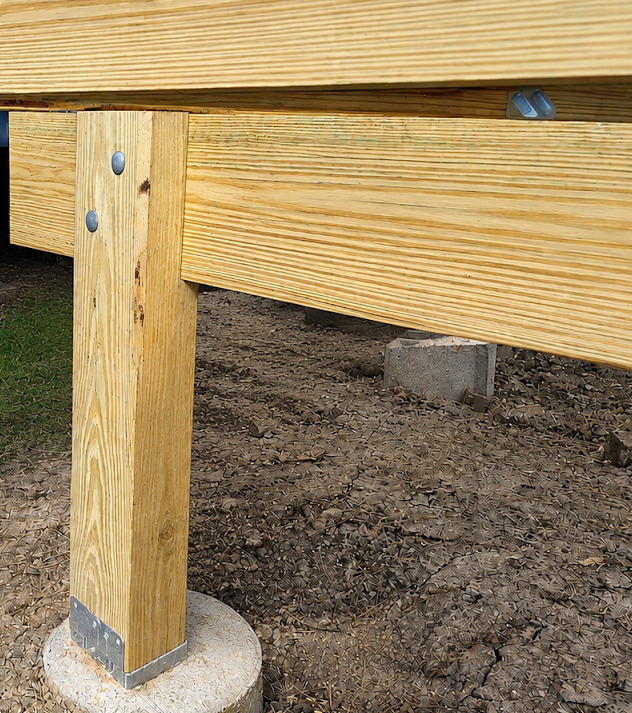
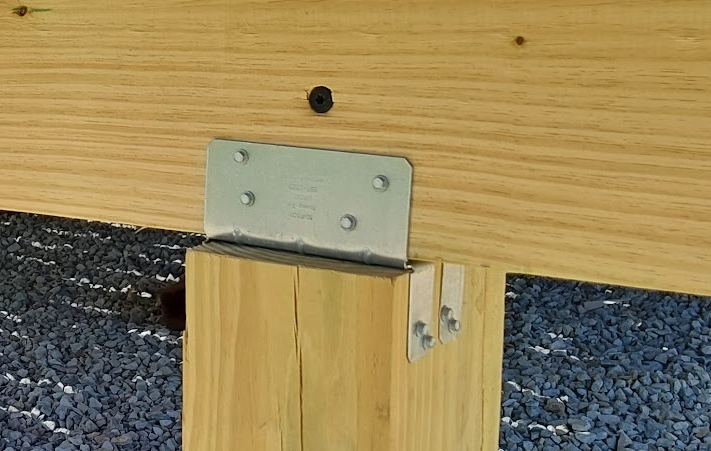
At this point, many readers notice that a traditional side-bolted beam connection is not shown in the prescriptive figures.
The common detail where a double 2x beam is attached to the side of an unnotched post using only through-bolts does not appear in the prescriptive figures.
That observation often leads to a second question:
Does the absence of a detail from the prescriptive figures automatically mean the connection is prohibited?
Not necessarily.
The purpose of this article is not to determine the structural adequacy of every possible beam-to-post connection. The purpose is to examine the specific prescriptive connection details provided in IRC Section R507.5.2.
Code Reference: IRC 2021 Section R507.5.2 – Deck Beam Connection to Supports
Always verify the code cycle adopted in your jurisdiction.
Why the Confusion Happens
Many older decks were built using side-bolted beam connections.
Some have performed perfectly for decades.
Because of that, people often assume the code must still recognize that detail as a prescriptive option.
Maybe. Maybe not.
The IRC is not asking whether a particular deck has survived for twenty years.
The IRC is providing prescriptive construction methods that can be built without a separate engineered design.
Those are two different questions.
A connection can exist in the field and perform well for years while still not being one of the specific prescriptive details shown in Section R507.
Applying the Section
This is where inspector thinking becomes important.
Before debating bolt sizes, post sizes, or connection strength, determine which code path is being used.
Question 1
Is the deck being built using the prescriptive provisions of IRC Section R507?
If the answer is yes, the deck should follow the beam-to-post details provided by that section.
Those details show beam bearing.
The beam either:
- Bears directly on top of the post.
- Bears on a notched post connection.
Question 2
Is an engineered design being provided?
If the answer is yes, the engineer may specify a connection that differs from the prescriptive details.
That’s a different compliance path.
The IRC specifically recognizes engineered design throughout the code.
The important point is understanding which path is being used before deciding what requirements apply.
Common Field Mistake
I’ve seen this mistake many times.
Someone points at an existing deck and says:
“It’s been standing for 25 years.”
That may be true.
But longevity alone does not answer the code question.
The actual question is:
Does the connection comply with the prescriptive provisions being used for the project?
Those are not the same analysis.
A deck surviving for decades does not automatically make it a prescriptive IRC detail.
Likewise, the fact that a connection is not shown in the prescriptive figures does not automatically mean it is structurally inadequate.
Those are separate issues.
Questions to Ask First
The goal is not simply to identify a deck beam to post connection that appears strong. The goal is to determine whether the connection follows the code path being used for the project.
Before making a correction or defending a connection, ask:
- Is the deck being built under the prescriptive provisions of IRC Section R507?
- Which beam-to-post detail is being used?
- Does the beam bear directly on the post?
- Does the connection match one of the figures provided in R507.5.2?
- Has an engineered design been submitted that permits an alternate connection?
Those questions usually resolve the disagreement very quickly.
I’ve seen the same thing happen with stair inspections. People often assume they know the requirement because they’ve built stairs before, only to discover that the actual code language says something different. If you’ve ever wondered why stairs that look fine still fail inspection, take a look at my post on Stair Riser Height and Tread Depth: Why Stairs Fail Inspection
Field Reminder
The question isn’t whether the connection has worked.
The question is whether it matches the code path being used.
Get the Right Code Guide for the Job
Tired of code confusion, inspection fails, or second-guessing your wiring? These practical field guides and checklists are built for pros, contractors, and serious DIYers—clear, code-cited, and inspection-tested. Grab the resource that fits your next project:
Available Guides:
• Pass the Inspection: A Field Guide to GFCI & AFCI Code Requirements
My book with clear explanations, diagrams, and field checklists to help you wire right the first time and pass every inspection. Covers NEC 2020/2023, written for real-world job sites.
• Kitchen GFCI & AFCI Requirements Checklist (NEC 2020 & 2023 Field Guide)
• Laundry Area GFCI & AFCI Requirements Checklist (2020 & 2023 NEC Field Guide)
• Garage & Outdoor GFCI Requirements Checklist (NEC 2020 & 2023 Field Guide)