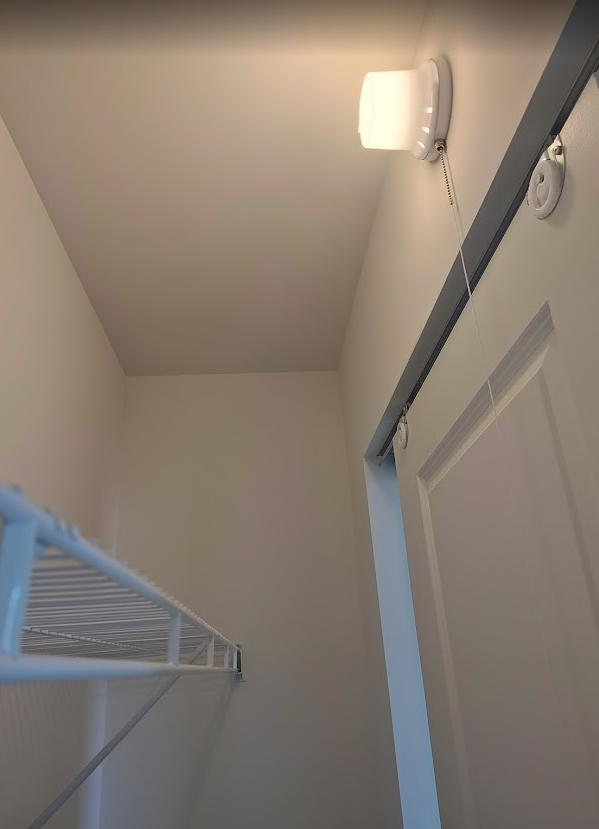
Closet lighting code requirements are often misunderstood. Many people assume that if a fixture uses LED technology, it can be installed almost anywhere in a clothes closet. The National Electrical Code (NEC), however, regulates more than the type of light source. It also regulates where the luminaire may be installed in relation to the defined clothes closet storage space.
A luminaire that is otherwise permitted can still violate the Code if it is installed too close to the clothes closet storage space. Understanding that relationship is the key to properly applying NEC 410.16.
Closet Lighting Code Requirements in the 2023 NEC
The 2023 NEC begins Section 410.16 by defining the clothes closet storage space before identifying the permitted luminaire types, prohibited luminaire types, and required installation clearances. This organization emphasizes that the storage space must first be identified before the installation requirements can be properly applied.
The required clearances are measured from the nearest point of the defined clothes closet storage space.
Before applying any electrical Code requirement, it’s important to identify exactly what the Code is regulating. The same principle applies to bathroom lighting. If you haven’t read my related article, Do Recessed Shower Lights and Bathroom Exhaust Fans Need GFCI Protection? it explains when GFCI protection is—and isn’t—required for recessed shower lights and bathroom exhaust fans.
Understanding the Clothes Closet Storage Space
Before determining whether a luminaire complies with NEC 410.16, the clothes closet storage space must first be identified.
The simplified illustration below is intended to help explain the concept of the defined clothes closet storage space. Once that area is identified, NEC 410.16 uses it to determine the permitted luminaire types and required installation clearances. For your specific installation, refer to NEC 410.16 and Figure 410.16(A), Clothes Closet Storage Space, for the official Code language, dimensions, and storage-space diagram.
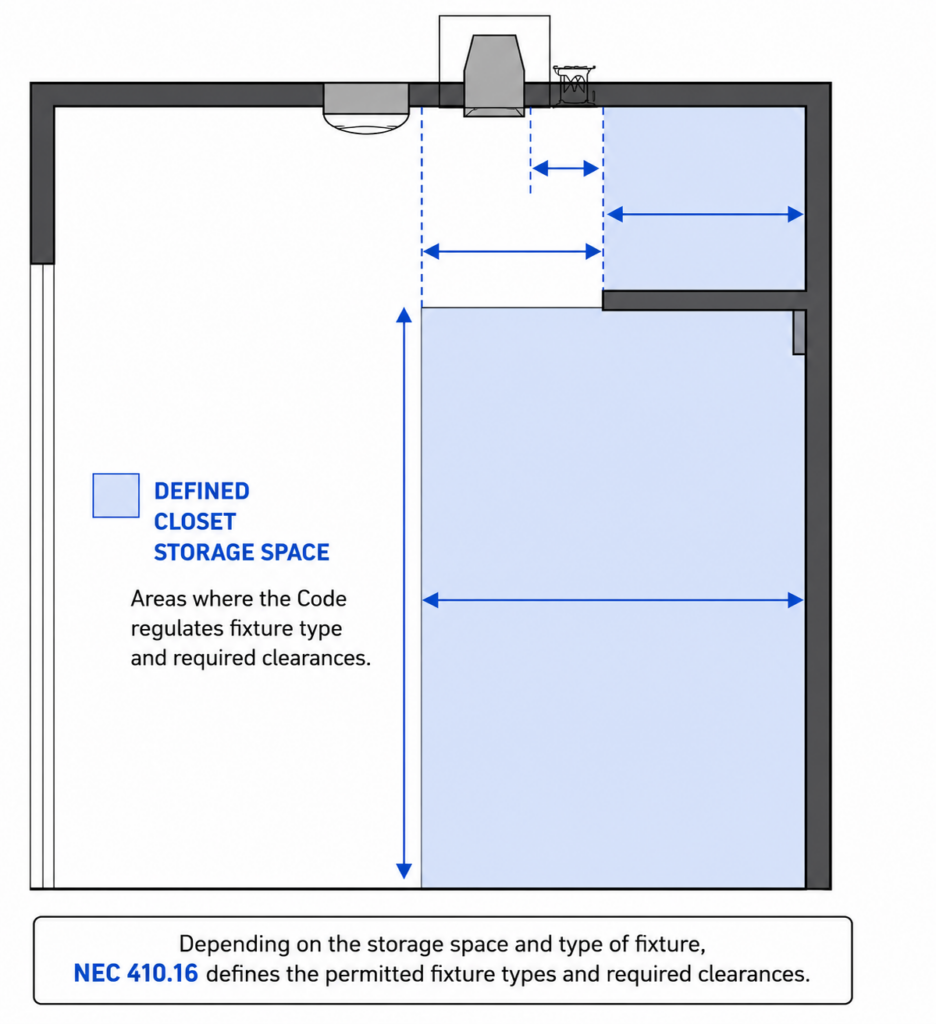
Section 410.16(A) defines the clothes closet storage space using the closet walls, shelving, and clothes-hanging rod. Below the upper shelf area, the storage space extends 24 inches horizontally from the side and back walls to a height of 6 feet or to the height of the highest clothes-hanging rod, whichever is greater.
Above that elevation, the storage space extends vertically to the ceiling using a horizontal distance of 12 inches from the walls or the width of the shelf, whichever is greater.
For closets that permit access to both sides of a hanging rod, the storage space also extends 12 inches on each side of the rod for the entire length of the rod.
The important point is that the required luminaire clearances in NEC 410.16(D) are measured from the nearest point of the defined clothes closet storage space, not simply from the closet wall. Because shelf width and hanging-rod location affect the storage-space boundary, they also affect where the required luminaire clearances are measured.
Luminaire Types Permitted
Section 410.16(B) permits only the following luminaires in clothes closets:
- Surface-mounted incandescent luminaires with completely enclosed light sources.
- Recessed incandescent luminaires with completely enclosed light sources.
- Surface-mounted LED luminaires with completely enclosed light sources.
- Recessed LED luminaires with completely enclosed light sources.
- Surface-mounted fluorescent luminaires.
- Recessed fluorescent luminaires.
- Surface-mounted fluorescent or LED luminaires identified as suitable for installation within the clothes closet storage space.
Notice that enclosed light sources are required for incandescent and LED luminaires unless the luminaire qualifies under the specific exception discussed later.
Luminaire Types Not Permitted
Section 410.16(C) prohibits the following luminaires in clothes closets:
- Incandescent luminaires with open lamps.
- Incandescent luminaires with partially enclosed lamps.
- Pendant luminaires.
- Pendant lampholders.
These luminaires are not permitted regardless of the available clearance.
Closet Lighting Code Requirements for Minimum Clearances
After confirming that the luminaire is one of the permitted types, Section 410.16(D) establishes the minimum required clearance between the luminaire and the nearest point of the clothes closet storage space.
| Luminaire Type | Minimum Clearance |
|---|---|
| Surface-mounted incandescent or LED luminaire with a completely enclosed light source installed on the wall above the door or on the ceiling | 12 inches |
| Surface-mounted fluorescent luminaire installed on the wall above the door or on the ceiling | 6 inches |
| Recessed incandescent or LED luminaire with a completely enclosed light source installed in the wall or ceiling | 6 inches |
| Recessed fluorescent luminaire installed in the wall or ceiling | 6 inches |
These clearances are measured from the luminaire to the nearest point of the defined clothes closet storage space.
The Exception
Section 410.16(D) contains one important exception.
Surface-mounted fluorescent or LED luminaires are permitted to be installed within the clothes closet storage space when they are identified for that use.
This exception is limited.
It does not apply simply because a fixture uses LED technology. The luminaire must be specifically identified as suitable for installation within the clothes closet storage space.
How NEC 110.3(B) Applies
When a surface-mounted fluorescent or LED luminaire is identified for installation within the clothes closet storage space, NEC 110.3(B) applies.
Section 110.3(B) requires equipment that is listed, labeled, or identified for a use to be installed and used in accordance with the instructions included with its listing, labeling, or identification.
If the luminaire’s listing identifies it as suitable for installation within the clothes closet storage space, it must be installed in accordance with those instructions.
Why These Requirements Exist
The NFPA Insights accompanying Section 410.16 explain the purpose behind these requirements.
The clearance requirements are intended to reduce the possibility of clothing, blankets, boxes, cartons, and other combustible materials coming into contact with hot luminaires or broken lamps.
The Insights also clarify an important detail that is often overlooked:
The required clearance is measured to the luminaire—not to the lamp itself.
While NFPA Insights help explain the purpose behind the Code, they are explanatory material and are not enforceable Code language.
Another point worth remembering is that the NEC does not require a luminaire to be installed in a clothes closet. However, if one is installed, it must comply with the requirements of Section 410.16.
Common Inspection Mistakes
Several issues commonly lead to correction notices during inspections:
- Assuming any LED luminaire is acceptable simply because it uses LED technology.
- Measuring the required clearance from the closet wall instead of the defined clothes closet storage space.
- Overlooking how shelf width changes the storage-space boundary.
- Installing an open-lamp incandescent fixture or pendant luminaire in a clothes closet.
- Assuming the exception applies to all LED luminaires rather than only those identified for installation within the clothes closet storage space.
Inspection Takeaway
When applying closet lighting code requirements, don’t begin by asking whether the fixture is LED.
Begin by identifying the clothes closet storage space defined in NEC 410.16(A). Then verify that the luminaire type is permitted under Section 410.16(B), confirm it is not prohibited by Section 410.16(C), and apply the minimum clearance requirements in Section 410.16(D).
If the installation relies on the exception, verify that the surface-mounted fluorescent or LED luminaire is identified for installation within the clothes closet storage space and install it in accordance with NEC 110.3(B).
Always verify any local amendments and follow the requirements of the Authority Having Jurisdiction (AHJ).
Get the Right Code Guide for the Job
Available Guides:
• Pass the Inspection: A Field Guide to GFCI & AFCI Code Requirements My book with clear explanations, diagrams, and field checklists to help you wire right the first time and pass every inspection. Covers NEC 2020/2023, written for real-world job sites.
• Kitchen GFCI & AFCI Requirements Checklist (NEC 2020 & 2023 Field Guide)
• Laundry Area GFCI & AFCI Requirements Checklist (2020 & 2023 NEC Field Guide)
• Garage & Outdoor GFCI Requirements Checklist (NEC 2020 & 2023 Field Guide)