
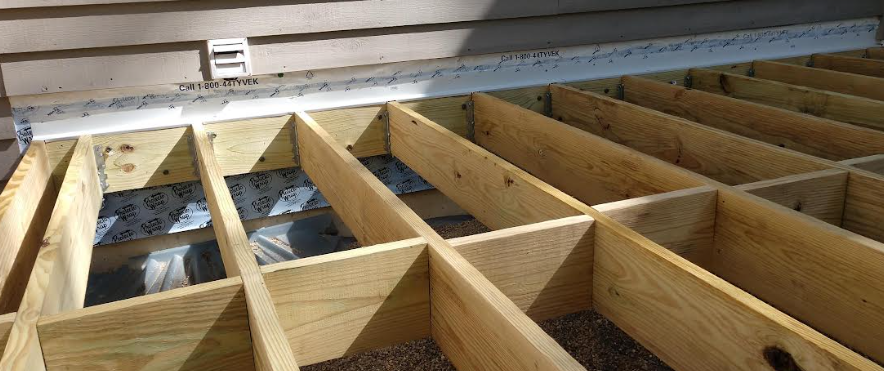
Deck ledger flashing requirements are critical because moisture intrusion at the ledger connection can damage the band joist and structural framing.
The deck ledger connections get a lot of attention for structural fastening, but inspectors also look closely at water management at the ledger-to-wall interface. The International Residential Code addresses this directly because moisture intrusion at the band joist has been a common cause of structural decay.
Understanding the flashing requirement requires looking at how the IRC treats both deck ledgers and exterior wall water management.
Another place where inspectors see similar misunderstandings is in bathroom layouts. Code minimums are often known, but the way inspectors actually measure them in the field is where many installations fail. If you want a real example of how those measurements are evaluated during inspection, see Bathroom & Shower Fixture Spacing Requirements (IRC 2021–2024): What Actually Gets Missed in the Field.
Under the 2021 IRC, Section R507.2.4 requires corrosion-resistant metal flashing of nominal thickness not less than 0.019 inch (0.48 mm), or an approved nonmetallic material that is compatible with the substrate of the structure and the decking materials.
Deck Ledger Flashing Requirements in the IRC
Under the 2021 International Residential Code (IRC), two sections control this condition:
IRC R507.2.4 — Deck Ledger Flashing
and
IRC R703.4 — Flashing
These sections work together.
- R507.2.4 specifically addresses flashing at deck ledgers.
- R703.4 requires approved corrosion-resistant flashing to be applied shingle-fashion in a manner that prevents entry of water into the wall cavity or penetration of water to the building structural framing components.
IRC Section R703.4(5) also specifically requires flashing where exterior porches, decks, or stairs attach to a wall or floor assembly of wood-frame construction.
The Trigger Condition
The flashing requirement applies when:
A deck ledger is attached to the dwelling wall.
The ledger connection penetrates the exterior wall assembly and creates a potential entry point for water. When that condition exists, the IRC requires flashing to protect the structure behind the wall covering.
How the Code Evaluates Flashing
The IRC does not prescribe a single flashing shape, but it does establish the required performance.
R703.4 establishes the general requirement that flashing must be installed shingle-fashion in a manner that prevents entry of water into the wall cavity or penetration of water to the building structural framing components.
The flashing must also extend to the surface of the exterior wall finish.
From an inspection standpoint, this means the flashing must direct water outward so it cannot enter the wall cavity or reach the structural framing components behind the wall covering.
What Inspectors Look For in the Field
When inspecting a ledger connection, inspectors are looking for flashing that satisfies the performance requirements of IRC Section R703.4 at the deck attachment location.
Flashing Installed Above the Ledger
The flashing must be installed so water cannot run behind the ledger and into the wall assembly.
If flashing is omitted or installed in a way that allows water to run behind the ledger, the protection required by IRC Section R507.2.4 has not been achieved.
Proper Overlap with the Water-Resistive Barrier
Exterior walls include a water-resistive barrier (WRB) behind the siding.
For flashing to work properly, the WRB must lap over the flashing, allowing water to shed outward.
If the flashing is installed over the WRB, water can be directed behind the wall covering instead of away from it.
Continuous Protection Along the Ledger
Inspectors also look for flashing that runs continuously along the length of the ledger.
Gaps, seams, or interruptions can allow water to enter the wall assembly even if flashing is present in some locations.
Why Ledger Flashing Matters
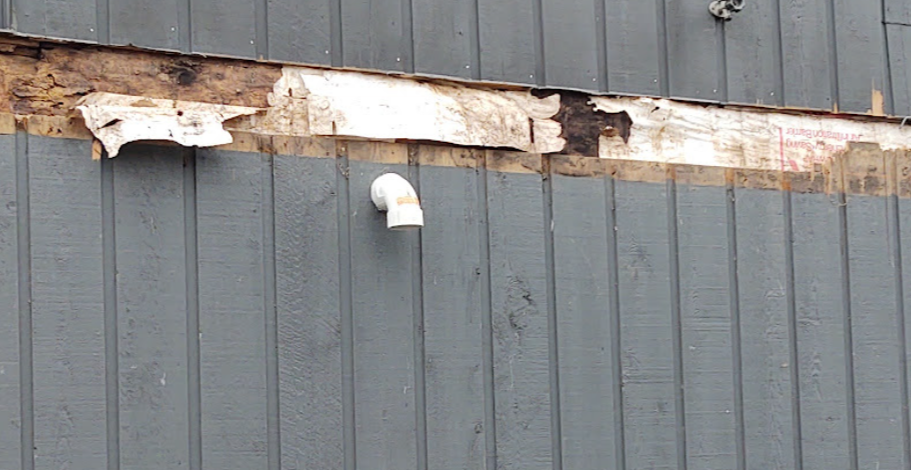
The deck ledger transfers load directly into the band joist of the dwelling. If water reaches that structural member over time, the band joist can deteriorate.
Once the band joist is compromised, the structural capacity of the ledger connection may also be affected.
That is why the IRC requires flashing at deck ledger attachments to prevent water from reaching the wall cavity and structural framing components, including the house band joist.
When Flashing Alone Does Not Solve the Problem
Flashing protects the wall assembly, but it does not resolve structural issues related to the ledger connection itself.
For example, flashing does not address conditions where a ledger is attached to:
- brick veneer
- stone veneer
- hollow masonry
- walls with exterior insulation
Those situations involve separate structural provisions under IRC R507.2.1 and R507.9.
The Inspection Principle
From an inspection standpoint, the ledger connection is evaluated for two different conditions:
- Structural load transfer under the deck ledger provisions.
- Moisture protection at the wall penetration under IRC Sections R507.2.4 and R703.4.
Both conditions must be satisfied for the installation to comply with the IRC.
Get the Right Code Guide for the Job
Tired of code confusion, inspection fails, or second-guessing your wiring? These practical field guides and checklists are built for pros, contractors, and serious DIYers—clear, code-cited, and inspection-tested. Grab the resource that fits your next project:
Available Guides:
• Pass the Inspection: A Field Guide to GFCI & AFCI Code Requirements
My book with clear explanations, diagrams, and field checklists to help you wire right the first time and pass every inspection. Covers NEC 2020/2023, written for real-world job sites.
• Kitchen GFCI & AFCI Requirements Checklist (NEC 2020 & 2023 Field Guide)
• Laundry Area GFCI & AFCI Requirements Checklist (2020 & 2023 NEC)