
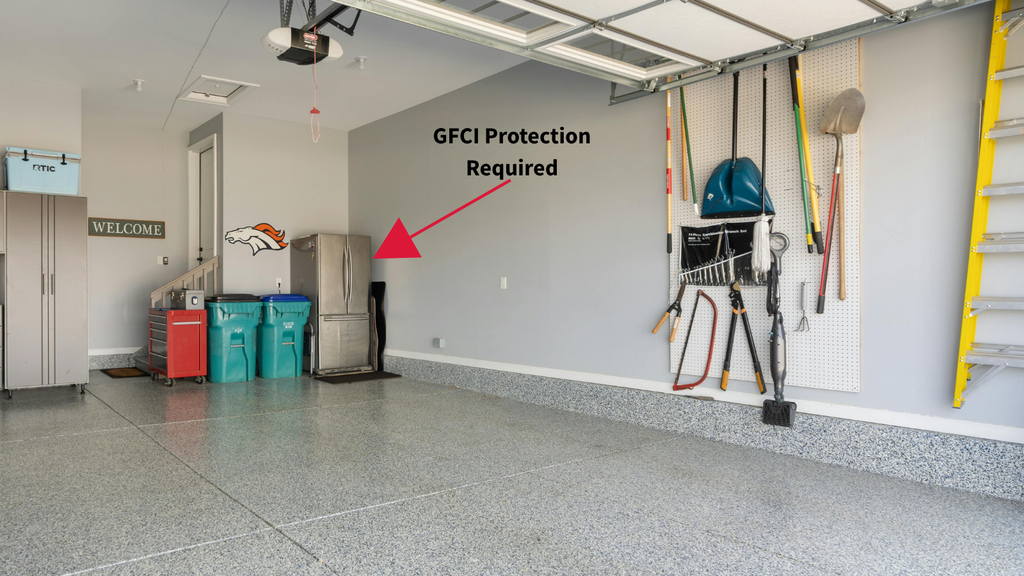
Yes. Garage refrigerator GFCI protection is required under the current NEC when the receptacle falls within the scope of NEC 210.8(A). The same applies to a freezer in a dwelling-unit garage.
There is no general exception just because the receptacle serves a refrigerator or freezer, is dedicated to that appliance, or is located behind it.
But if you have been in the electrical trade for a while, you may remember when that wasn’t necessarily the case.
You are remembering correctly.
The NEC used to contain an exception that could allow a garage refrigerator or freezer receptacle to be installed without GFCI protection.
That exception disappeared with the 2008 NEC.
What Does the NEC Require Today?
NEC 210.8(A)(2) includes dwelling-unit garages among the locations where receptacles within the scope of 210.8(A) require GFCI protection.
Under the 2020 NEC, 210.8(A) expanded the requirement beyond the older 125-volt, 15- and 20-ampere limitation to cover 125-volt through 250-volt receptacles supplied by single-phase branch circuits rated 150 volts or less to ground.
For the typical 120-volt refrigerator or freezer plugged into a receptacle in a dwelling-unit garage, the answer is straightforward:
The garage location triggers the GFCI requirement.
The fact that the receptacle supplies a refrigerator or freezer does not create an exception from that requirement.
As always, verify the NEC edition adopted in your jurisdiction along with any applicable local amendments.
Why Do Some Electricians Remember an Exception?
Because there really was one.
The 2005 NEC included two exceptions under 210.8(A)(2) for dwelling-unit garages.
One addressed receptacles that were not readily accessible.
The other addressed certain receptacles supplying appliances occupying dedicated space that were not easily moved from one place to another in normal use.
That second exception could apply to appliances such as refrigerators and freezers when the conditions of the exception were satisfied.
The 2005 NEC Handbook even illustrated a freezer in its discussion of garage GFCI requirements and explained how the appliance exception could apply.
So the old idea that a garage refrigerator or freezer could be installed without GFCI protection did not simply come from trade folklore.
The NEC actually contained an exception.
What Changed in the 2008 NEC?
The 2008 NEC removed both of the previous exceptions from 210.8(A)(2).
That meant receptacles covered by the garage requirement could no longer avoid GFCI protection simply because they were not readily accessible or because they supplied a qualifying refrigerator, freezer, or other appliance occupying dedicated space.
The Code-development record for the 2008 NEC shows that refrigerators and freezers were specifically part of the discussion.
Concerns were raised about unwanted GFCI tripping and the possibility of losing food if a refrigerator or freezer lost power.
The Code-Making Panel did not restore the appliance exception.
That history is important because it explains why electricians who worked under earlier editions of the NEC may remember the requirement differently.
The rule actually changed.
What About a GFCI Receptacle Behind the Refrigerator?
This is where another Code change becomes important.
When the appliance exception disappeared in the 2008 NEC, GFCI protection became required for these garage receptacles, but the NEC did not yet contain the later requirement that the GFCI device itself be readily accessible.
That changed with the 2011 NEC.
The 2011 NEC added the requirement that the GFCI device providing the protection be installed in a readily accessible location.
For example, a standard receptacle behind a refrigerator or freezer can receive GFCI protection from an upstream GFCI device or an appropriate GFCI circuit breaker.
The key is that the GFCI device itself must meet the applicable readily accessible requirement.
Putting a GFCI receptacle behind a refrigerator where the appliance has to be moved to reach the TEST and RESET buttons can create an accessibility problem.
Does a Dedicated Circuit Change the GFCI Requirement?
No.
Installing the refrigerator or freezer on an individual branch circuit does not, by itself, eliminate the GFCI requirement for a receptacle located in a dwelling-unit garage.
That is another place where the old Code language can cause confusion.
Under the older exception, the way the receptacle and appliance were installed mattered.
Once that exception was removed, simply providing a dedicated circuit no longer created an exemption from the garage GFCI requirement.
How I Would Evaluate This in the Field
When looking at a refrigerator or freezer in a garage, I would start with a few basic questions:
What NEC edition has the jurisdiction adopted?
That determines which Code requirements apply.
Is this a dwelling-unit garage covered by 210.8(A)(2)?
If it is, determine whether the receptacle falls within the scope of 210.8(A) for that Code edition.
Is GFCI protection actually being provided?
Don’t assume a standard-looking receptacle isn’t protected. It may be protected by a GFCI circuit breaker or another GFCI device upstream.
Is the GFCI device readily accessible as required by the applicable NEC edition?
If the protection is provided by a GFCI receptacle or another GFCI device, make sure its location meets the applicable accessibility requirement.
Why This Still Causes Confusion
This is another good example of why Code-cycle history matters.
An electrician working under the 2005 NEC could have installed a qualifying garage refrigerator or freezer receptacle without GFCI protection and been Code compliant.
Beginning with the 2008 NEC, that old garage appliance exception was gone.
Then the 2011 NEC added the requirement that the GFCI device providing the protection be readily accessible.
So there are really three points in the timeline:
2005 NEC: A qualifying garage refrigerator or freezer receptacle could be exempt from GFCI protection.
2008 NEC: The appliance exception was removed.
2011 NEC: The GFCI device providing required protection also had to be readily accessible.
Understanding that timeline explains a lot of the conflicting information that still gets passed around today.
The Bottom Line
A refrigerator or freezer receptacle in a dwelling-unit garage does not get a GFCI exception simply because it serves a dedicated appliance or is on an individual branch circuit.
But that wasn’t always the rule.
The 2005 NEC contained an exception that could apply to refrigerators and freezers. The 2008 NEC removed that exception, and the 2011 NEC added the readily accessible requirement for the GFCI device.
If you remember doing it differently years ago, there may be a legitimate Code reason why.
The important thing is to determine which NEC edition applies and evaluate the installation under that Code—not under a requirement that existed several cycles earlier.
For a deeper look at how the garage GFCI requirements changed, including the old garage door opener exception, see: When Did Garage Door Openers Start Requiring GFCI Protection?
Get the Right Code Resource for the Job
Tired of code confusion, failed inspections, or second-guessing your work? Building Code Geek resources are written for contractors, inspectors, electricians, tradespeople, and serious DIYers. Every resource is practical, code-cited, inspection-focused, and designed to help you understand what the code actually requires.
Building Code Geek Guides
Pass the Inspection: A Field Guide to GFCI & AFCI Code Requirements
My book with clear explanations, real-world examples, diagrams, and field checklists to help you wire it right the first time and prepare for inspection with confidence. Covers NEC 2020 and 2023.
Building Code Geek Field Guides & Checklist
Browse the complete collection of downloadable field guides, checklists, bundles, and plan-reading resources designed to simplify complex code requirements and help you get it right the first time.
Recommended Tools & Resources
Trusted Tools & Resources for Contractors, Inspectors & Serious DIYer