
A Field-Level Authority Reference for Contractors, Electricians, Inspectors, and Serious DIYers
1. What GFCI Protection Is (and Is Not)
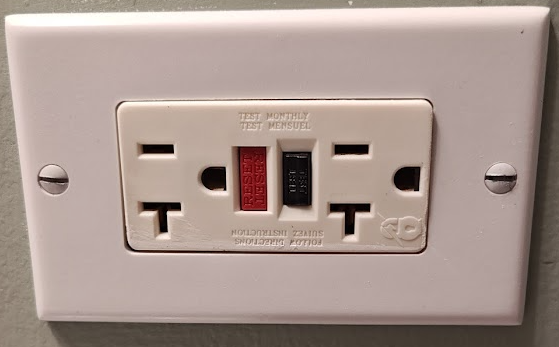
GFCI protection exists to protect people—not equipment.
A Ground-Fault Circuit Interrupter continuously monitors the current on the ungrounded (hot) and grounded (neutral) conductors. Under normal conditions, those currents are equal. If the device detects even a small imbalance—typically 4 to 6 milliamps—it trips the circuit in a fraction of a second. That trip speed is fast enough to prevent electrocution, not just a mild shock.
What a GFCI is not:
- It is not overcurrent protection.
- It does not replace a breaker.
- It does not protect wiring from overloads or short circuits.
That job still belongs to the breaker or fuse. A GFCI is a life‑safety device, period.
Common misunderstandings seen in the field:
- Assuming GFCI protection is optional if a receptacle is hard to reach.
- Confusing GFCI protection with AFCI or overcurrent protection.
- Thinking one GFCI per space “covers everything.”
The NEC does not regulate GFCI by convenience—it regulates it by location and exposure risk.
2. Where GFCI Protection Is Required (NEC 210.8)
Under NEC 2020 and 2023, GFCI protection is required for all 125‑volt through 250‑volt receptacles supplied by single‑phase branch circuits rated 150 volts or less to ground in the following dwelling‑unit locations:
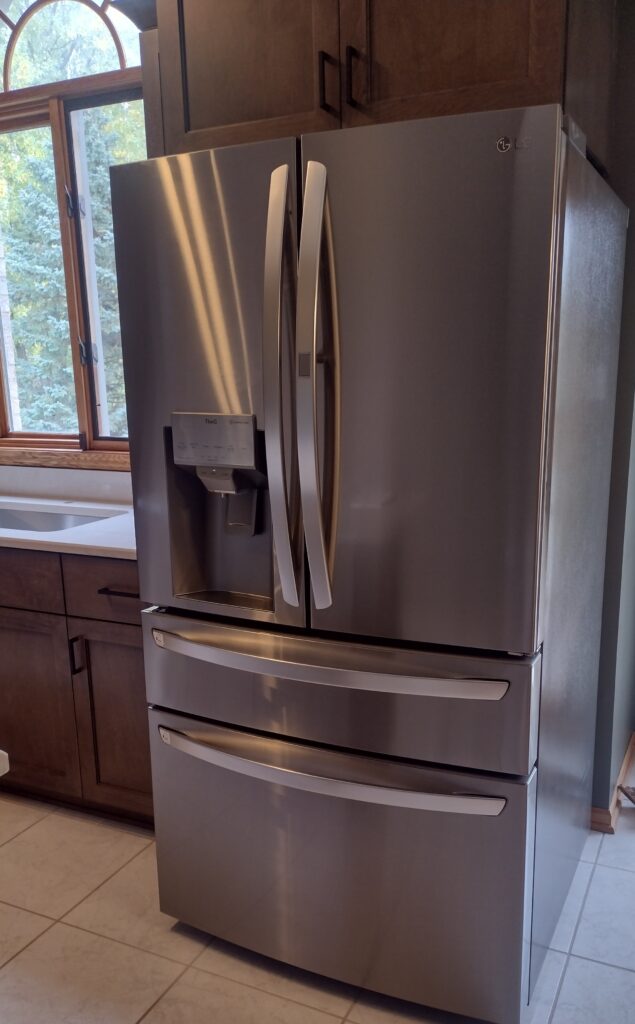
- Bathrooms – all receptacles.
- Garages – If it’s a garage receptacle, it requires GFCI protection.
- Outdoors – all exterior receptacles.
- Basements – finished and unfinished.
- Crawl spaces – at or below grade.
- Kitchens – Every receptacle installed in a kitchen—regardless of its location or what it serves—now requires GFCI protection.
- Laundry areas – washers, dryers, and all receptacles.
- Within 6 feet of sinks – measured along the cord path.
- Boathouses.
- Bathtubs and shower stalls – receptacles within 6 feet.
- Utility rooms, damp locations, and wet locations.
Kitchen Clarification (2023 NEC)
The 2023 NEC expanded kitchen requirements. Every kitchen receptacle now requires GFCI protection, including:
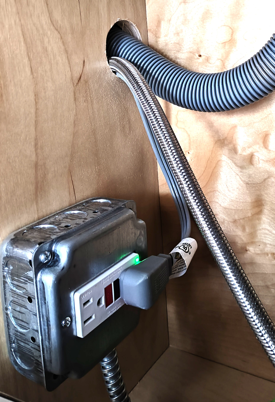
- Refrigerator outlets.
- Microwave outlets.
- Garbage disposal receptacles.
- Dishwasher outlets.
- Any wall or island receptacle.
This change alone has caused a significant increase in failed finals when installers follow pre‑2023 habits.
Garage Clarification
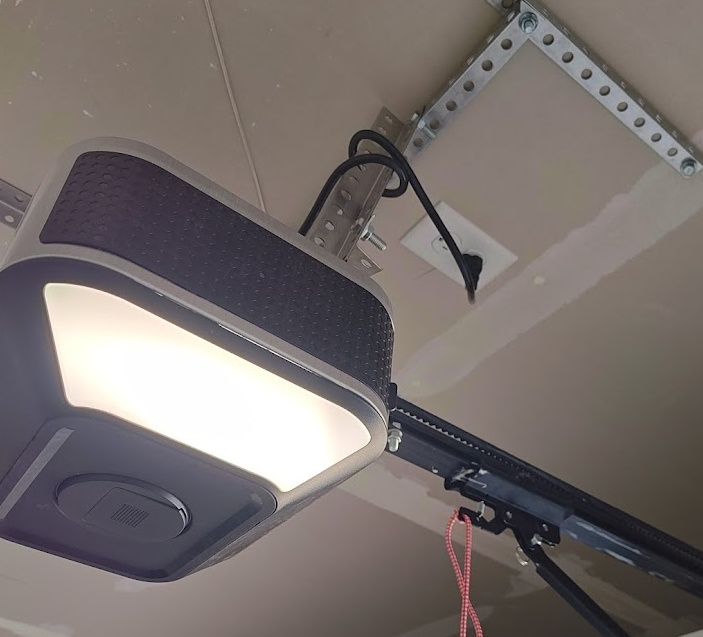
There are no exemptions in garages based on:
- Height.
- Dedicated use.
- Labeling (“for opener only”).
If it’s a garage receptacle, it requires GFCI protection.
3. GFCI Requirements for Appliances
The NEC now clearly requires GFCI protection for a wide range of appliances—even when hardwired.
Dishwashers
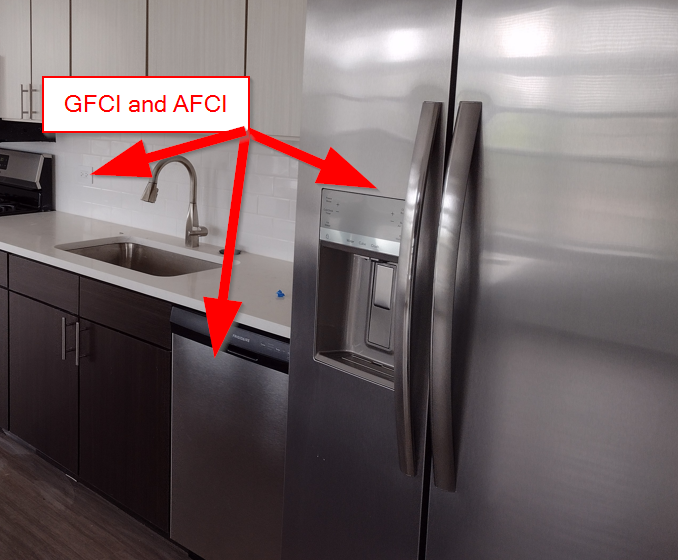
Definitions for this section:
- Receptacle: The device you plug into.
- Outlet: Any point where power is supplied to equipment—including both receptacles and hardwired connections.
All dishwashers in dwelling units require GFCI protection for the outlet that supplies them—whether that is a receptacle or a hardwired connection.
- Cord‑and‑plug (receptacle): Yes—protect the receptacle.
- Hardwired: Yes—protect the outlet supplying the dishwasher.
- Any location: Yes.
Dishwashers are covered in two code sections:
- NEC 210.8(D).
- NEC 422.5(A).
Inspectors may cite either section. Both are correct. The code intent is unambiguous—the outlet supplying the dishwasher must be GFCI protected, whether receptacle or hardwired.
Laundry Equipment
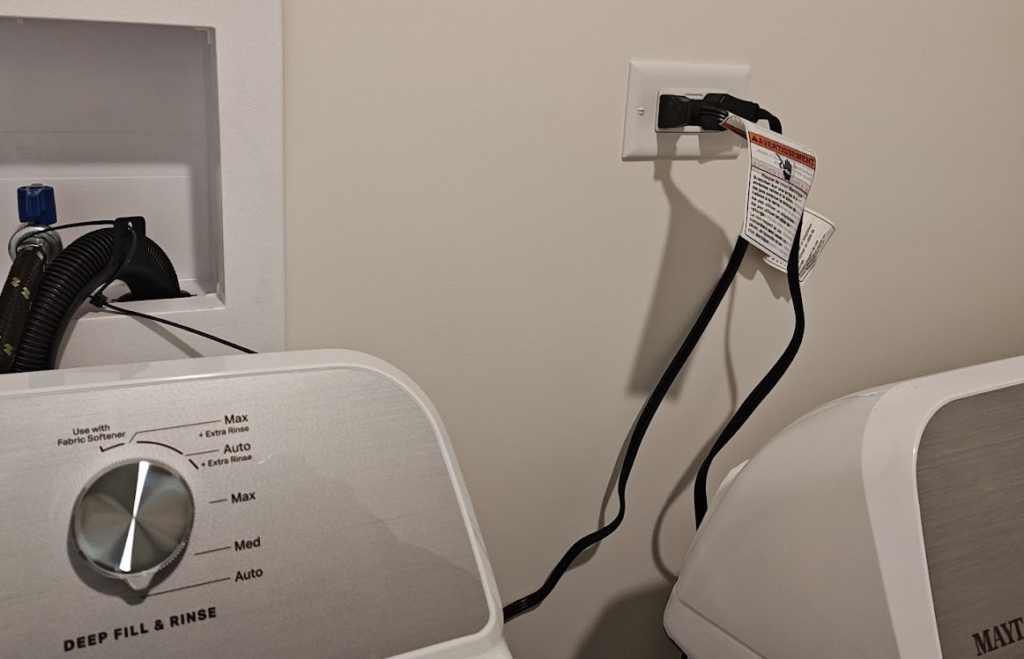
- Washing machines: The receptacle supplying a washing machine requires GFCI protection.
- Gas dryers: The receptacle supplying a gas dryer requires GFCI protection.
- Electric dryers (240V): The outlet (either receptacle or hardwired connection) supplying an electric dryer requires GFCI protection when supplied by a single‑phase system ≤150V to ground.
In standard residential panels, each leg of a 240V circuit measures 120V to ground, which places typical dryer circuits squarely inside the GFCI requirement.
GFCI Requirements for Ranges, Ovens, and Cooking Appliances (2023 NEC):
- As of the 2023 NEC (210.8(D)), GFCI protection is required for the branch circuit or outlet supplying electric ranges, wall-mounted ovens, counter-mounted cooking units, and microwave ovens—as long as they are rated 150 volts or less to ground and 60 amperes or less, whether single- or 3-phase.
- This requirement applies regardless of where these appliances are located in the kitchen or dwelling.
- Both receptacle and hardwired (outlet) connections are included.
Other Common Appliances Requiring GFCI Protection for the Outlet (2023 NEC 210.8(D)):
- Automotive vacuum machines
- Drinking water coolers and bottle fill stations
- High-pressure spray washing machines
- Tire inflation machines
- Vending machines
- Sump pumps
- Dishwashers
- Electric ranges
- Wall-mounted ovens
- Counter-mounted cooking units
- Clothes dryers
- Microwave ovens
Field rule:
If it can leak, splash, or sit near moisture, expect GFCI protection requirement for the outlet.
Accessibility Rule for Appliances
If the appliance connection is hidden or hard to reach, it is not considered accessible:
- Do not bury a GFCI device behind it.
- Use a GFCI breaker or an upstream accessible device to protect the outlet.
4. GFCI Breaker vs GFCI Device
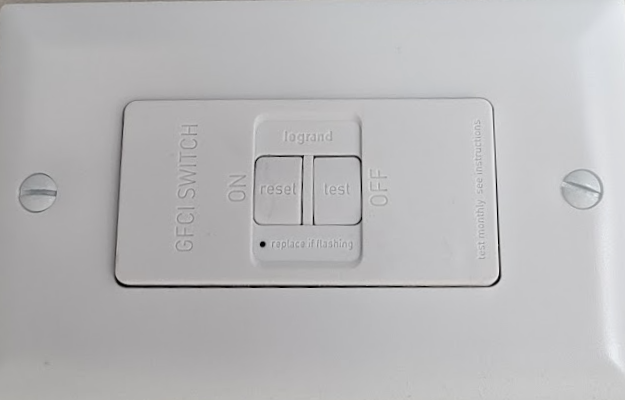
Both methods are allowed. The correct choice depends on accessibility and layout.
GFCI Receptacle
Best used when:
- The reset button is easily accessible.
- Only a limited number of downstream outlets are protected.
Industry best practice:
- Limit downstream protection to 3–4 devices to reduce nuisance tripping and simplify troubleshooting.
GFCI Breaker
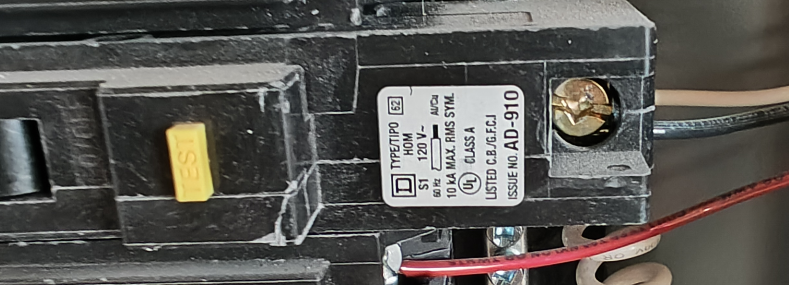
Best used when:
- To protect outlets supplying hardwired appliances.
- Receptacles behind appliances.
- Receptacles mounted on ceilings.
- Outlets difficult to reach without a ladder.
A breaker provides protection without violating the “readily accessible” rule.
Line vs Load Errors
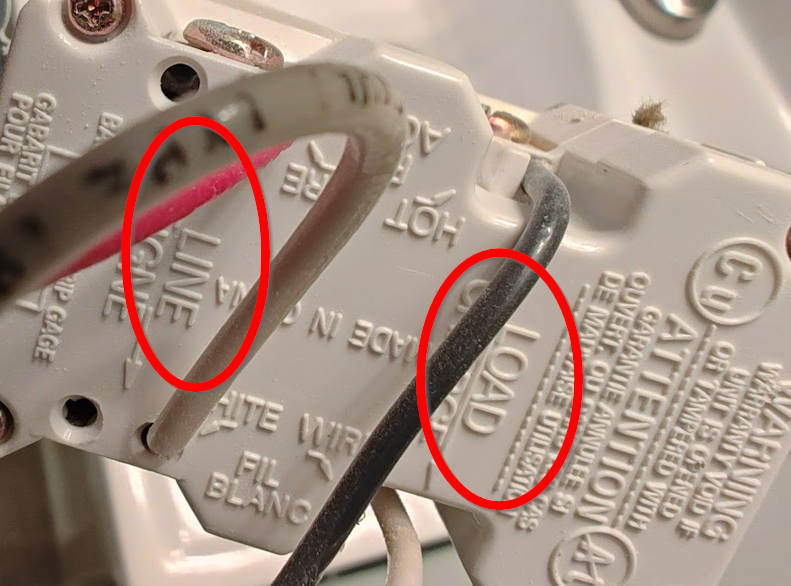
Reversing line and load terminals is one of the most common inspection failures.
A mis-wired GFCI may appear powered but provide zero downstream protection.
Always:
- Identify line conductors before removal.
- Test the load-off after installation with a GFCI tester.
5. Common GFCI Inspection Failures
Based on real‑world inspections, these are the issues that get tagged most often:
- Line/load reversed on GFCI receptacle.
- Dishwasher outlet (receptacle or hardwired) not GFCI protected.
- Laundry dryer outlet (receptacle or hardwired) missing GFCI protection.
- Garage door opener receptacle not protected.
- GFCI device mounted on ceiling or behind appliance.
- Standard breaker used where GFCI breaker is required for the outlet.
- Outdoor HVAC equipment outlet unprotected where enforced.
- Assuming older installations are automatically grandfathered.
- Electric range outlet not GFCI protected (per 210.8(D))
- Wall oven/counter cooktop/microwave oven outlet not GFCI protected
6. NEC 2020 vs NEC 2023 GFCI Changes
What Changed
- Expansion of GFCI to all kitchen receptacles (not just countertop locations).
- Explicit inclusion of specific appliances in 210.8(D), requiring GFCI protection for the branch circuit or outlet supplying them, including:
- Electric ranges
- Wall-mounted ovens
- Counter-mounted cooking units
- Dishwashers
- Clothes dryers
- Microwave ovens
- Clearer language closing prior loopholes for hardwired equipment that was previously argued as “not requiring” GFCI protection.
What Did Not Change
- The definition of “readily accessible.”
- The Class A GFCI performance requirement.
- The core location-based protection reasoning—water exposure and shock risk still drive the rules.
Existing Installations
Most AHJs do not require retroactive GFCI upgrades unless one of the following occurs:
- A branch circuit is modified or extended.
- A device or outlet is replaced.
- A remodel or alteration triggers compliance with the currently adopted NEC.
Always verify enforcement expectations with your local AHJ, especially for appliance upgrades under 210.8(D), as adoption and enforcement timing can vary.
7. GFCI vs AFCI (Brief Comparison)
- GFCI protects people from shock.
- AFCI protects structures from arc‑ fault caused fires.
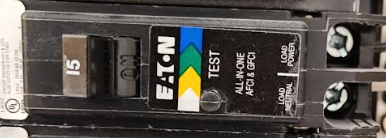
Some areas—like kitchens, laundry rooms, and finished basements—require both. In those cases, a dual‑function breaker is typically the cleanest solution.
8. Field‑Level Takeaways
- GFCI is location‑driven, not convenience‑driven.
- Accessibility matters just as much as protection.
- Dishwashers and laundry equipment are no longer optional.
- Garage outlets have zero exemptions.
- Ceiling‑mounted GFCI resets fail inspection.
- Breakers solve many accessibility problems.
- Test everything before calling for final.
If you walk a jobsite thinking like an inspector, you’ll catch almost every GFCI issue before it costs time or money.
Common Field Confusion Points: Where Pros and DIYers Get Tripped Up
- Do all dishwashers need GFCI?
- Yes—plug-in or hardwired, any location.
- Does a laundry area need GFCI if there’s no sink?
- Yes—sink presence does not matter.
- Do 240V dryers need GFCI?
- Yes, in typical residential single-phase systems, protection is required for the outlet (receptacle or hardwired).
- Do electric ranges, wall ovens, cooktops, or microwave ovens need GFCI?
- Yes—as of 2023 NEC 210.8(D), the branch circuit or outlet supplying electric ranges, wall-mounted ovens, counter-mounted cooking units, and microwave ovens must be GFCI protected if rated 150 volts or less to ground and 60 amperes or less.
- Do garage door opener outlets need GFCI?
- Yes—no height or “dedicated use” exemption exists.
- Can a ceiling-mounted opener outlet be on the required garage circuit?
- No. Required garage circuits only serve vehicle-bay outlets at or below 5½ feet.
- Is a ceiling-mounted GFCI acceptable?
- No. It is not readily accessible.
- Does “hardwired” mean exempt?
- No. The code applies to both receptacle and hardwired outlets supplying appliances.
- Can old wiring methods still pass?
- Only if untouched and accepted by the AHJ. New work must meet current code..