

Wondering how to read a plumbing schedule on construction plans?
If you’ve ever stared at the plumbing detail sheet in a set of construction drawings and wondered, “What’s all this spaghetti?”—you’re not alone. Let’s break down what these diagrams really show, why they matter, and how to read the symbols, schedules, and callouts like a pro.
Want to see how foundations get detailed? Read How to Read a Foundation Plan (Without Missing What Really Matters)
1. How to Read a Plumbing Schedule on Construction Plans Example: What to Look For
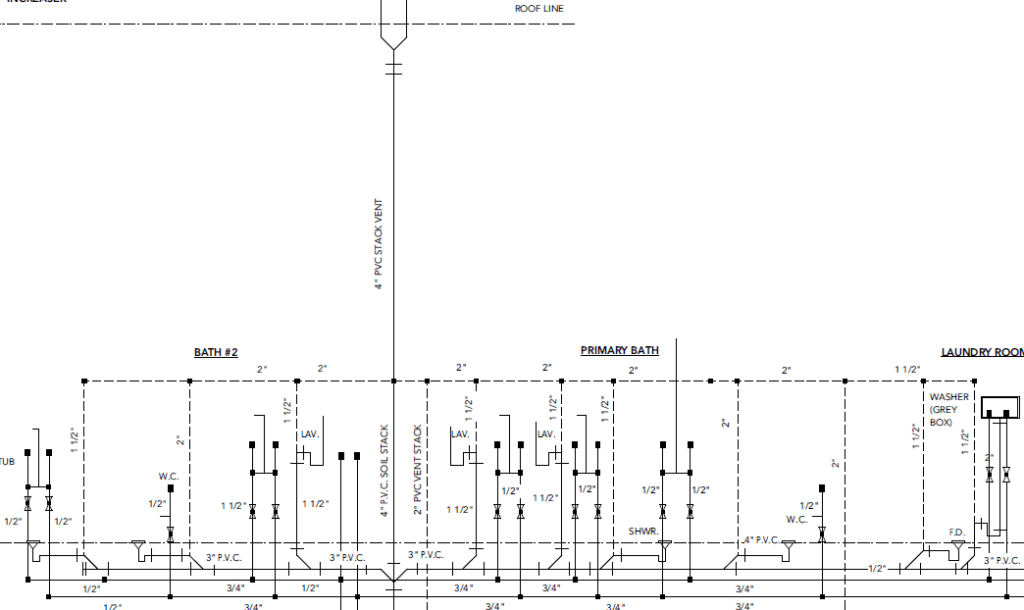
The sample sheet is a real-world Plumbing Soil, Waste, Vent & Water Diagram for a new two-story single-family home. You’ll see:
- Main stacks and branch lines—usually thick solid lines for drains, dashed or lighter for vents.
- Callouts for pipe material and size (e.g., “3″ PVC,” “1/2″ supply”).
- Fixture symbols—toilets (“W.C.”), lavatories (“Lav.”), showers (“SHWR”), washers (“WASH”), etc.
- Connection to main sewer—often via a 4″ PVC drain, with sump and ejector pits in the basement.
- Grey box detail—the washer box, showing supply and waste connections.
- Valves and special notes for things like backflow preventers, air chambers, and shutoffs.
Key takeaway:
You’re seeing a map of how every sink, tub, toilet, washer, and floor drain gets water and loses waste. Each symbol ties back to a fixture on the schedule.
2. Understanding the Plumbing Fixture Schedule
how to read a plumbing schedule on construction plans example

It’s basically a legend that tells you what each tagged item on the plan actually is…included on this print:
- KS-1: Kitchen Sink
- Manufacturer: Kohler
- Model: K-3148
- Notes: Faucet K-6131-3
- WC-1: Tank-Toilet
- Manufacturer: Kohler
- Model: K-03386
- Notes: 1.28 gal flush
- LAV-1: Lavatory
- Manufacturer: Kohler
- Model: K-2196
- Notes: Faucet K-454-4S
- SHWR-1: Shower
- Manufacturer: Kohler
- Model: K-13131
- Notes: Head K-10284
- TUB-1: Bathtub
- Manufacturer: Kohler
- Model: K-1246
- Notes: Faucet K-16246
Want to verify exactly where GFCIs are required by code?
For a field-ready guide to passing your GFCI and AFCI inspections—including the latest code updates—check out my book
3. The Diagram: Reading the Layout

What you’ll see in this type of layout:
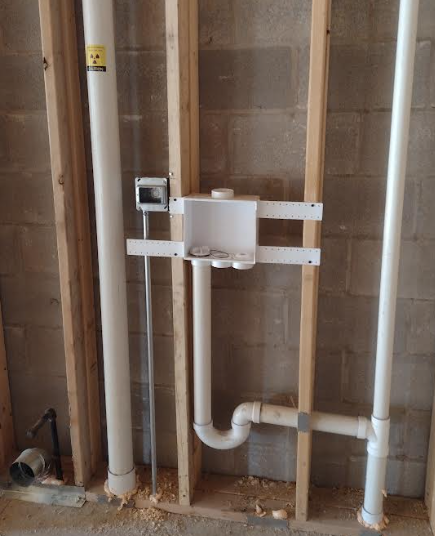
- Laundry box detail—Shows a washer “grey box” with hot/cold supply, 2″ waste line, and shutoff valves. This is where your washing machine connects.
- Supply and waste piping—1/2″ copper lines (hot/cold) running to the laundry box; 2″ PVC waste drops into the main drain system.
- Trap and venting—A 2″ PVC P-trap held close to the floor, properly vented as shown by the dashed lines—critical for preventing sewer gas backup.
- Ejector pit connection—Below-grade waste drains into an ejector pit, with 2″ discharge line, gate valve, and check valve, then pumped to the main 4″ PVC sewer.
- Key callouts and dimensions—Finished height (42″) for the box, pipe lengths, and sweat connection details called out for field installation.
- Accessible shutoffs and fittings—All valves, connections, and the ejector lid are clearly labeled for inspection, making it easy to verify in the field..
Key takeaway:
This layout doesn’t just show where pipes go—it details every critical connection, valve, and fitting for your laundry and below-grade drain system. If you’re roughing in a basement, this is the inspection roadmap: get the heights, pipe sizes, and valve locations right, and you’re on your way to a clean sign-off.
4. Reading the Notes, Materials, and Installation Details

The plan is loaded with notes. Here’s what to look for (and why it matters):
- Pipe Slope:
- Material Callouts:
- Soil/waste lines: Schedule 40 PVC
- Vents: Schedule 40 PVC
- Water supply: Type “L” copper (above grade)
- 2018 IRC Table P2906.4
- Shutoff Valves:
- Required at every fixture, sillcock, and major appliance
- Must be accessible and labeled
- 2018 IRC P2903.9.3
- Air Chambers:
- Water hammer arrestors required at plumbing fixtures (see notes for specifics)
- 2018 IRC P2903.5
- Trap Details:
- Example: 2″ P-trap for washer drain, close to floor
- 2018 IRC P3201
5. Symbols and How to Cross-Reference
- Circle with letter/number: Fixture tag (ties back to schedule)
- Solid lines: Usually drains/waste
- Dashed lines: Often vents (verify in plan legend)
- Squares/boxes: Washer box (“grey box”), mechanicals, sump/ejector pits
General Code & Field Points: What Matters for Everyone
- Boring and Notching:
- Support of Piping:
- Pipes must be supported per code (spacing, hangers, etc.)
- 2018 IRC Table P2605.1
- Cleanouts:
- Required at base of every soil stack, and at direction changes >45°
- 2018 IRC P3005.2.9
- Water Heater & Relief:
- Temperature/pressure relief valve required, must discharge to safe location
- 2018 IRC P2804.6.1
Why Plumbing Codes Differ: State/Local Rules
- Plumbing codes are state-adopted:
- This plan is based on the 2006 IPC (Indiana) with state amendments, but many areas use the IRC or UPC, each with their own rules. Always check your local code—what’s legal in one state could be a violation in another.
Conclusion
If you want to get comfortable reading plumbing plans, start by following the diagram from the main stack to each branch, referencing tags against the schedule, and cross-checking every note against code. Remember: plumbing codes aren’t one-size-fits-all. Most places require a licensed plumber to inspect or sign off, but anyone can learn to read the “roadmap” that is the plumbing plan.
Want more real-world plan reading and inspection tips? Check out my full blueprint reading series on Building Code Geek—where we take code from the books and bring it to the jobsite.