Kitchen receptacle spacing is critical for passing inspection and safe, code-compliant kitchens. Here’s how NEC 210.52(A) applies in the real world—whether you’re rewiring an older kitchen, tackling a new build, or just trying to make your inspection go a little easier. NEC 210.52(A) is the core rule behind most outlet layout fails I see in the field. This guide breaks it down step by step, from kitchen counters to general wall spaces, so you can pass inspection and actually enjoy using your kitchen.
Why Does Receptacle Spacing Matter?
Here’s what’s tripping up contractors, DIYers, and homeowners again and again:
- Missed outlets behind counter appliances: Easy to skip, but the code doesn’t care—spacing still applies.
- Overloaded outlets: Too few circuits or poor spacing means toasters, air fryers, and coffee pots are sharing a single plug.
- Existing homes with older layouts: Kitchens built before the NEC’s modern rules rarely have enough outlets, which shows up fast when you update the space.
- Doorways and wall breaks ignored: It’s easy to forget that walking through a door resets your measurement for the next 6-foot/12-foot rule.
Kitchen Receptacle Spacing Rules (NEC 210.52(A))
Proper kitchen receptacle spacing ensures you’ll pass inspection.
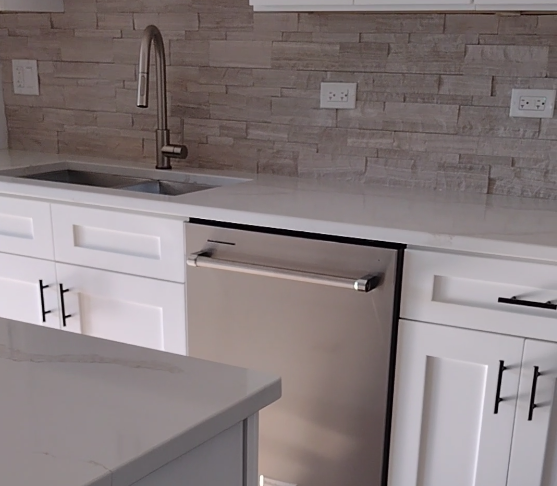
- Every point along a countertop wall line must be within 24 inches of a receptacle.
- If you place a tape at any spot on the wall behind your counter, you shouldn’t have to reach more than 24″ left or right to find an outlet.
- Any counter wall space 12 inches or wider requires a receptacle.
- That includes awkward stubs, breakfast nooks, or any continuous section behind a counter.
- Behind sinks, cooktops, or ranges:
- if the space behind is less than 12 inches wide (on a straight wall) or less than 18 inches wide (in a corner), as shown in NEC figures. Those areas are exempt from the wall line and do not require a receptacle. But any counter area not meeting both those conditions must be served.
Small-Appliance Branch Circuit Rules (NEC 210.52(B), 210.11(C)(1))
- Two or more 20-amp small-appliance branch circuits are required for kitchens, pantries, breakfast rooms, and dining areas.
- These circuits can only serve wall and countertop receptacle outlets in those rooms.
- No lights, dishwashers, or disposals allowed on these circuits.
- Each outlet covered by these rules must be supplied by at least one of the required circuits—no sharing with non-kitchen loads.
- Appliance outlets (for refrigerators) can be supplied by these branch circuits, unless otherwise permitted: Exception No. 2: a receptacle outlet to serve a specific appliance shall be permitted to be supplied from an individual branch circuit rated 15 amperes or greater.
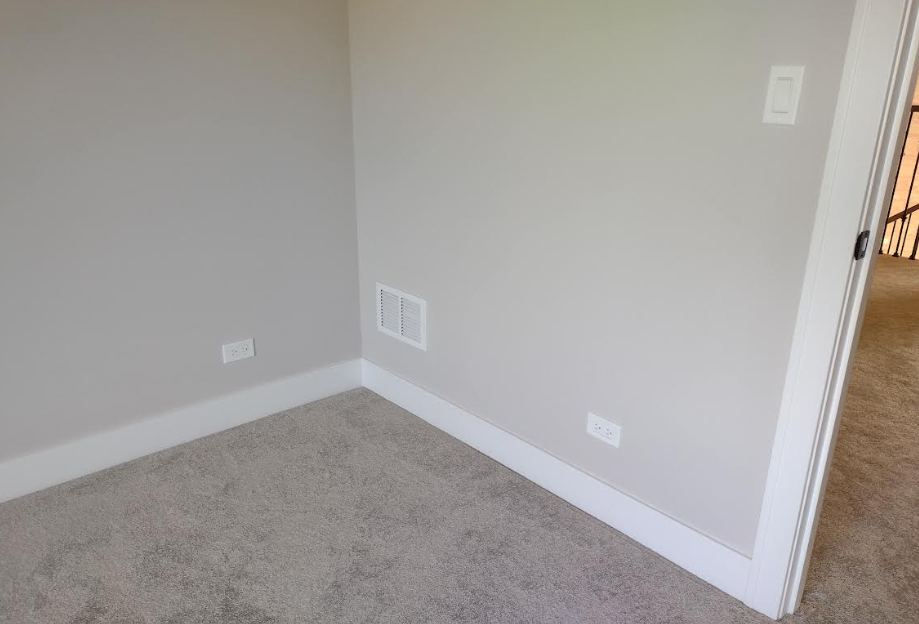
General Wall and Kitchen Receptacle Spacing: NEC 210.52(A) Overview
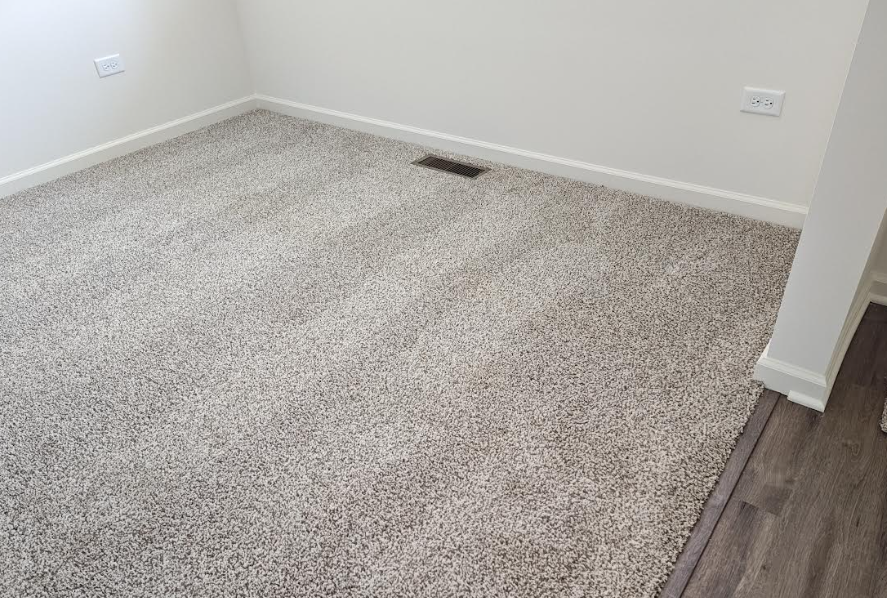
Here’s how it really works:
- Kitchen Counter – Maximum spacing between outlets:
- The absolute farthest you can space two receptacles apart is 48 inches (center to center). Picture yourself standing in the middle:
- ➤ You should never have to reach more than 24 inches left or right to find an outlet.
- The absolute farthest you can space two receptacles apart is 48 inches (center to center). Picture yourself standing in the middle:
- General wall spacing – 6-foot/12-foot rule—what it means:
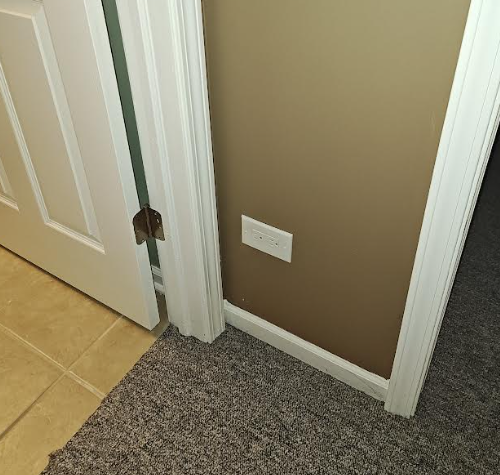
- As you walk any wall, you need to install outlets so that no spot along the floor line is ever more than 6 feet away from a receptacle.
- That means, starting at a doorway or wall break, put your first outlet within 6 feet, and every outlet after that no more than 12 feet apart.
- If you’re standing facing anywhere along the wall, you should be within 6 feet of a receptacle—no exceptions.
- As you walk any wall, you need to install outlets so that no spot along the floor line is ever more than 6 feet away from a receptacle.
- Why the code does this:
- This keeps people from running extension cords across a room or over walkways, which is an obvious safety risk. The goal is to have a receptacle close by wherever you might need one.
- How to measure it in the field:
- Start at any doorway or opening where the wall starts.
- The first receptacle must be within 6 feet of the starting point.
- After that, the maximum distance between outlets is 12 feet—so from any spot facing the wall, you should never be more than 6 feet left or right from a receptacle.
- Start at any doorway or opening where the wall starts.
- Minimum wall section:
- Any wall space that’s at least 2 feet wide gets a receptacle. If the wall is less than 2 feet, you can skip it.
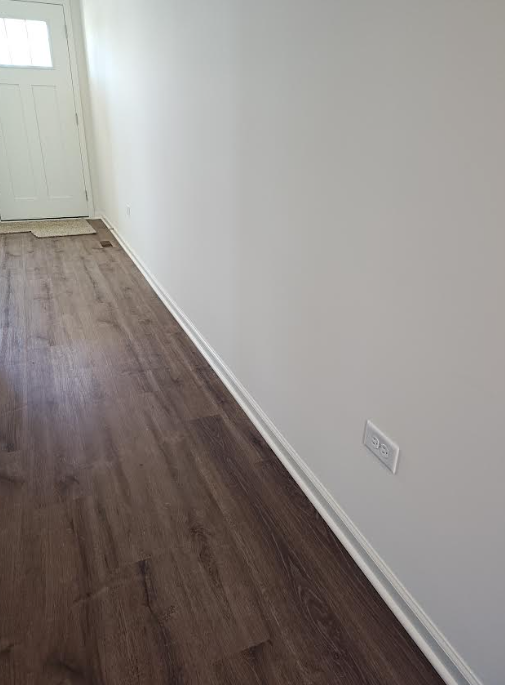
- Hallway receptacle:
Any hallway that is 10 feet or longer (measured along the centerline) must have at least one receptacle outlet.
Common Mistakes and Field Tips
- If in doubt—use a tape measure. Inspectors (and code) won’t accept “close enough.”
- Don’t skip the tiny wall sections. That little stub wall next to the pantry or at the end of a counter? If it’s 12″ or more (kitchen) or 2′ or more (general walls), it needs an outlet.
- Update receptacle spacing in a remodel. If you’re pulling permits for a kitchen update, most AHJs will require all spacing and circuit requirements to meet current NEC—no grandfathering the old layout unless the AHJ explicitly allows it.
FAQs and Real-World Scenarios
Q: Does the 24” countertop rule apply around sinks and cooktops?
A: The 24″ spacing rule does not apply directly behind a sink, cooktop, or range if the space behind is less than 12 inches wide (on a straight wall) or less than 18 inches wide (in a corner), as shown in NEC figures. Those areas are exempt from the wall line and do not require a receptacle.
For all other countertop wall spaces—including areas 12″ or more (straight wall) or 18″ or more (corner)—the standard 24″ spacing rule applies continuously along the counter.
Q: What about when I walk into a room through a door?
A: The code treats the wall space as starting fresh at each doorway. As you enter a room, you must place a receptacle within 6 feet of the door opening on each usable wall, and continue the 12-foot maximum spacing from there. Each break (door, archway, window to floor, etc.) starts a new measurement—so you never go more than 6 feet from a break without an outlet, and never more than 12 feet between outlets on a wall.
Q: Can I combine lights or appliances with my kitchen small-appliance circuits?
A: No. The two (or more) required 20A circuits serving kitchen/breakfast area receptacles can’t be shared with lighting, dishwashers, or disposals, except for specific allowances by your AHJ.
Inspection Checklist (for Contractors, DIYers, Homeowners)
- All kitchen counters 12”+ wide have an outlet—no exceptions.
- No point along any kitchen countertop wall line is more than 24” from a receptacle.
- At least two 20A small-appliance circuits serve all kitchen wall and counter outlets—nothing else.
- All general wall spaces follow the 6’/12’ rule and 2’ minimum wall section.
- If you’re unsure about a wall space, measure and/or ask your local AHJ.
Range Hood and Over-the-Range Microwave Outlet: What the Code Requires
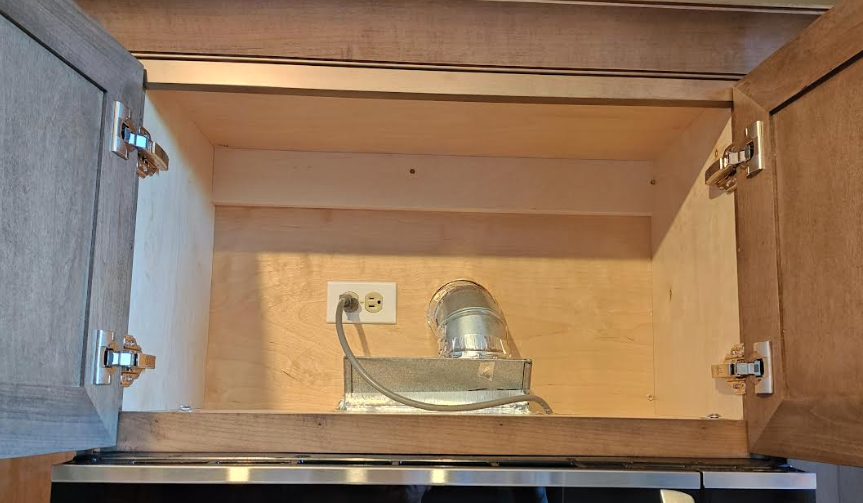
When it comes to range hoods or microwave/hood combos, the code is clear—but it’s also easy to miss details that can cause an inspection fail or require a costly re-do. Here’s the breakdown in contractor/DIY-friendly terms:
If your range hood or microwave/hood is listed for a cord-and-plug connection, NEC 422.16(B)(4) allows it—if you follow these five rules:
- Cord length:
- The cord must be at least 18 inches and no longer than 4 feet.
- Receptacle location:
- The outlet must be installed where it protects the cord from physical damage (usually inside the upper cabinet directly above the appliance).
- Circuit type:
- The receptacle must be supplied by an individual branch circuit—not shared with other kitchen outlets, not tapped off a small-appliance circuit.
- This means the receptacle for a cord-and-plug connected hood or microwave/hood combo must have its own dedicated circuit from the panel, with nothing else connected to it.
- For hardwired range hoods: The circuit must comply with manufacturer instructions and NEC requirements for fixed appliances—but does not require an individual (dedicated) branch circuit unless specified by the manufacturer.
- Accessibility:
- The cord-and-plug receptacle has to be accessible (not buried behind drywall or inaccessible after installation).
- Grounding:
- The cord must include a ground wire and a grounded plug, unless the appliance is double-insulated and marked as such by the manufacturer.
Bottom Line:
If your range hood or microwave/hood combo is cord-and-plug connected, you must provide an accessible, dedicated receptacle on its own individual branch circuit, with the correct cord length and grounding. Ignore this, and you’ll have an inspection fail every time.
Want to know if your dishwasher needs GFCI protection under the 2023 NEC? Check out my in-depth post, Does Your Dishwasher Require GFCI Protection Now? for the latest requirements, code clarifications, and field inspection tips.
Check out my book, Pass the Inspection: A Field Guide to GFCI & AFCI Code Requirements. It’s packed with real-world code breakdowns, easy checklists, and field-tested tips for contractors, inspectors, and serious DIYers.
Get it on Amazon here.