
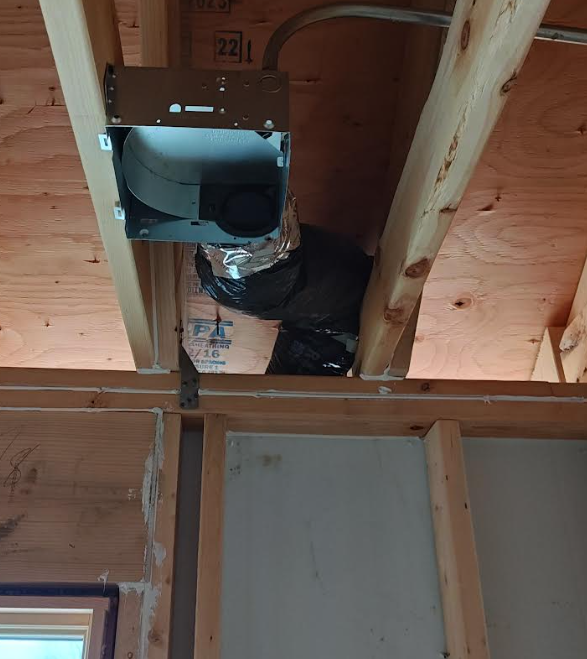
Bathroom exhaust fan code requirements aren’t just technical—they’re one of the most commonly failed details on inspections, especially for remodels and fan replacements.. If you want to pass inspection the first time, you need to know exactly why the code requires bathroom exhaust fans to vent directly outdoors—and what will get flagged in the field.
If you’ve ever found a bath fan dumping humid air into the attic—or spliced together with another duct—you’re seeing a code violation that’s still showing up on remodels and fan replacements today. Here’s exactly what the code says, how to pass inspection, and what gets flagged.
Bathroom Exhaust Fan Code Requirements: What the IRC Actually Says
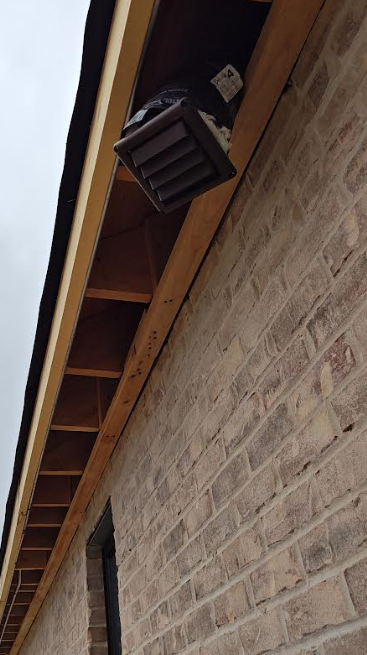
Understanding bathroom exhaust fan code requirements helps avoid the most common inspection fails
- Bathroom exhaust must discharge directly outdoors.
- IRC M1501.1 (2021 IRC):
- “The air removed by every mechanical exhaust system shall be discharged to the outdoors in accordance with Section M1504.3. Exhaust air shall not be discharged into an attic, soffit, ridge vent or crawl space.”
- This defines the outdoor discharge requirement for each exhaust system.
- If you change, replace, or reroute a fan, the new work must meet current code.
- IRC R102.7:
- “The legal occupancy of any structure existing on the date of adoption of this code shall be permitted to continue without change, except as is specifically covered in this code or as is deemed necessary by the building official for the general safety and welfare of the occupants and the public. Additions, alterations or repairs to any structure shall conform to that required for a new structure without requiring the existing structure to comply with all of the requirements of this code…”
- All new work must meet current code.
- Each fan must have its own duct terminating outside (implied).
- IRC M1501.1 and M1505.2 do not explicitly prohibit joining multiple bathroom fans into one duct in single-family homes, but these sections are interpreted by many inspectors and jurisdictions to mean each fan must have its own dedicated duct terminating outdoors, to prevent cross-contamination and ensure proper function. This is an implied requirement in code language, and enforcement may vary by local AHJ. Always follow manufacturer instructions and check with your local code official.
- It’s OK to vent through the soffit if the duct runs continuously to a trim that terminates on the exterior face of the soffit. The key is that the exhaust air exits the building envelope—not into the soffit cavity or attic. Inspectors are looking for a weatherproof vent cap, trim, or hood at the termination.
- No discharging into the attic, soffit cavity, or any concealed space.
- The exhaust must exit the building envelope as specified by IRC M1501.1.
- No discharging into the attic, soffit cavity, or any concealed space.
- UL Listing required for exhaust air ducting.
- All exhaust air ducting must be listed and labeled in accordance with UL 181 for Class 0 or Class 1 air ducts and connectors, as specified in IRC M1506.1. Flexible ducts must be UL 181–listed for the intended application

Minimum CFM Requirements for Bathroom Exhaust Fans
- Minimum airflow for mechanical ventilation:
- IRC Table M1505.4:
- Intermittent operation (on/off): 50 cfm minimum
- Continuous operation: 20 cfm minimum
The required airflow must be delivered at the point of discharge (after duct losses). Applies to bathrooms and toilet rooms per the “Local Exhaust Rates” table.
Bath Fan Duct Installation: Field Checklist
- Are you meeting all bathroom exhaust fan code requirements for vent location, duct material, and length?
- Is the fan duct run as straight as possible?
- (Follow manufacturer instructions, and check Table M1504.2 for maximum allowable length based on duct type, size, and fan CFM. There is no specific “straight as possible” language for bath exhaust in the IRC, but minimizing run and bends improves performance and helps meet code airflow at discharge.)
- Are you using the right duct material?
- (Bathroom exhaust duct material must comply with Section M1504.1: duct must be of approved material as permitted by the code and manufacturer. Listed and labeled flexible ducts per UL 181 are allowed if installed per Table M1504.2 and the duct manufacturer’s instructions.)
- Are all joints sealed with foil tape or approved mastic?
- (Always follow manufacturer and code requirements for sealing all connections.)
- Is the exhaust duct securely supported and not sagging?
- (Check manufacturer requirements and best practices to avoid low spots or disconnected runs.)
- Is the vent cap/trim installed and weatherproof?
- (Make sure exterior terminations have proper hoods or covers—IRC M1501.1.)
- Does the duct terminate at least 3 feet from windows, doors, or other intake vents?
- (IRC M1506.2; check local amendments for any stricter distances.)
- Is the duct length compliant with IRC Section M1505 and Table M1504.2, and within manufacturer requirements?
- Always check Table M1504.2 for maximum allowable length based on your fan’s CFM, duct size, and duct type. Many manufacturers require much shorter maximum lengths than the code allows, so you must follow the most restrictive requirement.
- Are you following both manufacturer installation instructions and code requirements?
- (Never assume local code is less strict than the manufacturer—use whichever is most restrictive.)
- Did you confirm no duct is combined with another?
- (Each fan vents independently outdoors per implication of M1501.1 and M1505.2.)
Pro Tips for Passing Inspection
- When in doubt, make a sketch of your planned vent route and ask your inspector before you start.
- Always tape seams and joints—inspectors see more failed ducts due to loose, leaky connections than anything else.
- Check the fan’s installation manual for required duct types and maximum lengths, and stick to those limits even if local code is more relaxed.
- If you’re replacing an old fan that vented improperly, the new fan and duct must bring the system up to current code.
Bathroom Exhaust Fan Code Requirements: What You Need to Know
Q: What are the 2021 IRC bathroom exhaust fan code requirements?
A: Bathroom exhaust fan code requirements include direct outdoor venting (M1501.1), UL 181–listed duct (M1506.1), and meeting the minimum CFM from Table M1505.4.
Q: Can a bathroom fan vent into the attic or just under the roof deck?
A: No. IRC M1501.1 requires all exhaust air to discharge outdoors—never into an attic, crawlspace, or enclosed soffit.
Q: Can I combine two bathroom fans into one duct?
A: The IRC does not explicitly forbid, but code implies it in single-family homes and M1501.1 and M1505.2 are interpreted by most inspectors to require independent ducts for each fan.
Q: Is it OK to vent a bath fan through the soffit?
A: Yes, if the duct extends all the way to the exterior face of the soffit and terminates in a proper vent hood or trim. Simply ending the duct in the soffit cavity or attic is not allowed. (IRC M1501.1)
Q: What about flex duct—are there length limits?
A: Duct length must follow IRC Table M1504.2 and Section M1505, but many manufacturers require even shorter runs for their products. Always follow the most restrictive requirement.
Q: What if I’m just replacing a fan in an older house?
A: Any new work must comply with current code (R102.7)—even in existing homes. If you change the venting, you must upgrade the system to discharge outdoors using an approved method.
Q: What’s the minimum airflow my bathroom exhaust fan needs to deliver?
A: At least 50 cfm for intermittent operation or 20 cfm for continuous operation. (IRC Table M1505.4)
Q: What’s required for exhaust air duct listing?
A: All exhaust air ducts and connectors must be UL 181–listed as Class 0 or Class 1 per IRC M1506.1.
For a detailed breakdown of basement egress‑window wells—including sizing, ladder requirements and how the International Residential Code covers them—see my post Basement Window Well Requirements: What the IRC Says About Egress
Want more real-world code answers and inspection tips?
Check out my book, Pass the Inspection: A Field Guide to GFCI & AFCI Code Requirements. It’s written for inspectors, contractors, and serious DIYers who want to pass the first time—packed with code references, field photos, and exactly the kind of advice you see here.
Get your copy on Amazon