
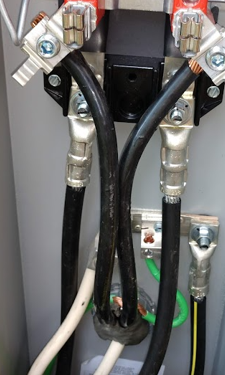
Raceway seal code requirements are some of the most commonly misunderstood areas in electrical inspections. If you’re running conduit outdoors, under slabs, or through cold-storage walls, it pays to know exactly what NEC 225.27 and 300.5(G) require—and why the wrong sealant can come back to haunt you at inspection.
2023 NEC Updates for Raceway Seal Code Requirements
2020 NEC 225.27:
Where a raceway enters a building or structure from outside, it shall be sealed. Spare or unused raceways shall also be sealed. Sealants must be identified for use with cable insulation, conductor insulation, bare conductor, shield, or other components.
2023 NEC 225.27:
Where a raceway enters a building or structure from outside, it shall be sealed in accordance with 300.5(G) and 300.7(A). Spare or unused raceways shall also be sealed. Sealants must be identified for use with cable insulation, conductor insulation, bare conductor, shield, or other components.
What changed?
The 2023 NEC didn’t add new sealing requirements, but it now explicitly says that when you seal a raceway entering a building, you must do it according to the rules in 300.5(G) (moisture entry) and 300.7(A) (condensation at temperature changes). This makes it clear you need to apply both standards—not just any seal. The core requirement for using a sealant “identified for use with conductor insulation” remains unchanged.
Why Lots of Installers and Inspectors Get Tripped Up

- “Seal at one end or both?”
- The code says “either or both.” Some AHJs insist you seal both entry and termination, others only the building entry. Check with your AHJ.
- Not all sealants are equal.
- Sealant must be identified for use with conductor/cable insulation. That means the packaging or documentation must back it up—not just “what we’ve always used.”
- Condensation ≠ Leaks.
- Warm air migrating into a cold raceway (walk-in cooler, freezer wall, unheated space) can condense, drip, and corrode. That’s why 300.7(A) exists.
- Unused (or spare) raceways count.
- A stub running from underground into a panel, even if empty, is a path for moisture, vapor, or gas—so NEC treats it just like a in-use conduit.
- Spray foam or “pink foam” confusion.
- Most DIY or home-center spray foams are not listed for electrical use and can degrade insulation over time due to solvents or incomplete curing inside the raceway.
In practice, I always sealed at the point where the raceway entered the building—not at both ends. My thinking was sealing both ends could trap moisture inside the conduit, especially with underground runs or big temperature swings. This isn’t spelled out directly in the Code, but it’s consistent with common industry practice. That said, the code allows sealing at either or both ends—so this is a judgment call you’ll have to make in the field, based on your site conditions and local AHJ’s expectations.
Can You Use Duct Seal? What About Pink Foam?
- Duct seal is popular because it’s pliable, easy to work with, and widely used for box entries, stub-ups, and raceways. However, most duct seals do not include documentation stating they are identified for use with conductor insulation inside a raceway—so don’t assume it will satisfy every inspector or project spec.
- Spray foam or “pink foam” may look sealed, but unless it’s listed for electrical use, it’s not code compliant and may damage insulation and fail over time.
- Spare or empty conduits must be sealed—not just the active ones.
- For jobs with humidity or big temperature swings (walk-in freezers, outdoor runs), proper sealant choice and placement are critical to avoid water, insulation, and equipment problems.
Raceway Seal Code Requirements: What’s Required for a Code-Compliant Raceway Seal
When you’re sealing a raceway that enters a building or structure from outside—or capping a spare/unused raceway—the NEC requires you to use a sealant that is “identified for use with cable insulation, conductor insulation, bare conductor, shield, or other components.” That means it should be tested and recognized as safe for permanent contact with the wiring and components inside the raceway.
If you’re working on a project where documentation or strict compliance is critical (such as engineered jobs, government contracts, or locations with demanding AHJs), check the manufacturer’s spec sheet and verify that the sealant is explicitly identified for this use. If you’re looking for a fully code-compliant, easy-to-document product, Polywater FST Foam Duct Sealant is UL listed for raceway sealing and approved for conductor insulation contact.
Looking for the real NEC requirements on portable generator bonding and grounding? Check out my full breakdown here: Portable Generator Bonding & Grounding: What the NEC Actually Says
Real-World Confusion Points

- Duct seal might pass inspection on typical jobs, but without documentation for conductor insulation, it may not actually meet the NEC requirement.
- Spray type foam not listed for electrical use may cure improperly or degrade insulation.
- Don’t overlook spare/empty conduits—these must be sealed like active raceways, especially in basements, cold storage, and outdoor runs.
- In extreme temps or humidity (walk-in freezers), a bad seal can quickly cause condensation, insulation breakdown, and even equipment failure.
Advice From the Field: Raceway Seal Code Requirements
- Always use a sealant that’s identified for electrical raceways—never substitute generic foam or unlisted products.
- Treat all stub-ups and spare conduits as live: seal at warm space entry points (and exit if required by your AHJ).
- For walk-in freezers, coolers, or cold-storage, focus the seal at the transition between warm and cold zones to control condensation.
- Keep documentation—spec sheets or UL listing—in your permit package for reference if required.
- Before you install, check: Does the sealant specifically say it’s for use with conductor insulation in raceways? If not, or if you can’t verify it, choose a product that does.
Pass the Inspection: A Field Guide to GFCI & AFCI Code Requirements
Need a straight-shooting reference for GFCI and AFCI code requirements? My field guide is written for electricians, contractors, and inspectors who want clear answers and practical tips for passing real-world inspections: Pass the Inspection A Field Guide to GFCI & AFCI Code Requirements
Laundry Area GFCI & AFCI Requirements Checklist (2020 & 2023 NEC)
Need a quick, code-accurate reference for your next laundry area install or inspection? Download my field-tested GFCI & AFCI Requirements Checklist from Payhip—built for both 2020 and 2023 NEC. Keep it handy on your phone or print it out for your toolbox—perfect for walk-throughs, punch lists, and on-the-job double-checks.