
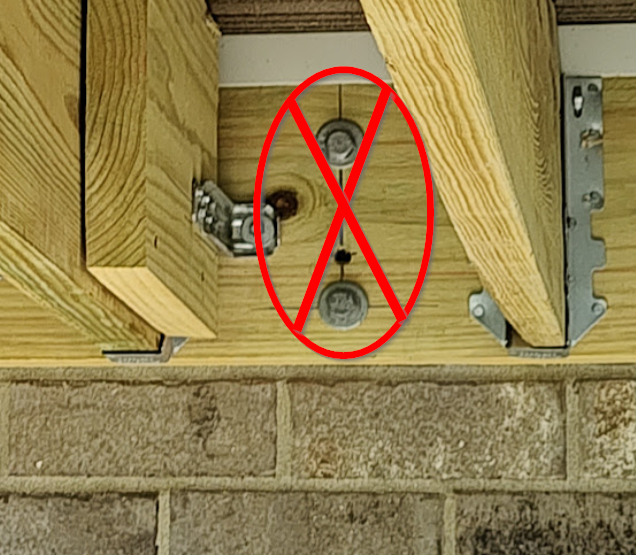
Understanding the IRC Structural Connection Requirement
A deck ledger attached to brick veneer is a condition that frequently fails inspection. The IRC deck ledger provisions assume the ledger connects directly to structural framing, typically the band joist, not exterior cladding systems such as brick veneer.
It looks secure. The bolts are tight. The ledger is flush to the wall.
But under the International Residential Code, that connection does not follow the prescriptive deck ledger provisions.
Understanding why requires looking at how the IRC actually evaluates ledger connections.
The IRC Prescriptive Method for Deck Ledgers
Under the 2021 International Residential Code, deck ledger attachment is addressed in:
IRC Section R507.9 – Deck Ledger Connection.
The prescriptive method is built around one structural assumption:
The ledger attaches directly to the band joist of the dwelling.
The prescriptive fastener spacing is established in:
Table R507.9.1.3(1) – Deck Ledger Connection to Band Joist
This table provides maximum spacing for lag screws or bolts based on:
- joist span
- design loads
- sheathing thickness
For example, under a 40 psf live load, a ledger supporting a 10-foot joist span may use lag screws spaced 18 inches on center.
Those values assume the fasteners are installed directly into the structural band joist.
Fastener Placement Requirements
The code also regulates where fasteners can be installed within the wood members.
Table R507.9.1.3(2) establishes minimum edge distances.
Examples include:
Ledger board:
- 2 inches from the top edge
- 3/4 inch from the bottom edge
- 2 inches from the ends
Band joist:
- 3/4 inch from the top edge
- 2 inches from the bottom edge
Figure R507.9.1.3(1) then illustrates the staggered two-row fastener pattern required by the prescriptive method.
All of these provisions assume the lag screws or bolts are installed directly into the band joist framing.
What Changes When Brick Veneer Is Present
Brick veneer construction introduces a completely different wall assembly.
A typical veneer wall includes:
- brick veneer
- an air cavity
- wall sheathing
- the structural rim or band joist
If lag screws are driven through the veneer, the fastener path now passes through materials that are not part of the prescriptive design assumptions in Table R507.9.1.3(1).
The IRC ledger tables do not account for:
- veneer thickness
- air cavity spacing
- compression of masonry cladding
Because of that, the prescriptive ledger connection method no longer applies.
From an inspection standpoint, the structural load path required by the IRC is no longer clearly established.
When Prescriptive Ledger Details Cannot Be Used
The code addresses this situation directly.
IRC 2021 R507.9.1.4 – Alternate Ledger Details states:
Alternate framing configurations supporting a ledger constructed to meet the load requirements of Section R301.5 shall be permitted.
This section allows ledger connections that do not follow the prescriptive tables, provided the alternate configuration meets the required structural loads.
In practice, that usually means an engineered or tested connection system.
Proprietary Brick Veneer Ledger Systems
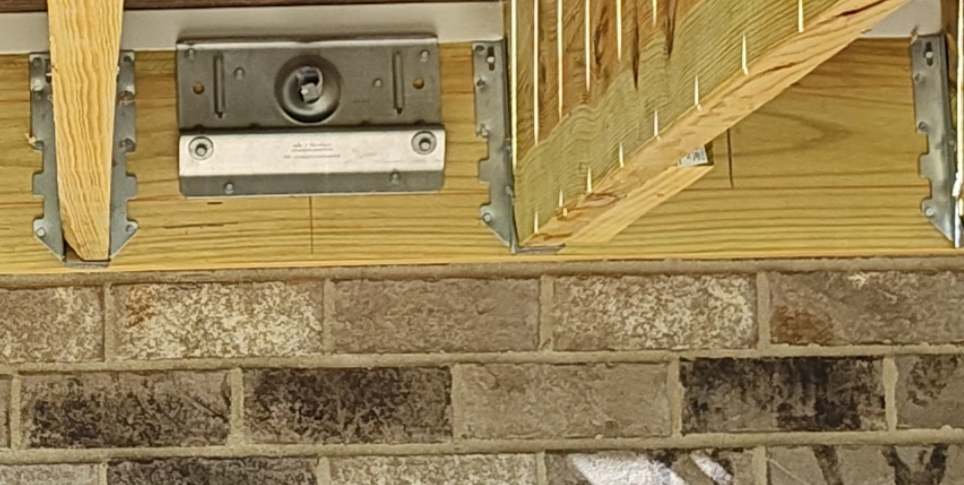
Several proprietary systems have been developed specifically for brick veneer walls.
One example is the Simpson Strong-Tie BVLZ Brick Veneer Ledger Connector.
These systems are designed to transfer the ledger load through the veneer cavity and into the structural rim joist, rather than bearing on the brick veneer itself.
When proprietary connectors are used, installation must follow the manufacturer’s instructions and evaluation reports for the system.
Approval ultimately remains subject to the authority having jurisdiction (AHJ).
Why Inspectors Flag A Deck Ledger Attached To Brick Veneer
Inspectors commonly flag a deck ledger attached to brick veneer because the prescriptive IRC ledger tables assume the fasteners engage structural framing rather than exterior cladding.
When a ledger is simply lagged through brick veneer, inspectors often cannot verify that the prescriptive conditions of R507.9 are satisfied.
The prescriptive tables assume:
- direct connection to the band joist
- known fastener embedment
- predictable wood-to-wood load transfer
Brick veneer interrupts those assumptions.
Without a documented alternate connection method, the installation no longer aligns with the prescriptive provisions of the IRC.
The Key Inspection Principle
The IRC deck ledger provisions are built around one structural concept.
Deck loads must transfer into the structural framing of the dwelling, typically through the band joist as described in IRC Section R507.9.
Exterior cladding systems—such as brick veneer—are not structural framing and are not part of the prescriptive load path assumed by the deck ledger tables in Table R507.9.1.3(1).
Understanding how prescriptive assumptions work is important across the IRC. The same inspection logic appears in other areas of the code—for example in Bathroom Fixture Clearances Under the IRC: What Inspectors Actually Measure in the Field where inspectors verify fixture spacing based on the exact measurement points defined by the code.
When that structural connection cannot be established using the prescriptive provisions, the code allows an alternate method.
Under IRC R507.9.1.4, alternate framing configurations may be used if they are capable of supporting the required loads in Section R301.5.
In practice, this typically means either:
- a prescriptive ledger attachment directly to the band joist, or
- an alternate framing configuration capable of supporting the required loads in Section R301.5.
Get the Right Code Guide for the Job
Tired of code confusion, inspection fails, or second-guessing your wiring? These practical field guides and checklists are built for pros, contractors, and serious DIYers—clear, code-cited, and inspection-tested. Grab the resource that fits your next project:
Available Guides:
• Pass the Inspection: A Field Guide to GFCI & AFCI Code Requirements
My book with clear explanations, diagrams, and field checklists to help you wire right the first time and pass every inspection. Covers NEC 2020/2023, written for real-world job sites.
• Kitchen GFCI & AFCI Requirements Checklist (NEC 2020 & 2023 Field Guide)
• Laundry Area GFCI & AFCI Requirements Checklist (2020 & 2023 NEC)