
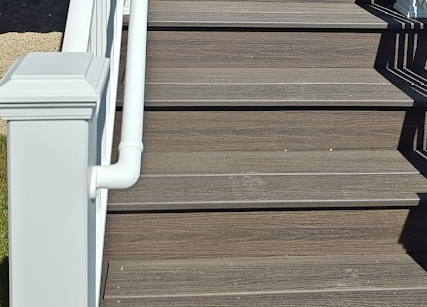
The Governing IRC Sections
This article breaks down handrail graspability requirements IRC and explains what fails inspection in the field.
Note: Height, projection, and wall clearance are separate handrail compliance checks under R311.7.8.1 through R311.7.8.3. and not covered in this post.
These requirements are all driven by the IRC (2018, 2021, and 2024—no meaningful change here):
- R311.7.8 — Handrails
- R311.7.8.1 — Height
- R311.7.8.3 — Handrail clearance
- R311.7.8.4 — Continuity
- R311.7.8.5 — Grip size
These sections don’t leave much room for interpretation.
They define when a handrail is required, what qualifies as graspable, and how it must be configured.
The Trigger Condition for Handrails
First thing I’m looking at in the field—how many risers are there?
This gets missed all the time on:
- Garage entries
- Split-level transitions
- Short interior runs
A handrail is required on not less than one side of each flight of stairs with four or more risers.
If it hits that 4-riser threshold, now everything else in this article applies.
What “Graspable” Means Under the IRC
This is where a lot of installs go sideways.
“Graspable” isn’t opinion. It’s not a judgment call.
It’s defined by shape and dimensions.
In the field, I’m checking:
Under the IRC requirements, required handrails must be Type I, Type II, or provide equivalent graspability.
If it does not meet one of the permitted grip profiles or provide equivalent graspability, it fails.
Handrail Graspability Requirements IRC: Type I vs Type II Handrails
Under the IRC, graspability is defined by specific profile dimensions, not judgment.
Now we’re identifying what we’re looking at.
Type I Handrails (Most Common)
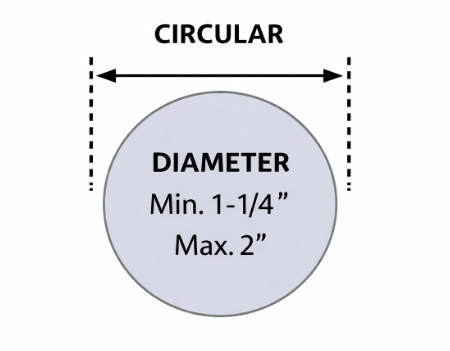
Circular:
- 1-1/4″ to 2″ diameter
Non-circular:
- Perimeter: 4″ to 6-1/4″
- Max cross-section: 2-1/4″
- For non-circular Type I profiles, the edges must also have a radius of not less than 0.01 inch.
If it fits inside those numbers, you’re good under Type I.
Type II Handrails (Larger Profiles)
If it’s bigger than a 6-1/4″ perimeter, it’s not Type I anymore.
Now it has to meet Type II, which means:
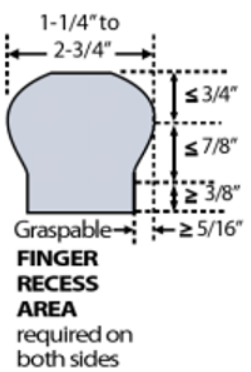
- the finger recess begins within 3/4 inch measured vertically from the tallest portion of the profile
- the recess must have a depth of not less than 5/16 inch within 7/8 inch below the widest portion of the profile
- that required depth must continue for not less than 3/8 inch
- the recess must extend to a level not less than 1-3/4 inches below the tallest portion of the profile
- the width of the handrail above the recess must be not less than 1-1/4 inches and not more than 2-3/4 inches
- edges must have a radius of not less than 0.01 inch
Here’s where most failures happen:
If it’s oversized and doesn’t have compliant recesses—
it fails.
There isn’t just one way to meet the graspability requirements. The IRC allows multiple compliant profile types, as long as they meet the dimensional criteria.
If you want to see additional compliant examples, this stair guide lays them out clearly:
Reference: Residential Stair Guide (Engineering Express)
Finger Recess Requirements (Type II)
This isn’t decorative. It has to function.
When I’m looking at it, I’m checking:
- Can your fingers get underneath?
- Can you actually hook into it?
- Does that work the entire length?
Common failures:
- Recess too shallow
- No recess at all
- Profile looks shaped but doesn’t meet depth
If your fingers can’t engage, it’s not graspable. That’s where it gets written up.
Continuity Requirements (R311.7.8.4)
Now I’m running the rail.
The requirement is simple:
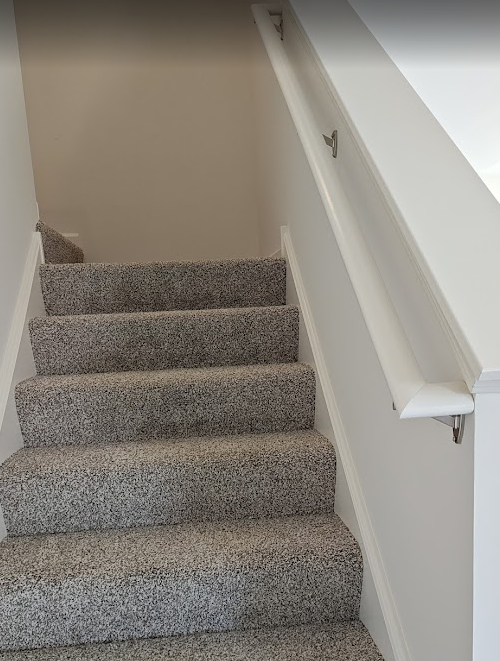
Under R311.7.8.4, the handrail must be continuous for the full length of the flight, from a point directly above the top riser to a point directly above the lowest riser.
What I’m asking myself:
Can I slide my hand from top to bottom without letting go?
A handrail interrupted by a post or newel can fail, but not in every case. Under the 2021 IRC, continuity is permitted to be interrupted by a newel post at a turn in a flight with winders, at a landing, or over the lowest tread.
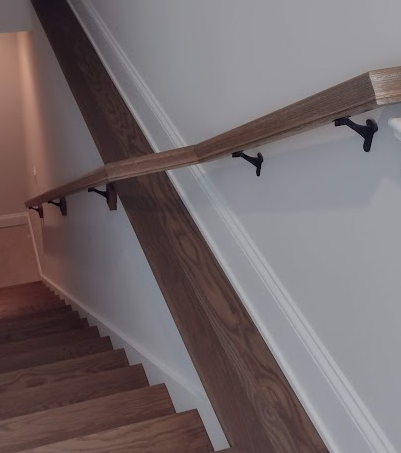
Continuity is about function, not appearance.
Handrail End and Return Requirements (R311.7.8.4)
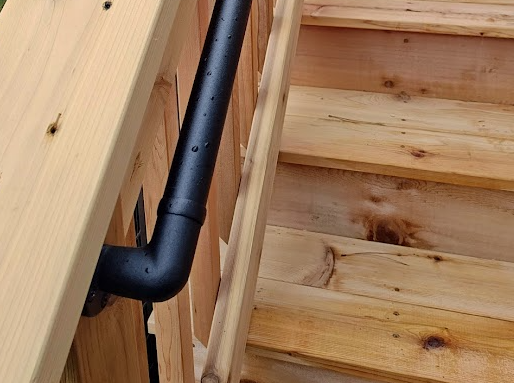
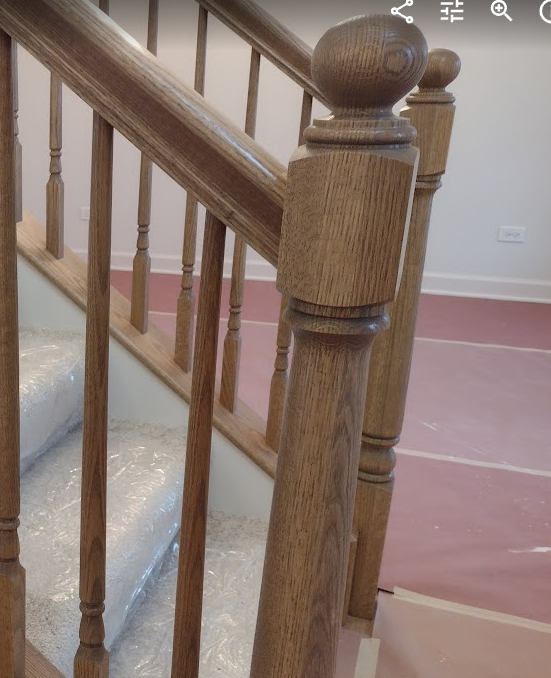
They have to:
- Return toward a wall
- Return toward a guard
- Return toward a walking surface continuous to itself
- Or terminate to a post
What doesn’t pass:
- Open ends
- Rails that just stop
Reason is simple—snag hazard and loss of control.
If it doesn’t return per code, it doesn’t pass.
Common Handrail Inspection Failures
These show up over and over:
2×4 used as a handrail

- Too wide
- Not graspable → Fail
Oversized decorative rails
- Too big for Type I
- No proper recess for Type II → Fail
Missing returns
→ Fail
Handrails broken by posts
→ Fail
Continuity is broken – beyond what the code allows
→ Fail
Flat or wide profiles
→ Fail
These failures are usually not about appearance. They fail because the profile, continuity, or end condition does not track the prescriptive IRC language.
Inspection failures aren’t limited to handrails. One of the most common structural failures we see in the field comes from improper deck attachment—especially when flashing is missing or installed incorrectly. If you want to understand how water intrusion leads to ledger failure and failed inspections, see this breakdown:
Deck Ledger Flashing Requirements Under the IRC
Inspection Logic: How Graspability Is Evaluated in the Field
This is the sequence every time:
- Trigger
- 4 or more risers?
- Presence
- Is a handrail installed?
- Profile
- Type I or Type II?
- Dimensions
- Within limits?
- Graspability
- Can the hand wrap and hold?
- Continuity
- Full run without interruption?
- Ends
- Returned or safely terminated?
If any one of those breaks down, the handrail doesn’t pass.
Final Field Point
This isn’t about how it looks.
It’s about whether that handrail actually works when someone loses their balance.
The IRC defines that through profile and dimension—not opinion.
Handrails are just one part of passing a stair inspection. If you want to see how this ties into risers, headroom, and guard requirements in the field, I break that down here: Pass Your Stair Inspection: Common IRC Code Violations!
Get the Right Code Guide for the Job
Tired of code confusion, inspection fails, or second-guessing your wiring? These practical field guides and checklists are built for pros, contractors, and serious DIYers—clear, code-cited, and inspection-tested. Grab the resource that fits your next project:
Available Guides:
• Pass the Inspection: A Field Guide to GFCI & AFCI Code Requirements My book with clear explanations, diagrams, and field checklists to help you wire right the first time and pass every inspection. Covers NEC 2020/2023, written for real-world job sites.
• Kitchen GFCI & AFCI Requirements Checklist (NEC 2020 & 2023 Field Guide)
• Laundry Area GFCI & AFCI Requirements Checklist (2020 & 2023)