YOU CAN MEET EVERY GUARD RULE AND STILL FAIL
Deck guard post attachment under the IRC is often misunderstood in the field.
If the walking surface is more than 30 inches above grade, a guard is required.
The code establishes the dimensional requirements—height and opening limitations.
Those are the visible parts of the code.
But here’s what happens in the field.
A guard can hit every one of those numbers perfectly—and still fail inspection.
Not because of height.
Not because of spacing.
Because of how it’s attached.
WHERE THE CODE QUIETLY CHANGES THE GAME
This comes down to how deck guard post attachment IRC requirements are evaluated in the field.
Once a guard is required under IRC R312.1.1, the code is no longer just dealing with layout and dimensions.
It becomes a structural requirement.
That shift is not obvious unless you follow it into the next sections:
- IRC R301.5 — establishes the load the guard must resist
- IRC R507.10 — establishes how that load must be transferred (for decks)
That’s the part most people miss.
WHAT THE GUARD IS ACTUALLY REQUIRED TO DO
Under R301.5, the guard isn’t just there to “be there.”
It has to perform.
Specifically:
- It must resist a 200-pound concentrated load applied at the top
- The infill must resist a 50-pound load
The concentrated load is applied at the top of the guard in the outward and downward direction. Where the guard also serves as a handrail, the load is applied in any direction.
That means the guard is expected to handle someone leaning, bracing, or falling into it.
So the real question isn’t:
“Does it look solid?”
It’s:
“Where does that 200-pound load go?”
THIS IS WHAT THE INSPECTOR IS LOOKING AT
By the time I’m looking at the guard in the field, I already know:
- The height is close or correct
- The spacing is likely compliant
What I’m paying attention to is something different.
I’m looking at the post and asking:
- What is it attached to?
- How is that connection made?
- Does that load actually make it into the framing?
If the answer stops at the rim board or decking, that’s where the failure starts.
THE LOAD PATH — THIS IS THE WHOLE ISSUE
Under IRC R507.10, deck guards must have a continuous load path.
That means the force travels through:
Guard → post → connection → joists → structure
If that path is broken anywhere, the system doesn’t comply.
This same load path concept shows up in deck-to-house connections as well. If you want to see how the code handles load transfer in that condition, read:
Deck Lateral Load Connection Requirements (IRC R507.9.2): What Inspectors Actually Look For
Where guards are mounted on top of the decking, the connection must extend through the decking and into framing or blocking so the load is transferred to the adjacent joists.
And in most failures, it’s broken right at the post.
WHERE THESE FAIL IN THE FIELD
This isn’t theory—this is what shows up over and over.
A post is bolted to the rim board, looks tight, doesn’t seem like a problem.
But the rim board isn’t tied into the joist system in a way that handles that load.
So when force is applied, the whole assembly flexes.
That’s a fail.
You’ll also see:
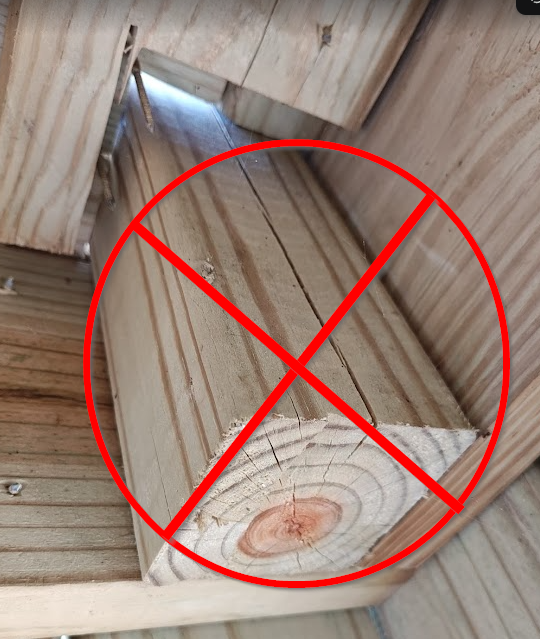
- Notched 4×4 posts at the connection
- Lag screws instead of through-bolts
- No blocking or joist tie-in
- Fasteners relying on end-grain withdrawal
None of these are appearance issues.
They’re load path failures.
WHAT A PASSING INSTALLATION ACTUALLY DOES
A compliant guard doesn’t just sit there—it transfers force.
From an inspection standpoint, I’m looking for:
- A connection that transfers load into the deck framing in a way that provides a continuous load path to the joists
- Hardware that can resist the load
- Framing that prevents rotation or movement under load
- Where proprietary systems are used, they must be installed in accordance with manufacturer instructions to ensure the guard loads are transferred to the framing as required by the code
If that load can move cleanly into the structure, the guard performs.
GENERAL CODE-COMPLIANT APPROACHES (WHAT THE CODE ALLOWS)
The code does not prescribe a single method for attaching guard posts.
What it requires is performance:
- The guard must resist the required load under R301.5
- The load must transfer through a continuous load path under R507.10
How that is achieved can vary.
From a code standpoint, compliant approaches generally fall into a few categories.
CONNECTION INTO JOIST SYSTEM (NOT JUST RIM)
A common principle across compliant designs is this:
The guard post is not relying on the rim board alone.
The connection is reinforced so the load transfers into:
- Adjacent joists
- Blocking between joists
- Or both
As demonstrated in tested configurations, reinforcing the connection between the rim and the joist system prevents the rim from acting as the weak point under load
BLOCKING AND LOAD DISTRIBUTION
Where posts occur between joists or at ends, compliant designs often include:
- Blocking between joists
- Additional framing tying joists together
The purpose is to:
- Distribute load
- Prevent rotation
- Maintain a continuous load path
Blocking connections must still comply with code limitations and cannot rely solely on fasteners in end grain.
TENSION TIES AND CONNECTOR-BASED SYSTEMS
One recognized approach is the use of:
- Tension ties
- Hold-down type connectors
- Tested hardware systems
These systems are designed to transfer lateral load from the post directly into the framing system.
Manufacturer-tested systems are commonly used because they are engineered to meet or exceed the required load when installed per their instructions.
APPROVED FASTENER SYSTEMS (ALTERNATIVE METHODS)
In addition to traditional bolts and hardware:
- Proprietary structural screw systems
- Tested fastening patterns
may be used where they are supported by evaluation reports or manufacturer documentation.
These systems are not interchangeable and must be installed as tested.
IMPORTANT LIMITATION
The IRC establishes performance requirements and certain prescriptive limitations.
It does not provide a single universal detail that covers all guard post conditions.
As shown in field-tested guidance:
- Multiple compliant configurations exist
- Not all conditions are prescriptively covered
- Some situations may require engineered design
2024 IRC NOTE (WHAT CHANGED)
The 2024 IRC expands on structural support for guards by addressing floor framing that supports guard loads. This reinforces the same principle already present in deck provisions—that guard loads must be accounted for in the supporting structure, not just at the post connection.
NOTCHED POSTS — CLEAR CODE LINE
Under IRC R507.10.2:
A 4×4 post supporting a guard load cannot be notched at the connection.
That’s not an interpretation issue.
If it’s notched at that location, it does not comply.
AHJ AND LOCAL INTERPRETATION
Everything above is based on the IRC 2021/2024 framework.
But in the field:
- Some jurisdictions are on IRC 2018
- Some have local amendments
- Some require specific hardware or engineered details
Final authority rests with the Authority Having Jurisdiction (AHJ).
If there’s any question about a connection method or hardware approach, that’s where it gets resolved.
BOTTOM LINE
A guard that meets height and spacing requirements is only halfway compliant.
If the post connection doesn’t transfer load into the structure, it fails.
That’s how the code is applied in the field.
Get the Right Code Guide for the Job
Tired of code confusion, inspection fails, or second-guessing your wiring? These practical field guides and checklists are built for pros, contractors, and serious DIYers—clear, code-cited, and inspection-tested. Grab the resource that fits your next project:
Available Guides:
• Pass the Inspection: A Field Guide to GFCI & AFCI Code Requirements
My book with clear explanations, diagrams, and field checklists to help you wire right the first time and pass every inspection. Covers NEC 2020/2023, written for real-world job sites.
• Kitchen GFCI & AFCI Requirements Checklist (NEC 2020 & 2023 Field Guide) –https://payhip.com/b/4G7Yd
• Laundry Area GFCI & AFCI Requirements Checklist (2020 & 2023 NEC)- https://payhip.com/b/KP3Wr
• Garage & Outdoor GFCI Requirements Checklist (NEC 2020 & 2023 Field Guide)
https://payhip.com/b/6a9yZ