
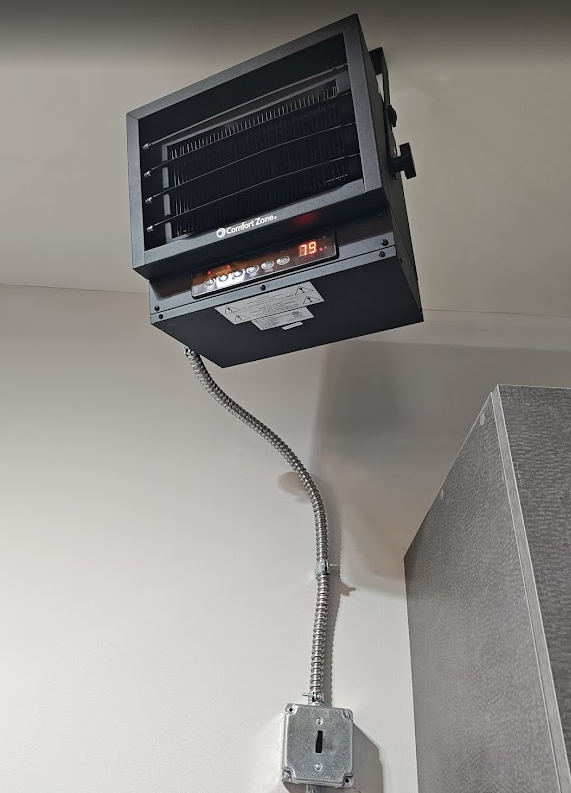
A common point of confusion in the field is how continuous-load rules affect garage heaters, workshop heaters, and other fixed electric space-heating equipment.
Most of the confusion starts when people blend together:
- conductor ampacity rules,
- breaker sizing rules,
- and continuous-load requirements,
as though they are all the same thing.
They are not.
This article walks through how the NEC actually applies continuous-load rules using a 5000W, 240V garage heater example. The goal is not to add requirements or “best practices.” The goal is to apply the NEC exactly as written — no more and no less.
If you missed my post on conductor ampacity, termination ratings, and 60°C vs 75°C conductor limitations, read that first because this post builds directly on those concepts.
Continuous Load Rules for Garage Heaters Under Article 424
Before sizing conductors or breakers, the first question is whether the load actually qualifies as a continuous load.
Under Article 100, a continuous load is:
“A load where the maximum current is expected to continue for 3 hours or more.”
That definition matters because continuous-load classification is based on expected operation — not simply the type of equipment installed.
That is the general NEC rule.
But fixed electric space-heating equipment is also specifically addressed by Article 424.
NEC 424.4(B) requires branch-circuit conductors supplying fixed electric space-heating equipment to have an ampacity of not less than 125 percent of the load of the equipment and any associated motor(s).
NEC 210.20(A) establishes branch-circuit overcurrent device sizing requirements where a branch circuit supplies continuous loads or a combination of continuous and noncontinuous loads.
So the important distinction is this:
The NEC is not simply saying, “all heaters are continuous loads.”
Equipment type alone is not how Article 100 defines a continuous load. But once the installation is fixed electric space-heating equipment governed by Article 424, NEC 424.4(B) imposes the branch-circuit conductor sizing requirement, while applicable branch-circuit overcurrent protection rules must still be coordinated with the installation requirements of Article 424.
5000W Garage Heater Example
Let’s use a typical 5000W, 240V fixed electric garage heater.
Basic load calculation:
5000W÷240V=20.83A
At this point, many people incorrectly stop and assume:
- a 20A circuit should work because the heater only draws about 21A,
or - the next standard breaker size is automatically acceptable without further analysis.
But fixed electric space-heating equipment governed by Article 424 requires additional sizing adjustments, including any associated motor load required by NEC 424.4(B). In many small garage heaters of this type, the associated blower motor load is relatively small — often approximately 0.5A to 1.5A at 240V — and is typically already included as part of the manufacturer’s listed equipment rating. If evaluated separately, however, the associated motor load would still need to be included. This example is focusing only on the fixed heating load portion of the calculation.
Where the 125% Rule Comes From
For branch circuits, NEC 210.20(A) requires the overcurrent device to be sized not less than:
- 125% of the continuous load,
plus - 100% of the noncontinuous load.
Fixed electric space-heating equipment is also specifically addressed by Article 424.
Fixed electric space-heating equipment is also subject to the overcurrent protection provisions of NEC 424.3(B), which work together with the branch-circuit sizing requirements discussed in this post.
NEC 424.4(B) requires branch-circuit conductors supplying fixed electric space-heating equipment to have an ampacity not less than 125 percent of the load of the equipment and any associated motor(s).
This is important because Article 424 independently imposes sizing requirements for fixed electric space-heating equipment rather than simply relying on the general continuous-load rules alone.
Applying the 125% Adjustment
Using the 5000W heater example:
20.83A×125%=26.04A
That means:
- the branch-circuit conductor ampacity must support at least 26.04A under NEC 424.4(B),
- and the branch-circuit overcurrent device must satisfy the continuous-load sizing requirements of NEC 210.20(A).
This is where conductor ampacity concepts from the previous article become important again.
But fixed electric space-heating equipment governed by Article 424 requires additional sizing adjustments, including any associated motor load required by NEC 424.4(B). In many small garage heaters of this type, the associated blower motor load is relatively small — often approximately 0.5A to 1.5A at 240V — and is typically already included as part of the manufacturer’s listed equipment rating. If evaluated separately, however, the associated motor load would still need to be included. This example is focusing only on the fixed heating load portion of the calculation.
Conductor Ampacity Still Matters
The continuous-load calculation does not replace conductor ampacity rules.
It works together with them.
Once the required adjusted load is determined, conductor sizing still follows:
- NEC 110.14(C),
- applicable terminal temperature limitations,
- and Table 310.16.
Under NEC 110.14(C), conductor ampacity must be coordinated so as not to exceed the lowest temperature rating of any connected termination, conductor, or device.
For example, if NM cable is used, NEC 334.80 limits ampacity to the 60°C column regardless of conductor insulation rating markings.
That means the conductor must still be evaluated using the correct ampacity column after the continuous-load adjustment is applied.
This is one reason a typical 5000W garage heater commonly ends up on:
- a 30A branch circuit,
- with 10 AWG copper conductors when NM cable is used.
Not because the heater “draws 30 amps.”
And not because the breaker determines conductor ampacity.
The sizing outcome is driven by the adjusted branch-circuit sizing requirements together with the allowable 60°C ampacity limitations that apply to NM cable under NEC 334.80:
- Article 424 sizing requirements,
- conductor ampacity limitations,
- and overcurrent device requirements.
EMT and THHN Example: Why Installation Method Still Matters
The conductor sizing outcome can change depending on the wiring method used.
In the earlier example using NM cable, NEC 334.80 limits ampacity to the 60°C column.
But if the same 5000W, 240V garage heater is installed using EMT with individual THHN conductors, the ampacity rules are applied differently.
The heater load is still:
And the Article 424 sizing adjustment still applies:
That required ampacity does not change.
What changes is how the conductor ampacity is evaluated.
Individual THHN conductors in EMT are not limited by NEC 334.80 because that section applies to NM cable. THHN conductors can use their higher temperature rating for ampacity adjustment, correction, or both, where permitted by NEC 110.14(C).
That is where the 90°C column often comes into the discussion.
For example, if ampacity adjustment or correction is required, the adjustment calculation may be performed using the conductor’s 90°C ampacity. But after that calculation is complete, the final allowable ampacity still cannot exceed the lowest temperature rating of the connected termination, conductor, or device under NEC 110.14(C).
So the process is:
- use the 90°C column only where permitted for adjustment or correction,
- apply any required adjustment or correction factors,
- then check the final ampacity against the applicable termination temperature limitation.
That distinction matters.
The 90°C column can help during adjustment or correction, but it does not automatically allow the conductor to be used at the 90°C ampacity as the final circuit ampacity.
For this 5000W heater example, the adjusted load is 26.04A. With typical 10 AWG copper THHN conductors in EMT, that conductor size commonly satisfies the required ampacity after the Article 424 sizing requirement is applied, assuming there are no additional derating conditions that reduce the final ampacity below the required load and the terminations are properly coordinated under NEC 110.14(C).
The Article 424 sizing requirement does not change.
What changes is how the conductor ampacity is evaluated based on the wiring method, conductor insulation, adjustment/correction factors, and termination limitations.
Common Misunderstanding: “The Heater Only Draws 21 Amps”
This is one of the most common field misunderstandings.
The actual operating current and the required minimum branch-circuit rating are not always the same thing.
In this example:
- the heater load is approximately 20.83A,
- but Article 424 sizing requirements push the minimum branch-circuit sizing requirements higher.
That distinction matters.
The NEC is not saying the heater suddenly draws more current.
The NEC is applying minimum branch-circuit sizing rules for fixed electric space-heating equipment.
Continuous Load Rules Do Not Override Manufacturer Instructions
Listed equipment must still be installed and used in accordance with NEC 110.3(B).
That means manufacturer instructions may specify:
- minimum circuit ampacity,
- maximum overcurrent protection,
- conductor sizing,
- or installation limitations.
Those instructions remain part of the installation requirements.
The NEC establishes the minimum rules. Listed equipment instructions can further control the installation where applicable.
Why This Matters in the Field
This is where inspection issues commonly show up:
- undersized branch circuits,
- incorrect assumptions about continuous-load application,
- confusion between conductor ampacity and breaker size,
- or misunderstanding how Article 424 interacts with general branch-circuit rules.
The important thing is understanding what is actually creating the sizing requirement.
The controlling requirement here is not simply that the equipment is a heater, but that Article 424 specifically imposes the branch-circuit sizing requirements for fixed electric space-heating equipment.
The NEC is specifically applying 125% sizing requirements to fixed electric space-heating equipment through Article 424.
That is an applicability question first.
Then the sizing rules are applied.
That distinction is how the NEC is actually supposed to be read in the field.
Final Takeaway
For garage heaters and fixed electric space-heating equipment, the correct NEC process is:
- identify the applicable equipment type,
- apply Article 424 where required,
- apply the 125% branch-circuit conductor ampacity rule in NEC 424.4(B),
- apply NEC 210.20(A) where the branch circuit supplies continuous loads,
- then size conductors and overcurrent protection using the proper ampacity and terminal-rating rules.
No guessing.
No assumptions.
No automatic shortcuts.
Just applying the NEC as written.
Get the Right Code Guide for the Job
Tired of code confusion, inspection fails, or second-guessing your wiring? These practical field guides and checklists are built for pros, contractors, and serious DIYers—clear, code-cited, and inspection-tested. Grab the resource that fits your next project:
Available Guides:
• Pass the Inspection: A Field Guide to GFCI & AFCI Code Requirements My book with clear explanations, diagrams, and field checklists to help you wire right the first time and pass every inspection. Covers NEC 2020/2023, written for real-world job sites.
• Kitchen GFCI & AFCI Requirements Checklist (NEC 2020 & 2023 Field Guide)
• Laundry Area GFCI & AFCI Requirements Checklist (2020 & 2023 NEC Field Guide)
• Garage & Outdoor GFCI Requirements Checklist (NEC 2020 & 2023 Field Guide)
• Residential Electrical Inspection Bundle – Includes Three Guides