
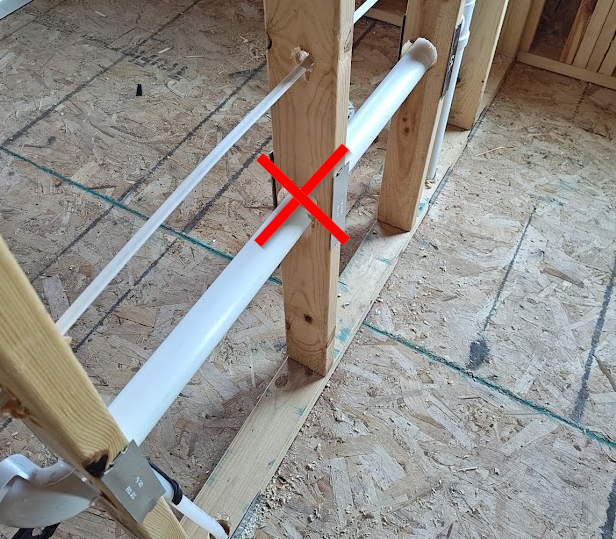
When drilling holes in 2×4 studs, can you use a 2-inch bit? In an interior nonbearing wall, that hole is within the IRC’s diameter limit. In an exterior wall or interior bearing wall, a hole that size requires the stud to be doubled, with no more than two successive doubled studs so bored. In either case, the hole must also meet the edge-clearance and location requirements.
For a conventional 2×4 measuring 3½ inches deep, the drilling limits are 1.40 inches at 40% and 2.10 inches at 60%. Which limit applies depends on the wall’s function and whether the required doubling is provided. Hole location also matters.
This article is based on 2021 IRC Section R602.6. The stud-drilling requirements discussed here are unchanged in the 2024 IRC. Verify the code edition and local amendments adopted for your project.
The examples concern holes bored through the 1½-inch thickness of conventional 2×4 wall studs installed on edge. The 3½-inch stud depth is the dimension used to calculate the limits. These examples do not address drilling into the stud face to mount hardware.
Identify the Wall Before Measuring the Hole
For drilling purposes, R602.6 distinguishes exterior walls and bearing partitions from interior nonbearing partitions.
Don’t assume an interior 2×4 wall is nonbearing. It may support floor, ceiling, or roof framing. Also, the exterior-wall category applies even when the exterior wall is nonbearing.
When the wall’s function is uncertain, review the framing plans and load path before choosing a drilling limit.
Need help tracing what a wall supports? See How to Read a Framing Plan for a closer look at load paths and structural details.
What the IRC Requires for Drilling Holes in 2×4 Studs
Under 2021 IRC Section R602.6:
- Bored-hole diameter cannot exceed 60% of the stud depth.
- In exterior walls or bearing partitions, holes over 40% require doubled studs, with no more than two successive doubled studs so bored.
- The hole edge must remain at least ⅝ inch from the stud edge.
- A hole cannot be in the same section as a cut or notch.
The section includes an exception for approved stud shoes installed according to the manufacturer’s instructions. The limits below describe the prescriptive drilling provisions without using that exception. Stud shoes are a separate repair topic.
What Those Percentages Mean for a 2×4
Use the actual 3½-inch depth, rather than the nominal 4-inch dimension or the stud’s 1½-inch thickness.
| Wall condition | Maximum hole diameter for a 3½-inch-deep stud |
|---|---|
| Exterior wall or bearing partition, without doubling under this provision | 1.40 inches (typically a 1⅜-inch drill bit) |
| Exterior wall or bearing partition, with required doubling and the successive-stud limitation | 2.10 inches (typically a 2-inch drill bit) |
| Interior nonbearing partition | 2.10 inches (typically a 2-inch drill bit) |
These are diameter limits. The edge-clearance and hole-location requirements still apply. Bit sizes are nominal; the finished hole must meet the applicable diameter limit. requirements still apply. Bit sizes are nominal; the finished hole must remain within the applicable diameter limit.
Does a 1⅜-Inch Hole Fit Within 40%?
Yes. 1⅜ inches equals 1.375 inches, which is below the calculated 1.40-inch limit.
That answers the diameter question. The hole still has to meet the location requirements.
What About a 2-Inch Hole?
A 2-inch hole is approximately 57.1% of a 3½-inch stud’s depth. It falls below 60% but exceeds 40%.
In an interior nonbearing partition, that diameter falls within the prescriptive limit.
In an exterior wall or bearing partition, that diameter triggers the doubling requirement. No more than two successive doubled studs may be so bored.
The same size hole gets a different evaluation because the wall condition changes what applies.
Is 2⅛ Inches the Same as 60%?
No. 2⅛ inches equals 2.125 inches, which exceeds 2.10 inches.
For a stud measuring 3½ inches deep, the calculation is:
3.50 inches × 0.60 = 2.10 inches.
Rounding a maximum upward changes the result. A 2⅛-inch hole exceeds the calculated 60% limit for that stud.
Measure From the Hole’s Edge
The ⅝-inch clearance is measured from the edge of the hole to the edge of the stud, not from the hole’s center.
For example, a centered 2-inch hole in a 3½-inch-deep stud leaves:
(3.50 − 2.00) ÷ 2 = 0.75 inch on each side.
That provides ¾ inch of remaining wood on each side, exceeding the ⅝-inch minimum.
Move the same hole toward one edge, however, and its clearance may become insufficient even though the diameter hasn’t changed.
How to Evaluate the Work Before Inspection
Start with the wall’s function. Then measure the actual stud depth, finished hole diameter, and remaining edge clearance.
If a hole in an exterior wall or bearing partition exceeds 40%, check whether the required doubling is provided and how many successive doubled studs have been bored.
Also check whether the hole occupies the same cross section as a cut or notch.
A hole that fits the diameter limit can still fail the location requirements. A properly positioned hole can still exceed the applicable diameter limit.
The inspection question is more than “How big is the hole?” It is “Does this hole meet the requirements for this wall and this stud?”
Get the Right Code Resource for the Job
Tired of code confusion, failed inspections, or second-guessing your work? Building Code Geek resources are written for contractors, inspectors, electricians, tradespeople, and serious DIYers. Every resource is practical, code-cited, inspection-focused, and designed to help you understand what the code actually requires.
Building Code Geek Guides
Pass the Inspection: A Field Guide to GFCI & AFCI Code Requirements
My book with clear explanations, real-world examples, diagrams, and field checklists to help you wire it right the first time and prepare for inspection with confidence. Covers NEC 2020 and 2023.
Building Code Geek Field Guides & Checklists
Browse the complete collection of downloadable field guides, checklists, bundles, and plan-reading resources designed to simplify complex code requirements and help you get it right the first time.
Recommended Tools & Resources
Trusted Tools & Resources for Contractors, Inspectors & Serious DIYers
As an Amazon Associate, I earn from qualifying purchases at no additional cost to you.