
Does This Garage Stair Need a Landing?
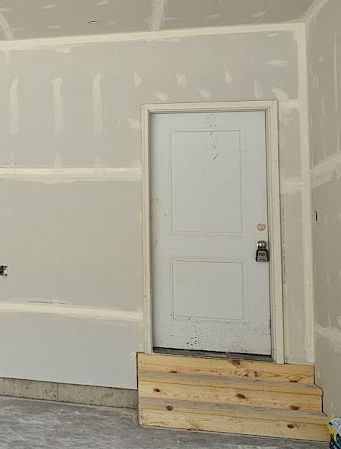
The garage stairs landing requirement in IRC R311.7.6 is often misunderstood during inspections. Walk into enough garages and you’ll eventually see the same thing.
Many people immediately assume the stair fails because there is no landing at the top.
Not necessarily.
The IRC contains an exception that specifically addresses interior stairways, including stairs located in an enclosed garage.
Understanding that exception can prevent unnecessary corrections and inspection disputes.
Garage Stairs Landing Requirement: The General Rule
The governing section is IRC R311.7.6 – Landings for Stairways.
The general rule requires a floor or landing at the top and bottom of each stairway.
That is the portion most people remember.
If you stop reading there, many garage stair installations appear to be violations.
The problem is that the section does not end there.
The Exception Many People Miss
IRC R311.7.6 includes an exception stating that a floor or landing is not required at the top of an interior flight of stairs, including stairs in an enclosed garage, provided that a door does not swing over the stairs.
This is the provision that commonly applies to garage-to-house stairways.
In many homes, the garage floor is lower than the dwelling floor, resulting in a short stairway leading to the entry door.
The exception allows the omission of a separate landing at the top of that stairway when the required conditions are met.
The Important Question
The key question is:
“Does the door swing over the stairs?”
Most garage-to-house doors swing into the dwelling.
When the door swings into the house, it is generally not swinging over the garage stair treads.
That is why the exception applies to many common garage stair configurations.
A Typical Garage Configuration
A common arrangement looks like this:
- Garage slab
- First riser
- Second riser
- Third riser
- House floor level
- Door swings into the dwelling
Many inspectors, contractors, and homeowners see this arrangement and may assume a top landing is missing.
Under the exception in R311.7.6, that assumption may be incorrect.
The absence of a separate landing does not automatically create a code violation.
What the Exception Does Not Do
The exception only addresses the landing requirement at the top of the stairway.
It does not eliminate other stair requirements.
Applicable provisions for:
- Riser height
- Tread depth
- Stair width
- Headroom
- Handrails
- Other stairway requirements
If you’re unsure whether a stair complies with IRC stair geometry requirements, see my post on Stair Riser Height and Tread Depth: Why Stairs Fail Inspection, where we break down the minimum IRC requirements and some of the most common stair inspection failures.
must still be satisfied where required.
The exception is narrow.
It should not be expanded beyond what the code actually says.
A Common Field Mistake
One of the most common mistakes is applying the general landing requirement without reading the exception.
This often results in a correction being requested for a condition that may already comply with the IRC.
When evaluating garage stairs, always read the entire section, including exceptions, before making a determination.
Code compliance is based on the complete requirement—not just the first sentence.
Bottom Line
The IRC generally requires landings at the top and bottom of stairways.
However, IRC R311.7.6 contains an exception for interior stairways, including stairs in enclosed garages.
When the door does not swing over the stairs, a separate landing at the top of the stairway may not be required.
That exception is the reason many garage-to-house stair configurations with two or three risers are permitted without a dedicated top landing.
As always, verify the adopted IRC edition and any local amendments before making a final code determination.
Key Questions & Clear Answers
Do garage stairs always require a landing at the top?
No. IRC R311.7.6 contains an exception for interior stairways, including enclosed garage stairs, when the door does not swing over the stairs.
Does the exception apply to enclosed garages?
Yes. The exception specifically references interior stairways, including stairs located in an enclosed garage.
Does the garage door have to swing inward?
The code focuses on whether the door swings over the stairs. The critical issue is not the direction of swing by itself, but whether the opened door occupies the stairway area.
Does the exception eliminate other stair requirements?
No. All other applicable stair provisions must still be met.
Should local amendments be checked?
Yes. Always verify the adopted IRC edition and local amendments enforced by the AHJ.
Get the Right Code Guide for the Job
Looking for more inspection-focused code resources? The following guides are designed to help contractors, inspectors, electricians, and serious DIYers quickly verify common code requirements in the field.
Available Guides:
Pass the Inspection: A Field Guide to GFCI & AFCI Code Requirements
My book with clear explanations, diagrams, and field checklists to help you wire right the first time and pass inspection with confidence. Covers NEC 2020 and 2023 requirements in a practical field-reference format.
Kitchen GFCI & AFCI Requirements Checklist (NEC 2020 & 2023 Field Guide)
A quick-reference field guide covering kitchen receptacles, appliance circuits, GFCI protection, AFCI protection, and common inspection issues.
Laundry Area GFCI & AFCI Requirements Checklist (NEC 2020 & 2023 Field Guide)
A focused guide covering laundry area receptacles, washing machines, dryers, GFCI requirements, AFCI requirements, and frequently missed inspection items.
Garage & Outdoor GFCI Requirements Checklist (NEC 2020 & 2023 Field Guide)
A field-ready checklist covering garage receptacles, outdoor receptacles, accessory structures, and common GFCI requirements that frequently generate correction notices.