
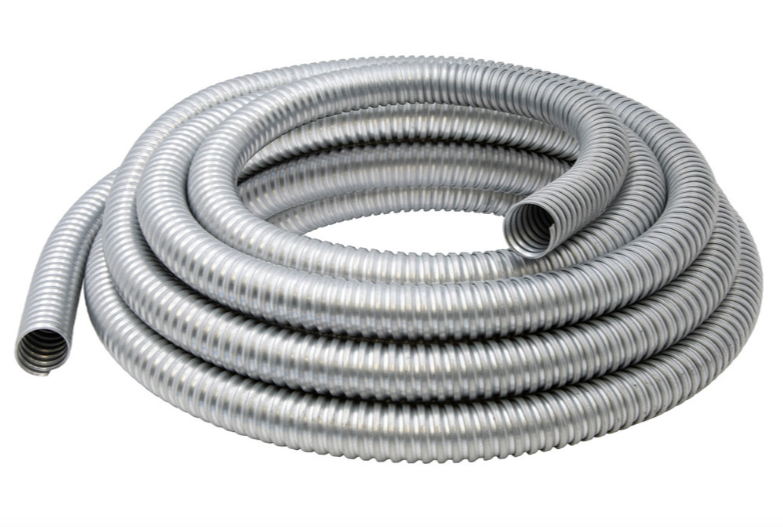
FMC fixture whip grounding rules are commonly misunderstood in the field, especially when no separate wire-type equipment grounding conductor is visible.
A common field example is a short FMC fixture whip containing only black and white insulated conductors with no separate wire-type equipment grounding conductor.
That immediately creates confusion in the field because many people assume:
“No equipment grounding conductor means it’s a code violation.”
But that is not always how the NEC treats flexible metal conduit.
This is one of those situations where applicability matters more than assumptions.
The NEC does not say grounding is optional.
What the NEC does allow — under specific conditions — is for the flexible metal conduit itself to serve as the equipment grounding conductor.
That distinction matters.
The First Thing to Identify: What Wiring Method Is It?
This is where the confusion usually starts.
Many electricians incorrectly call every flexible metallic wiring method “MC.”
But flexible metal conduit (FMC) and Type MC cable are not the same wiring method.
That distinction controls whether the metal wiring method itself can qualify as the equipment grounding conductor.
Flexible Metal Conduit (FMC)
FMC is a raceway covered under NEC Article 348.
It is an empty raceway that conductors are pulled into.
Typical field examples include:
- Fixture whips
- Troffer whips
- HVAC equipment connections
- Equipment requiring flexibility
- Short vibration-isolation connections
Type MC Cable
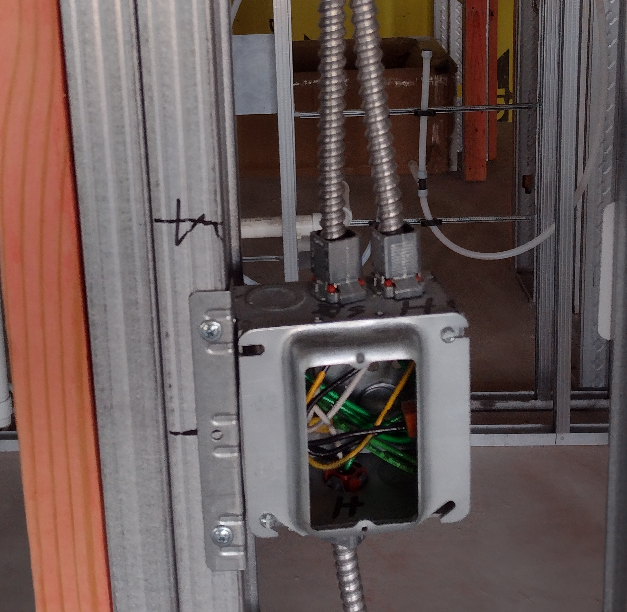
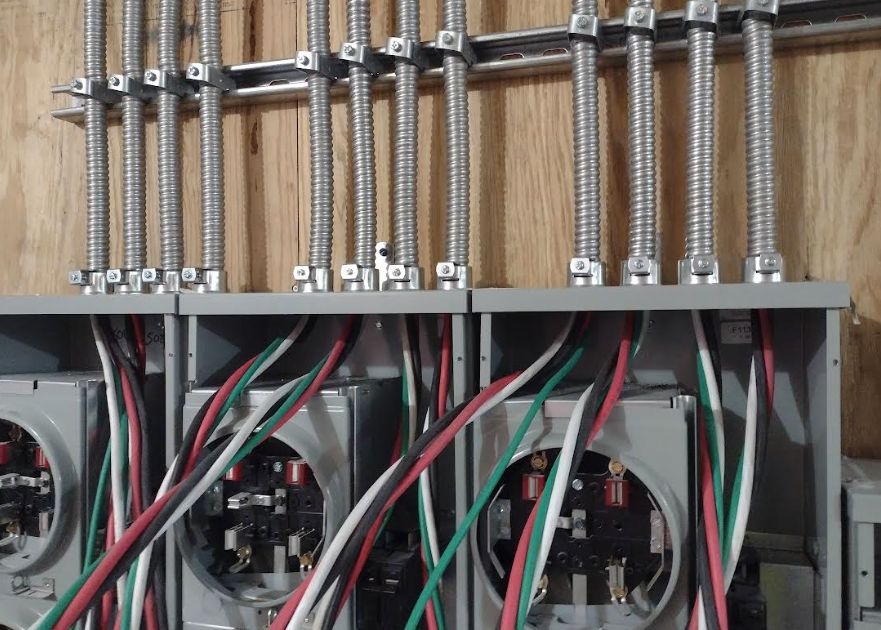
Type MC cable is a factory-manufactured cable assembly covered under NEC Article 330.
The cable assembly itself determines the grounding method.
Many MC cable assemblies contain an insulated equipment grounding conductor.
Others use a combination grounding/bonding design as part of the listed assembly.
Those are completely different NEC rules.
This article is specifically discussing FMC.
The Governing NEC Sections
For FMC grounding, the controlling sections are:
- NEC 348.60
- NEC 250.118(5)
NEC 348.60 directs you to NEC 250.118 for equipment grounding conductor requirements.
NEC 250.118(5) then establishes the conditions under which listed FMC is permitted to serve as the equipment grounding conductor.
This is where the commonly misunderstood “6-foot rule” comes from.
What the NEC Actually Permits
Under NEC 250.118(5), listed flexible metal conduit is permitted to serve as the equipment grounding conductor where the NEC conditions are met.
Those conditions include:
- The FMC must be terminated in listed fittings
- The overcurrent device cannot exceed the permitted rating
- The FMC size limitations must be satisfied
- The combined grounding path limitations must be satisfied
- The installation cannot fall into conditions requiring a wire-type equipment grounding conductor
This is important:
The NEC is not saying:
“Grounding is not required under 6 feet.”
The NEC is saying:
“The metal FMC itself is permitted to be the equipment grounding conductor under specific conditions.”
That is a completely different concept.
FMC Fixture Whip Grounding and the Misunderstood 6-Foot Rule
This is probably one of the most misunderstood grounding rules in the field.
Many people incorrectly simplify the rule into:
“If the whip is under 6 feet, you don’t need a ground wire.”
That is not what the NEC says.
The NEC is recognizing the FMC itself as the equipment grounding conductor where the conditions of NEC 250.118(5) are satisfied.
In a typical short fixture whip installation, the metal FMC and listed fittings together create the effective ground-fault current path.
That is why many short FMC fixture whips contain only:
- An ungrounded conductor
- A grounded conductor
with no separate wire-type equipment grounding conductor.
The metal raceway system itself is serving that function.
Why the Fittings Matter
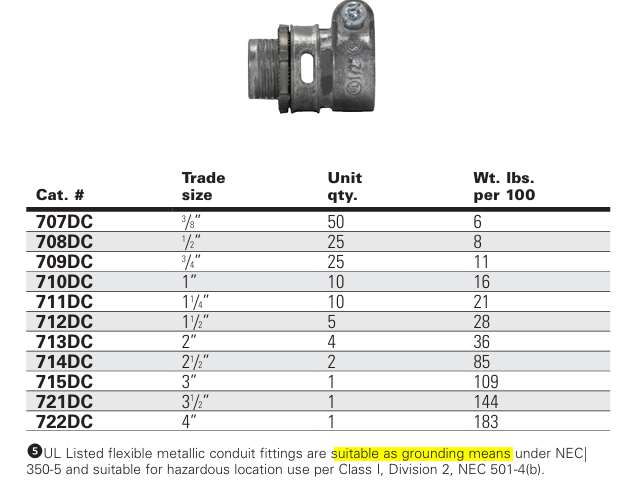
This is another place where field confusion shows up.
The FMC alone is not the entire grounding path.
The fittings are part of the grounding continuity.
That is why NEC 250.118(5) specifically requires listed fittings.
If the grounding path depends on the metal raceway system itself, continuity matters.
That includes:
- Listed FMC connectors
- Proper locknut engagement
- Tight mechanical connections
- Continuous metal path
- Proper enclosure bonding
This is also why inspectors often look closely at:
- Loose locknuts
- Damaged flex
- Non-listed fittings
- Improper transitions
- Excessive whip length
- Corrosion or paint interfering with continuity
The raceway system is functioning as the equipment grounding conductor.
So continuity matters.
Verifying FMC Grounding Suitability in the Field
NEC 250.118(5) permits listed FMC to serve as the equipment grounding conductor where the required conditions are satisfied.
In the field, electricians and inspectors commonly rely on:
- listed FMC,
- listed FMC fittings,
- and recognized installation methods
as part of the effective ground-fault current path.
However, manufacturer literature is not always consistent about explicitly stating:
“Suitable as grounding means.”
Some manufacturers clearly identify grounding suitability in their product documentation, while others reference only:
- UL listings,
- UL 514B,
- or FMC compatibility.
That can create legitimate confusion when verifying grounding continuity from product literature alone.
Ultimately, the installer and authority having jurisdiction (AHJ) are responsible for verifying:
- the wiring method,
- the fitting listing,
- the installation conditions,
- and compliance with NEC 250.118(5) and applicable product listings.
A Common Field Example
A very common installation is a short 3/8-inch FMC fixture whip between:
- A junction box
- And a fluorescent troffer or LED fixture
The whip may contain:
- One black conductor
- One white conductor
with no separate green wire.
If the FMC installation complies with NEC 250.118(5), the FMC itself is serving as the equipment grounding conductor.
That is why the installation may still pass inspection.
Again, that does not mean grounding is optional.
It means the NEC is recognizing the raceway itself as the grounding path.
Conditions That Change the Answer
This is where overgeneralizing becomes dangerous.
Not every FMC installation can use the raceway itself as the equipment grounding conductor.
Several conditions can trigger the need for a wire-type equipment grounding conductor.
Examples include:
- Exceeding the permitted FMC grounding limitations
- Installations requiring flexibility after installation
- Conditions involving vibration isolation
- Circuit ratings exceeding the NEC allowances
- FMC sizes outside NEC limitations
- Installations that do not maintain proper grounding continuity
This is why electricians cannot reduce the rule to:
“Flex under 6 feet never needs a ground wire.”
The actual NEC language is more precise than that.
Applicability controls the answer.
The Bigger Inspection Lesson
This is one of those NEC topics that separates memorized rules from actual code analysis.
The correct process is:
- Identify the wiring method
- Determine whether the raceway qualifies as an equipment grounding conductor under NEC 250.118
- Verify the applicable conditions
- Confirm continuity through listed fittings and enclosures
- Apply only the minimum NEC requirement
That is very different from simply assuming:
“No green wire means it fails.”
The NEC recognizes several metal raceway systems as equipment grounding conductors when the applicable conditions are satisfied.
FMC is one of them.
Just like conduit fill and ampacity rules, FMC fixture whip grounding depends on applying the correct NEC conditions to the actual wiring method. You can read more about that in my post:
“Why Your Conduit Can Pass Fill Rules and Still Fail Ampacity Requirements.”
Final Takeaway
The NEC does not waive grounding requirements for short flexible fixture whips.
What the NEC permits — under specific conditions — is for listed FMC and its fittings to serve as the equipment grounding conductor.
That is why many short FMC fixture whips contain only black and white conductors and still pass inspection.
The key is not whip length alone.
The key is whether the installation satisfies NEC 250.118(5).
Get the Right Code Guide for the Job
Tired of code confusion, inspection fails, or second-guessing your wiring? These practical field guides and checklists are built for pros, contractors, and serious DIYers—clear, code-cited, and inspection-tested. Grab the resource that fits your next project:
Available Guides:
• Pass the Inspection — A Field Guide to GFCI & AFCI Code Requirements
My book with clear explanations, diagrams, and field checklists to help you wire right the first time and pass every inspection. Covers NEC 2020 & 2023 requirements and is written for real-world job sites.
• Kitchen GFCI & AFCI Requirements Checklist (NEC 2020 & 2023 Field Guide)
• Laundry Area GFCI & AFCI Requirements Checklist (2020 & 2023 NEC)
• Garage & Outdoor GFCI Requirements Checklist (NEC 2020 & 2023 Field Guide)