
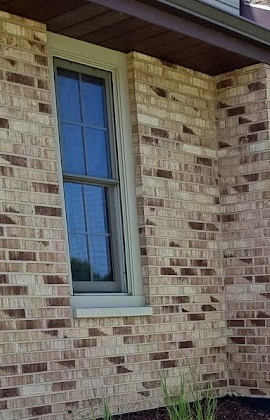
One of the most common questions I hear:
“If I’m replacing an existing bedroom window, does the new window have to meet today’s egress code?”
It’s a fair question because there are a lot of opinions on the subject.
Some people immediately assume every replacement window must meet today’s emergency escape and rescue opening requirements.
Others believe any existing bedroom window can simply be replaced with another window the same size.
Neither answer starts in the right place.
The first question isn’t how large the replacement window is.
The first question is:
Which IRC section applies to this project?
If you’re simply replacing an existing emergency escape and rescue window, the code provides a specific path that many people overlook.
This article focuses specifically on replacement bedroom windows under IRC Section R310.5. If you’re looking for the general requirements for emergency escape and rescue openings—including minimum net clear opening size, sill height, grade-floor exceptions, and when an egress window is required—start with my complete guide: Bedroom Egress Windows: What Actually Makes One Code Compliant?
Start With the Scope of the Project
This article addresses one specific situation:
Replacing an existing emergency escape and rescue window.
It does not address:
- creating a new sleeping room,
- converting an existing room into a bedroom,
- constructing a dwelling addition,
- or a change of occupancy.
Each of those situations is governed by different sections of the International Residential Code.
That’s the first step in any code analysis.
Determine the scope of the work before determining the requirements.
When Does IRC Section R310.5 Apply?
Section R310.5 applies only when all of the following conditions are met.
The Replacement Window Must Be the Largest Standard-Size Window That Fits
The replacement window must be the manufacturer’s largest standard-size window that will fit within:
- the existing frame, or
- the existing rough opening.
The code does not require enlarging the rough opening.
It also does not require a custom-manufactured window.
However, selecting a smaller replacement window simply because it is convenient does not satisfy this requirement.
The Operating Style Must Qualify
The replacement window must be either:
- the same operating style as the existing window,
or
- another operating style that provides an equal or greater window opening area than the existing window.
The Work Cannot Be Part of a Change of Occupancy
If the replacement is part of a change of occupancy, Section R310.5 does not apply.
What Does the Replacement Window Exception Actually Change?
This is where most of the confusion begins.
A qualifying replacement window under Section R310.5 is exempt from Section R310.2.
That means the replacement window does not necessarily have to comply with the normal emergency escape and rescue opening requirements for:
- minimum net clear opening area,
- minimum net clear opening height,
- minimum net clear opening width,
- maximum height from the floor to the bottom of the clear opening,
- and the requirement that those dimensions result from the normal operation of the window.
Those are the standard requirements for emergency escape and rescue openings.
Section R310.5 provides a different compliance path when its conditions are satisfied.
Above-Grade and Grade-Floor Replacement Windows
For most above-grade and grade-floor replacement windows, the analysis is fairly straightforward.
If:
- you’re replacing an existing emergency escape and rescue window,
- Section R310.5 applies,
- and every condition in that section is satisfied,
the replacement window may qualify without enlarging the existing opening to meet today’s standard emergency escape and rescue opening dimensions.
For many projects, that’s where the analysis ends.
Basement Replacement Windows Require One Additional Code Analysis
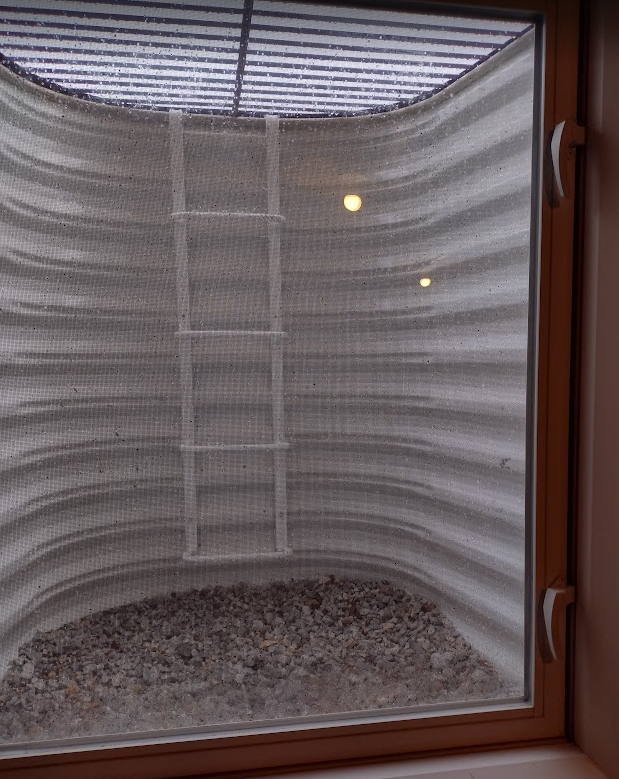
Basement replacement windows often involve one additional question.
Is the emergency escape and rescue opening located below adjacent grade?
If it is, Section R310.4 also becomes part of the analysis because the opening may require an area well.
This is where some people incorrectly assume the replacement-window exception eliminates every requirement associated with the basement opening.
It doesn’t.
Section R310.5 exempts qualifying replacement windows from Sections R310.2 and R310.4.4.
It does not exempt every other provision found in Section R310.4.
If the emergency escape and rescue opening is below adjacent grade, the applicable area-well provisions should also be evaluated based on the scope of the work.
Don’t Forget the Area Well
Where an emergency escape and rescue opening is below adjacent grade, Section R310.4 establishes separate requirements for area wells.
Depending on the project, those provisions may include:
- minimum area-well dimensions,
- allowing the window to fully open,
- ladders or steps where required, and
- drainage.
These requirements are evaluated separately from the replacement-window provisions in Section R310.5.
A Brief Note About Section R310.4.4
Section R310.5 also exempts qualifying replacement windows from Section R310.4.4.
For most replacement-window projects, this is a secondary consideration because Section R310.4.4 addresses bars, grilles, covers, screens, and similar devices installed over emergency escape and rescue openings or their area wells.
This exemption should not be interpreted as allowing a device that interferes with emergency escape or rescue.
Section R310.1.1 still requires emergency escape and rescue openings to be operational from inside the room without the use of keys, tools, or special knowledge.
Don’t Confuse These Four Different Projects
| Project | Governing IRC Section |
|---|---|
| Replacing an existing emergency escape and rescue window | R310.5 |
| Dwelling addition containing a sleeping room | R310.6 |
| New sleeping room created in an existing basement | R310.7 |
| Change of occupancy requiring an emergency escape and rescue opening | R310.7.1 |
Although all four situations involve bedroom windows, they are analyzed differently because each section has its own trigger.
Common Field Mistake
One of the most common mistakes is assuming every bedroom window project follows the same rules.
It doesn’t.
A replacement window, a new basement bedroom, a dwelling addition, and a change of occupancy each have their own code analysis.
Determine which situation you’re dealing with first.
Then apply the section that governs that work.
Questions to Ask Before Ordering a Replacement Window
- Am I replacing an existing emergency escape and rescue window?
- Does Section R310.5 apply?
- Is the replacement the manufacturer’s largest standard-size window that will fit?
- Is it the same operating style, or does the new operating style provide an equal or greater window opening area?
- Is the project part of a change of occupancy?
- Is the emergency escape and rescue opening below adjacent grade?
- Does an area well also need to be evaluated?
- Have state or local amendments modified these requirements?
- Has the Authority Having Jurisdiction (AHJ) adopted an interpretation that affects this project?
Local Amendments Matter
This article discusses the 2021 International Residential Code (IRC).
If your jurisdiction has adopted the 2024 IRC, these provisions have been renumbered into Section R319, but the replacement-window concepts remain substantially the same.
Always verify:
- the code edition adopted by your jurisdiction,
- state amendments,
- local amendments, and
- any requirements or interpretations of the Authority Having Jurisdiction (AHJ).
The adopted code always governs.
Field Reminder
The key to understanding replacement bedroom windows isn’t memorizing dimensions—it’s determining which IRC section governs the work being performed.
Get the Right Code Resource for the Job
Tired of code confusion, failed inspections, or second-guessing your work? Building Code Geek resources are written for contractors, inspectors, electricians, builders, permit applicants, architects, and serious DIYers. Every resource is practical, code-cited, inspection-tested, and designed to help you understand what the code actually requires.
Building Code Geek Book:
Pass the Inspection: A Field Guide to GFCI & AFCI Code Requirements
My book with clear explanations, real-world examples, diagrams, and field checklists to help you wire it right the first time and pass inspection with confidence. Covers NEC 2020 and 2023.
Building Code Geek Field Guides & Checklists:
Browse the complete collection of Building Code Geek Field Guides & Checklists
Download practical field guides, checklists, bundles, and plan reading resources designed to simplify complex code requirements and help you understand what the code actually requires.
Recommended Tools & Resources:
Trusted Tools & Resources for Contractors, Inspectors & Serious DIYers