
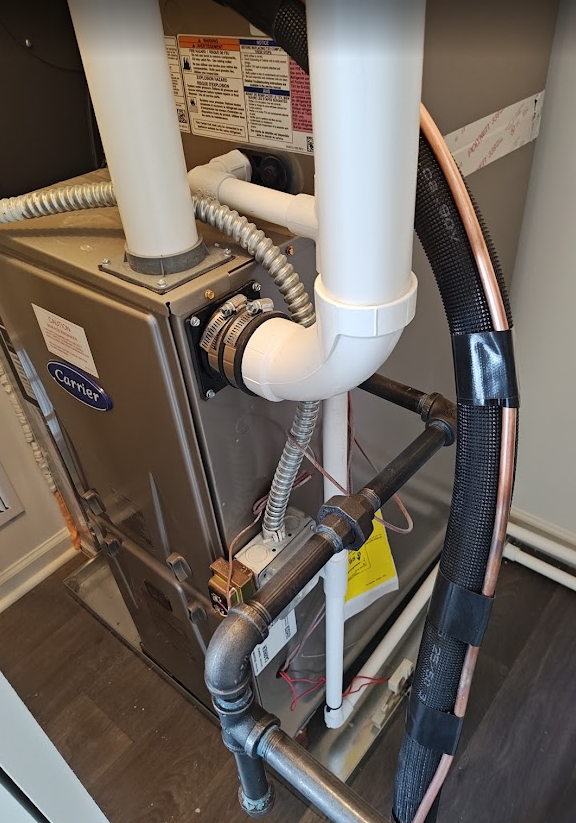
Most people see a high-efficiency furnace with PVC pipe running outside and immediately call it a direct-vent furnace. But what is a direct vent furnace under the IRC? The answer depends on where the furnace gets its combustion air and where the flue gases are discharged.
The exhaust pipe tells you where the combustion gases are going. It does not, by itself, tell you where the furnace is getting its combustion air.
That distinction matters because the 2021 International Residential Code (IRC) gives direct-vent appliances a specific definition. A furnace doesn’t become direct vent simply because it has PVC exhaust piping or because it is a high-efficiency condensing furnace.
Some furnaces can be installed in more than one configuration, depending on their listing and the manufacturer’s installation instructions.
So before we start measuring vent clearances from windows, doors, air intakes, grade, or other building openings, there’s a more basic question to answer:
Is this actually a direct-vent installation?
That’s where the analysis starts.
What Is a Direct Vent Furnace Under the IRC?
The 2021 IRC defines a direct-vent appliance as an appliance constructed and installed so that:
- All air for combustion is derived directly from the outside atmosphere.
- All flue gases are discharged directly to the outside atmosphere.
Both conditions matter.
That’s the key to understanding the term.
If all combustion air comes directly from outdoors and all flue gases discharge directly outdoors, the installation meets the IRC definition of a direct-vent appliance.
If the furnace is taking combustion air from the space around the appliance, it does not meet that definition simply because its exhaust is piped outdoors.
That is the first distinction to make.
Don’t Confuse Venting With Combustion Air
One reason this gets confusing is that we often use the word venting to describe the entire furnace installation.
But there are really two separate things happening.
The furnace needs air for combustion.
Then the products of combustion need to be discharged.
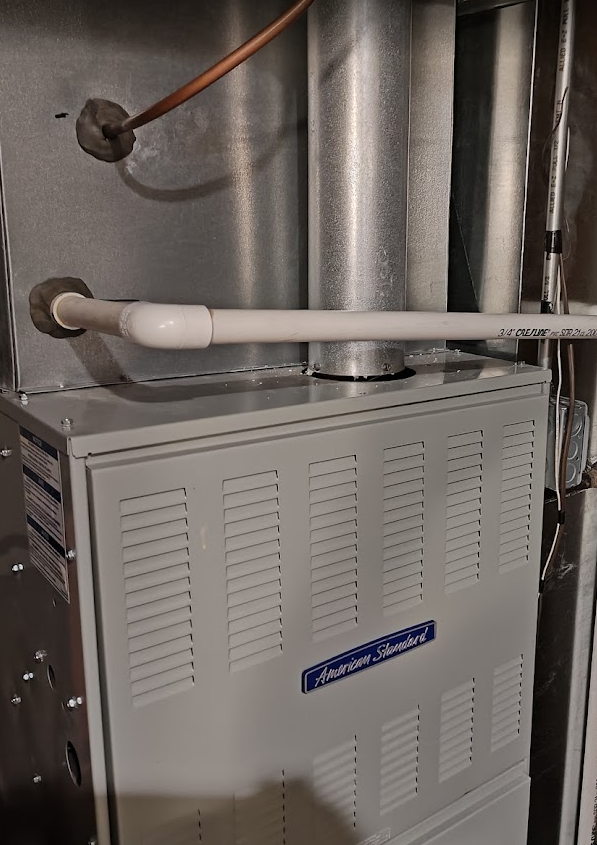
A conventional furnace using a Type B gas vent provides an easy comparison.
The B-vent carries combustion products from the appliance toward the outdoors. Combustion air for the appliance is a separate issue and must be provided as required by the applicable code provisions and the appliance manufacturer’s instructions.
A direct-vent appliance handles the arrangement differently.
Under the IRC definition, all combustion air comes directly from outdoors and all flue gases discharge directly outdoors.
That’s why looking only at the exhaust pipe doesn’t answer the question.
Does a High-Efficiency Furnace Always Have Two Pipes?
No.
This is where people can get tripped up.
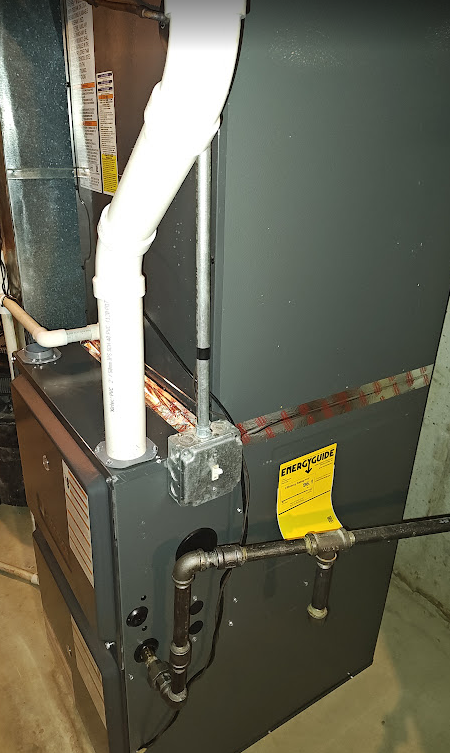
We’re accustomed to seeing high-efficiency condensing furnaces installed with two pipes.
Typically, one pipe carries combustion products outdoors and the other brings combustion air from outdoors to the furnace.
When the appliance is constructed and installed so that all combustion air comes directly from outdoors and all flue gases discharge directly outdoors, that fits the IRC definition of a direct-vent appliance.
But don’t turn that common two-pipe arrangement into a universal rule for every condensing furnace.
Depending on the furnace listing and manufacturer’s installation instructions, some furnaces permit more than one installation configuration.
A manufacturer may permit the furnace to be installed with combustion air piped directly from outdoors. The same furnace may also permit another configuration where the vent terminates outdoors but combustion air is obtained from the space in which the furnace is installed, provided that configuration and the required combustion-air provisions comply with the manufacturer’s instructions and applicable code requirements.
That second arrangement is not a direct-vent installation under the IRC definition because all combustion air is not being derived directly from the outside atmosphere.
So don’t identify the installation by counting pipes alone.
Identify where the combustion air actually comes from.
The Manufacturer’s Instructions Are Part of the Analysis
This is where IRC Section M1307.1 becomes important.
M1307.1 requires appliance installations to conform to the conditions of their listing and label and the manufacturer’s instructions.
It also requires the manufacturer’s operating and installation instructions to remain attached to the appliance.
That gives us a basic inspection process.
Get the manufacturer and model number.
Find the installation instructions.
Determine which venting and combustion-air configurations are permitted for that furnace.
Then compare those instructions with the actual installation.
You cannot reliably determine whether a furnace is properly installed simply by recognizing that it is a condensing furnace or seeing PVC pipe.
The specific appliance matters.
G2407.1 Sends Us Back to the Manufacturer
The fuel-gas provisions reinforce that same approach.
IRC Section G2407.1 (304.1) addresses combustion, ventilation and dilution air.
The section generally directs combustion, ventilation and dilution air to the methods contained in Sections G2407.5 through G2407.9.
But it then specifically addresses certain appliances, including:
- Direct-vent appliances.
- Gas appliances other than natural-draft design.
- Vented gas appliances not designated as Category I.
- Appliances equipped with power burners.
For those appliances, combustion, ventilation and dilution air must be provided in accordance with the appliance manufacturer’s instructions.
That’s an important distinction.
The code isn’t telling us to look at a furnace from across the room and decide how its combustion air should be provided based on what we normally see.
It sends us to the instructions for that appliance.
The IRC Specifically Addresses Listed Direct-Vent Appliances
The venting provisions do the same thing.
IRC Section G2427.2.1 (503.2.3) addresses listed direct-vent appliances and requires them to be installed in accordance with the manufacturer’s instructions.
So we now have several pieces working together:
The IRC definition tells us what a direct-vent appliance is.
M1307.1 requires the appliance installation to conform to its listing, label and manufacturer’s instructions.
G2407.1 directs combustion, ventilation and dilution air for direct-vent and certain other appliances back to the manufacturer’s instructions.
G2427.2.1 specifically requires listed direct-vent appliances to be installed in accordance with the manufacturer’s instructions.
That’s why the installation manual matters so much with these furnaces.
A Single PVC Exhaust Pipe Does Not Automatically Mean Something Is Missing
Here’s a common field mistake.
Someone sees a condensing furnace with one PVC pipe terminating outdoors.
They immediately say:
“The combustion-air intake is missing.”
Maybe.
But you don’t have enough information yet to make that call.
First identify the furnace.
Then determine what configurations the manufacturer permits.
If the manufacturer’s instructions permit the furnace to obtain combustion air from the surrounding space for that particular installation, the absence of an outdoor combustion-air intake does not automatically mean the furnace was installed incorrectly.
That doesn’t mean you stop the analysis there.
If combustion air is being taken from inside the building, the applicable combustion-air requirements still have to be addressed.
That is a separate analysis involving Sections G2407.5 through G2407.9 where applicable, along with the appliance manufacturer’s requirements.
We’ll cover that separately in this series.
For now, the point is simple:
One PVC pipe does not automatically mean something is missing, and two PVC pipes should not replace actually identifying the installation.
Why This Matters Before Checking Vent Clearances
Once we move outside the building, another common mistake starts.
Someone sees two PVC pipes and immediately begins applying clearance measurements.
Before grabbing the tape measure, identify what each pipe actually is.
IRC Section G2427.8 (503.8) addresses venting system terminal clearances and states that clearances for through-the-wall direct-vent and nondirect-vent terminals must comply with Figure G2427.8 and Table G2427.8.
Notice that the IRC itself distinguishes between direct-vent and nondirect-vent terminals.
G2427.8 also contains an exception stating that the clearances in Table G2427.8 do not apply to the combustion-air intake of a direct-vent appliance. This matters when looking at a typical two-pipe furnace termination.
The table establishes clearances for the vent terminal; it does not establish the required separation between that appliance’s vent terminal and its own combustion-air intake. That separation is determined by the appliance manufacturer’s installation instructions.
This should not be read as a blanket exemption for combustion-air intakes.
Row J still addresses a vent terminal’s clearance to a nonmechanical air-supply inlet to the building or to the combustion-air inlet of any other appliance.
That’s a good example of why we shouldn’t grab one clearance table and start applying every dimension to every pipe coming through the wall.
First identify the appliance.
Then identify the installation configuration.
Then identify whether you’re looking at a vent terminal or a combustion-air intake.
Only then can you determine which requirements apply.
We’ll get into those termination clearances separately because they deserve their own article.
Furnace vent terminals aren’t the only exhaust openings that need careful placement. Dryer exhaust systems have their own termination, clearance, duct, and installation requirements. See my complete guide to Dryer Vent Code Requirements under the 2021 IRC
Why “Two-Pipe Furnace” and “Single-Pipe Furnace” Can Be Misleading
There’s nothing wrong with using those terms conversationally.
If somebody tells me there’s a two-pipe condensing furnace in the basement, I have a pretty good idea what they’re describing.
But those terms aren’t enough for a code analysis.
A pipe count describes what you can see.
The IRC definition tells us what makes an appliance direct vent.
That’s a much better way to approach an inspection.
Instead of asking:
“How many pipes are there?”
Ask:
“Where does this furnace get all of its combustion air?”
Then:
“Where are the flue gases discharged?”
Now you’re applying the definition instead of assuming the answer from appearances.
Questions to Ask First
When you’re looking at a condensing furnace installation, start with these questions:
- What furnace is installed?
Identify the manufacturer and model number. - What configurations does the manufacturer permit?
Check the listing, label and installation instructions. - Where does the combustion air come from?
Determine whether all combustion air is supplied directly from outdoors or whether the furnace is using another permitted combustion-air arrangement. - Where are the flue gases discharged?
Identify the actual venting arrangement. - Does the installation meet the IRC definition of direct vent?
Don’t make that determination based only on PVC pipe or the number of pipes. - If combustion air comes from inside the building, what requirements apply?
That requires its own combustion-air analysis. - What does the manufacturer require for this installation?
M1307.1, G2407.1 and G2427.2.1 make the manufacturer’s instructions part of the code analysis. - Are there local amendments or additional AHJ requirements?
Always verify the locally adopted code and amendments before making the final determination.
Applicable 2021 IRC Sections
For this issue, the primary 2021 IRC references are:
Chapter 2 — Definition: Direct-Vent Appliances
Defines a direct-vent appliance as one constructed and installed so that all combustion air is derived directly from the outside atmosphere and all flue gases are discharged directly to the outside atmosphere.
M1307.1 — General
Requires appliance installations to conform to the conditions of their listing and label and the manufacturer’s instructions.
G2407.1 (304.1) — General
Addresses combustion, ventilation and dilution air and specifically requires direct-vent appliances and certain other appliance types to be provided with combustion, ventilation and dilution air in accordance with the appliance manufacturer’s instructions.
G2427.2.1 (503.2.3) — Direct-Vent Appliances
Requires listed direct-vent appliances to be installed in accordance with the manufacturer’s instructions.
G2427.8 (503.8) — Venting System Terminal Clearances
Addresses through-the-wall direct-vent and nondirect-vent terminal clearances through Figure G2427.8 and Table G2427.8. The exception states that the Table G2427.8 clearances do not apply to the combustion-air intake of a direct-vent appliance.
Field Reminder
Seeing PVC doesn’t tell you where the combustion air is coming from. Identify the installation first. Apply the requirements second.
Get the Right Code Resource for the Job
Tired of code confusion, failed inspections, or second-guessing your work? Building Code Geek resources are written for contractors, inspectors, electricians, builders, permit applicants, architects, and serious DIYers. Every resource is practical, code-cited, inspection-tested, and designed to help you understand what the code actually requires.
Building Code Geek Guides:
Pass the Inspection: A Field Guide to GFCI & AFCI Code Requirements
My book with clear explanations, real-world examples, diagrams, and field checklists to help you wire it right the first time and pass inspection with confidence. Covers NEC 2020 and 2023.
Building Code Geek Field Guides & Checklists
Browse the complete collection of downloadable field guides, checklists, bundles, and plan reading resources designed to simplify complex code requirements and help you get it right the first time.
Recommended Tools & Resources
Trusted Tools & Resources for Contractors, Inspectors & Serious DIYers