
Why This Matters in the Field
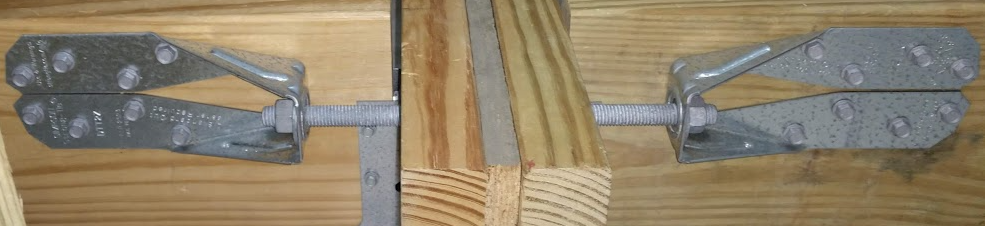
Deck lateral load connection requirements under IRC R507.9.2 are one of the most commonly misunderstood inspection items in the field.
Most installers focus on the ledger attachment and assume that once it is properly fastened, the structural connection to the house is complete. The IRC does not treat it that way. Vertical support and lateral resistance are handled separately, and each has its own requirement.
This section is where that separation shows up in the inspection.
Governing Code
IRC 2021
Section R507.9.2 — Deck lateral load connection
This section addresses how lateral loads are transferred from an attached deck into the structure or to the ground.
The Trigger Condition
This requirement applies when:
- The deck is attached to the dwelling, and
- The deck is built using the prescriptive IRC provisions
These requirements apply when using the prescriptive IRC provisions for deck construction.
Deck Lateral Load Connection Requirements: What the IRC Actually Requires
The section requires that lateral loads be transferred to:
- The ground, or
- A structure capable of transmitting those loads to the ground
It then provides two prescriptive methods.
Option 1 — Figure R507.9.2(1)
- Minimum of two hold-down tension devices per deck
- Installed within 24 inches of each end of the deck
- Each device must have an allowable stress design capacity of not less than 1,500 pounds
Option 2 — Figure R507.9.2(2)
- Minimum of four hold-down tension devices per deck
- Each device must have an allowable stress design capacity of not less than 750 pounds
This detail is specifically noted for conditions where floor joists are parallel to deck joists, which changes how the connection is made into the structure.
What the Figures Actually Establish
The figures define the prescriptive load path.
They show that the connection must:
- Engage the structural members of the dwelling consistent with the prescriptive detail shown in the figures.
- Transfer lateral load through a tension device as required by this section, rather than relying on ledger fasteners alone.
- Be installed in specific locations and quantities depending on the detail used
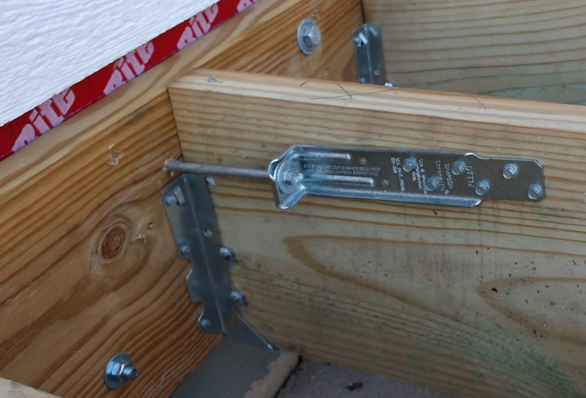
This is not a general concept—it is a defined connection method.
Why Ledger Bolts Do Not Satisfy This Requirement
Ledger attachment is addressed separately under R507.9.1 and is designed to support vertical loading.
R507.9.2 addresses lateral loading, which acts perpendicular to the house.
The code does not treat those as interchangeable. Meeting the ledger fastening requirements does not eliminate the need for a lateral load connection when this section is triggered.
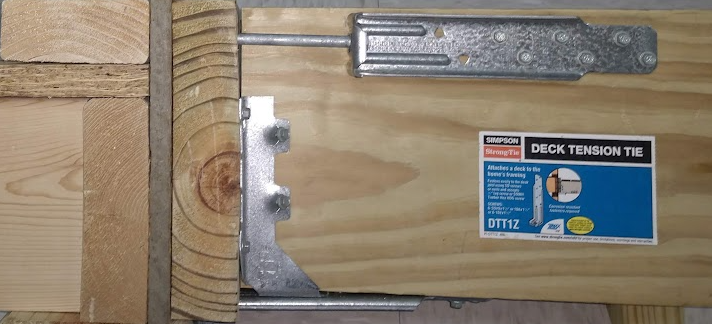
The tension tie is there to resist the forces trying to pull the deck away from the house under load.
Understanding deck lateral load connection requirements is what separates a passing inspection from a failed one on attached decks.
What Inspectors Are Looking For
Inspection is based directly on the section and figures.
Inspectors are verifying:
- A lateral load connection consistent with Figure R507.9.2(1) or (2)
- The correct number of devices for the method used
- Devices meeting the required allowable stress design capacity
- Connection into structural members, not sheathing
- Proper placement along the deck
If listed hardware is used, it must be installed in accordance with its manufacturer instructions.
For a complete inspection-level breakdown of how water intrusion affects this connection, see Deck Ledger Flashing Requirements Under the IRC
Where Hardware Fits In (Without Overreaching Code)
The IRC requires capacity, not a brand.
In practice, commonly used hold-down devices are selected to meet those capacities. For example:
- Devices rated around 1500 lb allowable stress design align with the two-connection method
- Devices rated around 750 lb allowable stress design align with the four-connection method
The product you choose must meet or exceed the required capacity and be installed per its listing.
That is the extent of what the code requires.
Common Inspection Failures
These are consistent across jurisdictions:
- No lateral load connection installed
- Ledger bolts assumed to satisfy the requirement
- Incorrect number of devices for the selected detail
- Hardware that does not meet required capacity
- Fastening into sheathing or non-structural components
- Ignoring the joist orientation condition in Figure R507.9.2(2)
Each of these fails the section as written.
What This Section Is Addressing
Attached decks are subject to forces that act away from the structure over time. The IRC does not assume that standard ledger fastening will resist those forces.
Instead, it requires a defined connection system capable of transferring those loads back into the structure or to the ground.
Key Distinction to Carry Forward
- Ledger attachment (R507.9.1) supports vertical load
- Lateral load connection (R507.9.2) resists pull-away forces
Both apply, and both are evaluated independently during inspection.
Get the Right Code Guide for the Job
Tired of code confusion, inspection fails, or second-guessing your wiring? These practical field guides and checklists are built for pros, contractors, and serious DIYers—clear, code-cited, and inspection-tested. Grab the resource that fits your next project:
Available Guides:
• Pass the Inspection: A Field Guide to GFCI & AFCI Code Requirements
My book with clear explanations, diagrams, and field checklists to help you wire right the first time and pass every inspection. Covers NEC 2020/2023, written for real-world job sites.
• Kitchen GFCI & AFCI Requirements Checklist (NEC 2020 & 2023 Field Guide)
• Laundry Area GFCI & AFCI Requirements Checklist (2020 & 2023 NEC)
• Garage & Outdoor GFCI Requirements Checklist (NEC 2020 & 2023 Field Guide)