Subpanel bonding” (NEC 2023) still often gets written up.
Not because it’s complicated — but because the line between service equipment bonding and load-side bonding gets crossed.
The NEC draws that line very clearly.
Inspectors enforce it the same way.
Start With the Real Distinction
“Subpanel” isn’t defined in the NEC.
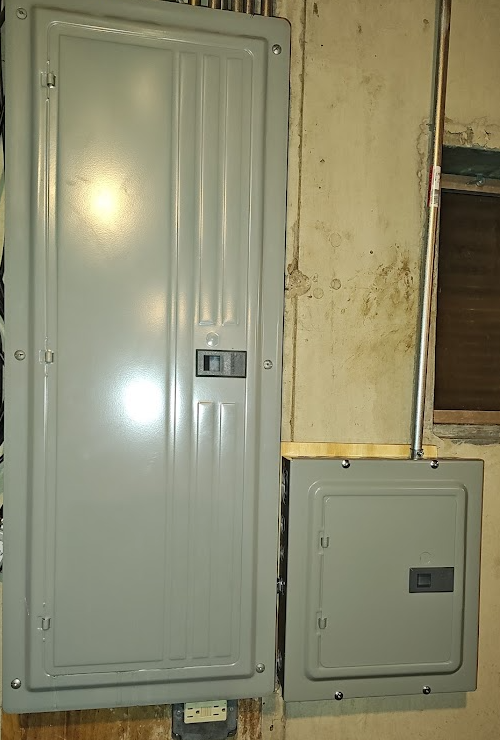
What we’re talking about is a panelboard supplied by a feeder — meaning it is on the load side of the service disconnecting means.
That phrase — load side of the service disconnect — is where everything changes.
The Primary Rule (NEC 2023)
The grounded conductor, as defined in Article 100, is a system or circuit conductor that is intentionally grounded — commonly referred to as the neutral in typical residential systems.
• Shall not be connected to normally non–current-carrying metal parts
• Shall not be connected to equipment grounding conductors
• Shall not be reconnected to ground
On the load side of the service disconnecting means.
That’s your dividing line.
At the service disconnect → bonding is permitted.
Downstream of it → bonding is prohibited unless another specific section permits it.
That’s not interpretation. That’s Code language.
Reinforced by 250.142(B)
NEC 250.142(B) says a grounded circuit conductor shall not be used for grounding non–current-carrying metal parts of equipment on the load side of the service disconnecting means (with limited exceptions not applicable to standard feeder panels).
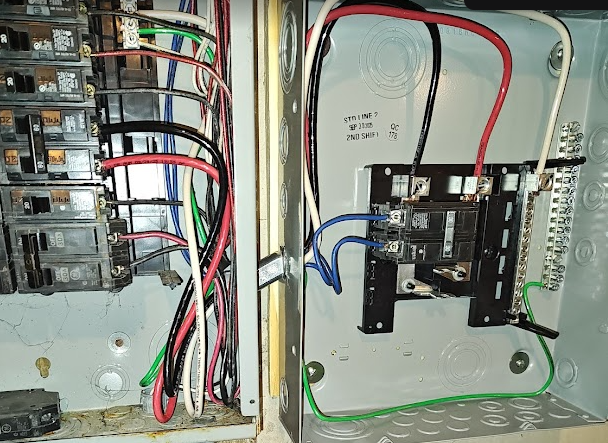
So if someone bonds the neutral bar to the enclosure in a feeder-supplied panelboard, they are effectively using the grounded conductor to ground the enclosure.
That is exactly what 250.142(B) prohibits.
Panelboard-Level Requirement (408.40)
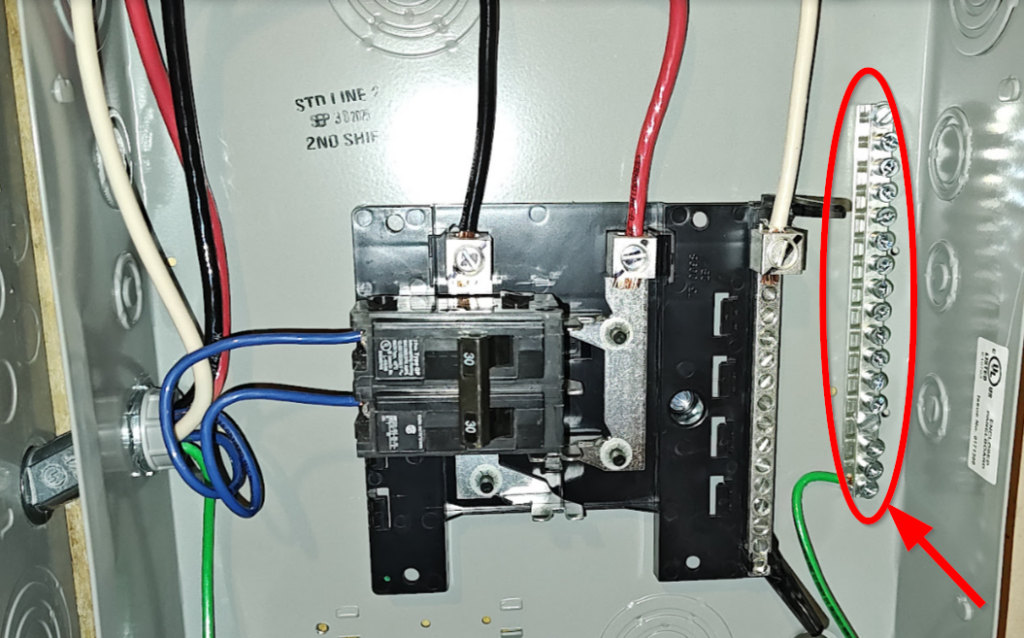
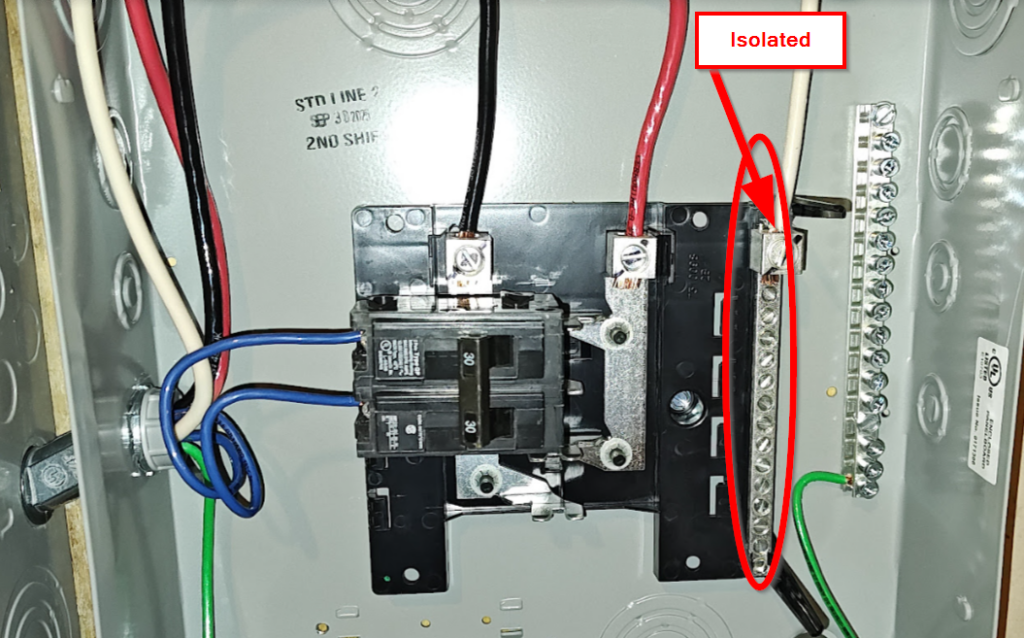
• Metal panelboard cabinets and frames to be connected to an equipment grounding conductor
• Equipment grounding conductors not to be connected to a neutral bar unless the bar is identified and located where neutral/ground interconnection is permitted by Article 250
In a typical feeder-supplied panelboard, that interconnection is not permitted.
So in the field, this means:
• Ground bar → bonded to enclosure
• Neutral bar → isolated from enclosure
That’s what passes inspection.
The Equipment Grounding Path (Including Conduit)
The feeder supplying a panelboard on the load side of the service disconnect must provide an equipment grounding path.
That path can be a separate equipment grounding conductor — a green or bare conductor run with the feeder conductors — or it can be a wiring method that qualifies as an equipment grounding conductor under NEC 250.118.
Article 250.118 specifically recognizes certain metal raceways and cable assemblies as equipment grounding conductors when properly installed. That includes rigid metal conduit (RMC), intermediate metal conduit (IMC), electrical metallic tubing (EMT), Type AC cable armor, certain listed MC cable assemblies, and other listed electrically continuous metal raceways.
The grounded conductor (neutral) does not perform that function in a feeder-supplied panelboard, because 250.24(B) prohibits reconnecting the grounded conductor to normally non–current-carrying metal parts on the load side of the service disconnect, and 250.142(B) prohibits using the grounded conductor to ground load-side equipment except where specifically permitted.
The rule does not change based on wiring method. Whether the enclosure is bonded by a conductor or by a qualifying raceway, the neutral remains isolated in a feeder-supplied panelboard.
Detached Buildings (250.32)
When a feeder supplies a separate building or structure, 250.32 applies.
Under 250.32(B):
If an equipment grounding conductor is run with the feeder, the grounded conductor shall not be connected to normally non–current-carrying metal parts at the separate building.
There is a narrow exception in 250.32(B)(1) for certain existing three-wire installations — but it is conditional and not applicable to new work where an equipment grounding conductor is installed.
Inspectors evaluate applicability carefully.
It is not automatic.
What Inspectors Actually Verify
When I open a feeder-supplied panelboard, I check:
- Is the neutral bar isolated from the enclosure?
- Is the bonding screw or strap removed?
- Is there a compliant equipment grounding path per 250.118?
- Are equipment grounding conductors terminated on a bonded grounding bar — not the neutral bar?
If those four things check out, you’re aligned with NEC code requirements.
If the neutral is bonded downstream of the service disconnect, it gets a Red Tag.
Field Summary
Service equipment (at the service disconnect):
• Neutral bonding permitted
• Main bonding jumper installed per 250.28
Feeder-supplied panelboard:
• Neutral isolated
• Enclosure bonded by EGC or qualifying raceway per 250.118
• No neutral-to-metal connection per 250.24(B)
Bond once at the service disconnect.
Isolate downstream.
This is the foundation of compliant subpanel feeder bonding under NEC 2023.
For more grounding clarification, see my detailed breakdown on Portable Generator Bonding & Grounding: What the NEC Actually Says.
Available Guides
Get the Right Code Guide for the Job:
Tired of code confusion, inspection fails, or second-guessing your wiring? These practical field guides and checklists are built for pros, contractors, and serious DIYers—clear, code-cited, and inspection-tested. Grab the resource that fits your next project:
Available Guides:
Laundry Area GFCI & AFCI Requirements Checklist (2020 & 2023 NEC)
Kitchen GFCI & AFCI Requirements Checklist (NEC 2020 & 2023 Field Guide)
Pass the Inspection: A Field Guide to GFCI & AFCI Code Requirements
My book with clear explanations, diagrams, and field checklists to help you wire right the first time and pass every inspection. Covers NEC 2020/2023, written for real-world job sites.